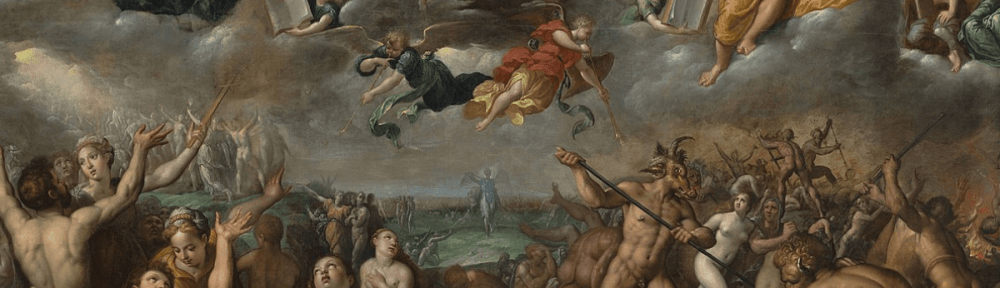
This coming Sunday is the Solemnity of Christ the King: 41 Then he will say to those on his left, ‘Depart from me, you accursed, into the eternal fire prepared for the devil and his angels. The words spoken to those on the left are the mirror image of those spoken in v. 34 to the “righteous:” “depart” instead of “come,” “accursed” instead of “blessed,” “eternal fire” instead of kingship, and a fate prepared in advance, though in this case not specifically for “you” but for the devil and his angels, whose lot the unrighteous are to share.
The blessing in v. 34 was specifically attributed to “my Father,” but this verse stops short of saying explicitly that these people are cursed by God. This is, however, often the implication of an unattributed passive, and here the reference must be to the displeasure of God that results in their punishment. Nonetheless, it is also possible to read the passage and say this is the fate you have chosen for yourself apart from God, just as you lived your life apart from God.
As to the phrase “eternal fire,” fire has been a repeated image for ultimate judgment; see 3:10, 12; 5:22; 7:19; 13:40, 42, 50; 18:8, 9. If we are to maintain any parallelism with v. 34, then we would expect “prepared for you since the foundation of the world,” but that is not said here. The kingship prepared from the beginning reflects the desire of God that all be saved (1 Tim 2:4). Lacking such fire prepared from the foundation of all things, there is thus a difference between God’s eternal purpose of blessing and the regrettable need for a “plan B” to deal with spiritual rebellion.
The devil and his angels represent all the forces of spiritual evil, probably including the demons or “unclean spirits” we have met throughout the gospel as Jesus’ opponents in cases of exorcism. In much Jewish thought by this time Satan was pictured as the leader of a spiritual host in opposition to God and his angels, and it is the ultimate elimination of all that spiritual opposition which is here envisaged. The theme will be graphically developed in the book of Revelation where the devil and all his followers are thrown at last into the lake of fire (Rev 19:20; 20:10, 14–15; 21:8). There, as here, the same punishment is awarded to human beings who have followed Satan as to his spiritual forces. And there, as here, the offenses listed seem hardly to fit so melodramatic an end: they include the “cowardly” and “liars” as well as murderers and idolaters (Rev 21:8), just as here the failure to provide humanitarian aid may seem to us relatively low on the scale of spiritual evil. But the imagery of this pericope, as of the book of Revelation, allows for only two categories, the saved and the lost; there is no allowance for grades of good or evil.
What We Fail To Do. 42 For I was hungry and you gave me no food, I was thirsty and you gave me no drink, 43 a stranger and you gave me no welcome, naked and you gave me no clothing, ill and in prison, and you did not care for me.’ 44 Then they will answer and say, ‘Lord, when did we see you hungry or thirsty or a stranger or naked or ill or in prison, and not minister to your needs?’ 45 He will answer them, ‘Amen, I say to you, what you did not do for one of these least ones, you did not do for me.’ The exchange between the king and the accursed mirrors the exchange with the righteous, though suitably abbreviated to avoid tedious repetition – even absenting “brothers and sisters” with reference to the “least ones” in v. 45. The list is the same, the perplexed “when did we see you” response, and the King’s reply. One contrast might lie in something small. In v.44, summarizing the actions of the accursed, they ask when they did “not minister to your needs?” In the language of the NT one would expect to find the work/root diakoneō – from which we take the modern word “deacon.” It is a word that is used in Matthew (4:11; 8:15; 27:55, 20:26; 23:11) to describe the unselfish care for others which marks true discipleship. The fault of the “accursed” is not so much that they have done wrong but that they have failed to do what is commanded of them. It echoes the parable of the bridesmaids (vv. 1–12) and the servants (vv. 24–27).
Image credit: Jacob Adriaensz Backer: Last Judgment (Matthew 25:31-33), National Museum in Warsaw, PD-US
Discover more from friarmusings
Subscribe to get the latest posts sent to your email.
 friarmusings
most scarcy passsage in NT !! exceeded only by ease of a camel thru the needle !! seemingly can not be done ??? no that cant be correct maybe everybody is saved ???