This coming Sunday is the 3rd Sunday of Advent. As mentioned in a previous post, the prologue and the beginning of John’s gospel appears on this 3rd Sunday of Advent as well as the gospel for the Mass on Christmas during the day (all years) and on the 3rd Sunday of Christmas (all years). So perhaps it is good to consider in detail this amazing text in its own right.
John the Evangelist has deftly changed the narrative presented in the Synoptic Gospels. Here in the fourth gospel the story of Jesus is not ultimately a story about Jesus; it is the story of God as God reveals God’s self in the person of Jesus. Thus the narrative is well placed in Advent at the head of the liturgical year: “In the beginning…”
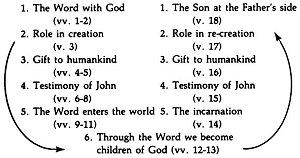 This prologue of John’s Gospel serves as an introduction to the context of the fourth gospel. In its short span of eighteen verses, it states briefly what the whole of the Gospel will spell out over twenty-one chapters. It has both structure and content. The structure has been partially determined by the presentation of “wisdom personified” in the Old Testament books. There, as in Wisdom 9:9–12 or Proverbs 8:22–36, Wisdom is first with God, then shares in creation, will come to earth, and there gift humankind. This same progression is found in our prologue. The other factor that has determined the structure is the Hebrew fondness for parallelism — notions being repeated in order — and for inverse parallelism, that is, repeated in inverse order. Visually, John’s poetic prologue unfolds as follows:
In content, these eighteen verses speak of God’s revelation, of how he has explained himself to us. It is this that accounts for the extraordinary title that our author uses — “the Word.” Its best equivalent is “revelation.” As we humans reveal ourselves through what we say and, even more, by what we do (our body language), so God through the centuries has offered his own self-revelation through act and speech. The prologue details this. God revealed himself through creation (vv. 2–5), but also through his Old Testament word (vv. 10–13), that is, through his covenants, the Mosaic writings, the prophets, and the wisdom literature. Those who opened their eyes and believed in this ancient revelation became “children of God … born … of God” (vv. 12–13). Finally God has revealed himself to the utmost through the incarnation of the Word, in whom God’s glory, his presence, stands revealed as a sign of his enduring love (v. 14). (The Greek text tells us that the Word “pitched his tent” among us, a striking reference to God’s Old Testament presence in the tent-tabernacle during Moses’ wanderings with Israel in the desert.) To this incarnate Word John the Baptist has given testimony, a testimony that initiated the historical manifestation of Jesus, in whom the Father stands completely revealed and in whose fullness we, the Christian community, have all shared. The prologue ends with the upstroke of the pendulum arm to the right, in parallel to the very beginning of the poem. The Word, whose name is Jesus Christ (v. 17), is the Son, the only Son, who is “at the Father’s side” (v. 18) and reveals him to those open to light and truth.
The prologue is reminiscent of the first chapter of Genesis on a number of scores:
- The opening words are identical, “In the beginning…..”
- There is a parallelism in the role of the Word. In Genesis God creates things through His word (“And God said….”); in the gospel we are told that they were made through the Word.
- In Genesis, God’s creation reaches it peak when He creates man in His own image and likeness; in the gospel, the work of the Incarnate Word culminates when man is raised in a new creation to being a child of God.
- In Genesis God proclaims “Let there be light….”; in the gospel we are told that the Word is a “A light to the world…”.
Also the Prologue immediately presents one of St John’s most common features – the double entendre; a word with two meanings. St John never chooses these words lightly. They always provide the careful reader with a deeper spiritual insight.
The opening phrase, “In the beginning….” presents the reader with a choice. The Greek beginning (aiken) and the Hebrew word (bereshek) are literally translated as “In the first…”. Does it refer to chronology/sequence or does it refer to rank? The casual reader probably only sees the chronology. In typically Johannine fashion it represents both. For St John, Jesus is the “first,” the one who creates and the only begotten Son of the Father.
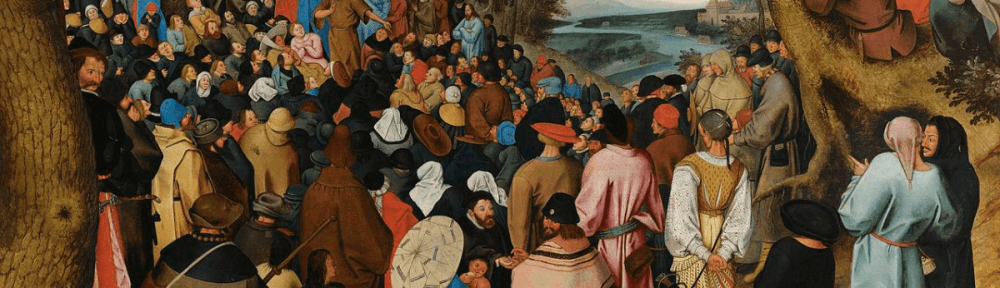
Image credit: “Saint John the Baptist Preaching to the Masses in the Wilderness” by Pieter Brueghel the Younger (1564–1638), Galerie de Jonckheere, Paris | US-PD
Discover more from friarmusings
Subscribe to get the latest posts sent to your email.

