An Unclean Spirit

This coming Sunday is the 4th Sunday in Ordinary Time. In their synagogue was a man with an unclean spirit (v. 23). Strangely the NAB does not translate euthys – the first word in the sentence. The word means “just then,” “suddenly” or “immediately.”  In the NAB translation it seems as though the man was just there. But the Greek euthys implies a sudden entrance into the synagogue like bursting upon the scene. This follows immediately upon Jesus’ teaching with authority that amazes listeners. The “suddenly” that divine power (exousia) is confronted by the corrupting power of a person is possessed by an unclear spirit. Was he part of the crowd listening to Jesus’ teaching who suddenly stood up and cried out? Did he come in off of the street? In any case, suddenly, we have the “holy one of God” on the holy day (sabbath) in the holy place (synagogue) meeting an “unclean spirit.”  It is a dramatic moment somewhat lost by not translating one word. Continue reading

St. Francis de Sales

Today is the Memorial of St. Francis de Sales, a priest known for his spirit of optimism, hope, freedom and confidence in God’s love both in his life and his writings.  The gospel for the memorial is well chosen for its emphasis on remaining in the love of God, the joy of following Christ, and bearing the fruit of that love and joy – fruit that remains in this lifetime and the next. Continue reading

Helping at the Margins

Years ago I served as a lay missionary in the Kibera slums of Nairobi. I lived and worked among some of the poorest of the urban poor in East Africa. I lived with a Pallottine priest from Ireland who was one of 18 children and the son of a working blacksmith. It is not hard to imagine that household finances were stretched very thin, yet the father had a great compassion for the “travelers” a group of Irish people with their own traditions, language, stories and more. Known as “travelers” (lucht siúil, meaning the walking people) their history is filled with stories of discrimination, mistrust, and poverty. Continue reading

Being Family

The gospel today is one that was a central part of St. Francis of Assisi’s way of following Christ. Those who would follow this way of following Christ needed to understand that there was a clear demarcation between the former way of sin and that of “leaving the world.” In his writing known as the Earlier Exhortation, Francis divides the world of people into two categories: “Those Who Do Penance” and “Those Who Do Not Do Penance.” In medieval writing “penance” does not refer primarily to sacramental confession, but to a life directed to conversion to Christ. Continue reading

The One Gift

From the Rule for Monks by St. Basil the Great:

What words can adequately describe God’s gifts? They are so numerous that they defy enumeration. They are so great that any one of the demands our total gratitude in response. Yet even though we cannot speak of it worthily, there is one gift that no thoughtful man can pass over in silence. God fashioned man in his own image and likeness; he gave him knowledge of himself; he endowed him with the ability to think which raised him above all living creatures; he permitted him to delight in the unimaginable beauties of paradise, and gave him dominion over everything upon earth.


Image credit: Pexels

Teaching and Authority

This coming Sunday is the 4th Sunday in Ordinary Time. Mark concentrates upon a single Sabbath when Jesus’ synagogue teaching provoked a reaction from the people present. The two words that describe the people’s reactions are: ekplessomai (v. 22) and thambeo (v. 27) – “astounded” and “amazed.” The first term, more literally means “be besides oneself” – or in the slang, “to be blown away!”  It comes from something that is so incomprehensible that one’s mind can’t fathom what has been experienced. These are not terms of faith. In Mark’s gospel we will come to learn that miracles never produce proper faith. Continue reading

And so it begins

This coming Sunday is the 4th Sunday in Ordinary Time in Lectionary Cycle B. The first major section of Mark’s Gospel extends from 1:14 to 3:6, and describes the initial phase of the Galilean ministry. Within this section the evangelist records the calling of the first disciples , Jesus’ ministry in and around Capernaum, and a series of controversies which are climaxed by the decision to seek Jesus’ death. Continue reading

Sunday of the Word of God

Today the Church Universal celebrates Sunday of the Word of God, a celebration established by Pope Francis in 2019. It is a celebration that is close to my heart. I have taught Bible Studies in parishes since 1986 and have more that 2,500 posts on my blog FriarMusings that have something to do with the Word of God. I just think the Bible is awesome, amazing, and from the Old Testament to the end of the New Testament is filled with things you need to know – and more importantly you need to be able to share. Continue reading

St. Sebastian

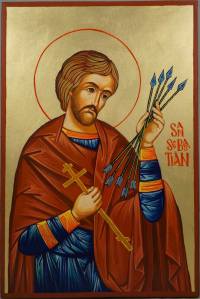
Today’s liturgical possibilities include an optional memorial for St. Sebastian who is the patron saint of athletes. Relatively little is known about St. Sebastian, a Christian martyr of the 3rd century. It is believed that he was an officer in the imperial bodyguard and Christian, but not openly so. When his faith was discovered the Diocletian, the Roman emperor, sentenced him to death. Sebastian was tied to a tree, executed by archers and left for dead. However, he had not died. He was found alive and nursed back to health. When at last he was able, he publicly announced his faith, denounced Diocletian for his persecution of Christians, and for this was martyred as he was beaten to death by the emperor’s guard. It is his virtues and gifts of strength, stamina, perseverance, courage and justice in the face of adversity and a superior opponent – and yet he gave his all.

The readings from today’s Mass include optional readings in celebration of the saint. The first reading is from the first letter of St. Peter and includes the following admonition:

Always be ready to give an explanation
to anyone who asks you for a reason for your hope,
but do it with gentleness and reverence
(1 Pt 3:15)

Are you ready?