“This is how the birth of Jesus Christ came about…” What follows in today’s gospel, provides a wonderful answer to the Advent question: who is coming? The gospel reading provides its contribution to the larger answer: Jesus Christ (v.18), son of Mary (v.18), adopted son of Joseph (v20), son of David (v.20), named Jesus (v.21), the one who will save his people from their sins (v.21), and Emmanuel…God with us (v.22).
All of this is accomplished in a dream given to St. Joseph. The angelic message is that all is as God intends, so take Mary into your home, name the child Jesus, and raise him as your own son. It is all part of the plan:
“All this took place to fulfill what the Lord had said through the prophet: ‘Behold, the virgin shall be with child and bear a son, and they shall name him Emmanuel,’ which means ‘God is with us.’”
This passage is offered as biblical proof of the Virgin Birth, but I don’t think it is likely that Matthew was citing Isaiah 14 as a proof text of that. The structure of the pericope is that it is not so much argued or even described, but assumed as a known fact. Matthew was writing some 80 years after the events of the Nativity. Be that as it may, there is more to Matthew’s use of the text, and that use is found in the context of Isaiah’s story.
Here is the story in brief: Ahaz, King of Judah was caught between the proverbial “rock and the hard place.” One one side was the Assyrians, the superpower of the day. On the other side was the rebel faction of Samaria and Syria, this faction wanting Judah to join them. And then there is the prophet Isaiah who is advising him to trust in the Lord. But then Isaiah did not have much to work with. King Ahaz: “he did not do what was right in the eyes of the LORD …” (2 Chronicles) – reintroduction of child sacrifice gives you a hint of how bad a covenant king he was.
Isaiah views Ahaz as one who lacks faith and trust in God, and in this way the king becomes a symbol of the people of God who also lack faith and trust in God. The king and the people depended upon an ideology of the Davidic dynasty as the sign of their “covenant” with God. Their ideology professed a sublime confidence God would protect his chosen king and city…no matter what. Such a profession is easily made when there is no immediate danger. Faced with an actual invasion, however, “the heart of the king and the heart of the people trembled, as the trees of the forest tremble in the wind” (Isa 7:2).
What, then, is signified by the birth of Immanuel? The name “God is with us” is not a promise that God will shelter the king and the people from all harm if only he has faith; rather, it is an ambivalent sign. The presence of God is not always protective. It can also be destructive, as on the “day of the Lord.” Yet it is not entirely destructive. The birth of a child is perhaps the most universal and enduring symbol of hope for the human race. The newborn child does not contribute to military defense or help resolve the dilemmas of the crisis, but he is nonetheless a sign of hope for a new generation.
Who is this child to be born? For Isaiah and for Matthew, this child is a symbol of hope in weakness, of new life in the midst of destruction. All is as God intends. Even an inauspicious birth in a manger can be a sign of the presence of God.
“This is how the birth of Jesus Christ came about…”
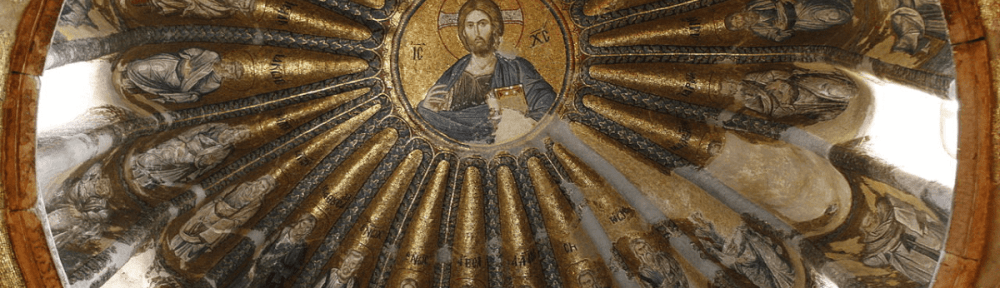
Image credit: Photograph | South dome of inner narthex at Chora Church, Istanbul, depicting the ancestors of Christ from Adam onwards | Wiki Commons from José Luiz Bernardes Ribeiro | CC BY-SA 3.0
Discover more from friarmusings
Subscribe to get the latest posts sent to your email.
 friarmusings