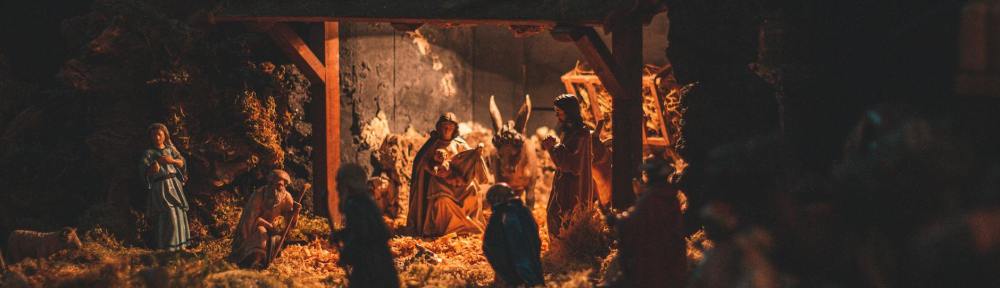
The gospel reading for the Christmas Eve Vigil Mass is the genealogy of Jesus from the Gospel of Matthew. For a Mass that is typically preceded by or includes a children’s Christmas pageant, it is not exactly the reading one would naturally select. There is a part of us all that want to attend Christmas Mass and be reminded of angelic choruses, shepherds, and an infant in the manger. But the Nativity is more than a nice Christmas card scene. It is the arrival of Hope.
These first 17 verses are not only the beginning of Matthew’s gospel, and not simply the beginning of the New Testament account, they are the continuation of the story of redemption and salvation that began when Adam and Eve first rebelled in the Garden of Eden. If the Hebrew Scriptures are the story of God’s rescue plan pointing to a Savior, the gospels are the capstone and fulfillment of God’s promise. And so it is fitting to begin by remembering that the God the story of our salvation, told in the story of God’s people:
1 The book of the genealogy of Jesus Christ, the son of David, the son of Abraham.2 Abraham became the father of Isaac, Isaac the father of Jacob, Jacob the father of Judah and his brothers.3 Judah became the father of Perez and Zerah, whose mother was Tamar. Perez became the father of Hezron, Hezron the father of Ram,4 Ram the father of Amminadab. Amminadab became the father of Nahshon, Nahshon the father of Salmon,5 Salmon the father of Boaz, whose mother was Rahab. Boaz became the father of Obed, whose mother was Ruth. Obed became the father of Jesse,6 Jesse the father of David the king. David became the father of Solomon, whose mother had been the wife of Uriah.7 Solomon became the father of Rehoboam, Rehoboam the father of Abijah, Abijah the father of Asaph.8 Asaph became the father of Jehoshaphat, Jehoshaphat the father of Joram, Joram the father of Uzziah.9 Uzziah became the father of Jotham, Jotham the father of Ahaz, Ahaz the father of Hezekiah.10 Hezekiah became the father of Manasseh, Manasseh the father of Amos, Amos the father of Josiah.11 Josiah became the father of Jechoniah and his brothers at the time of the Babylonian exile.12 After the Babylonian exile, Jechoniah became the father of Shealtiel, Shealtiel the father of Zerubbabel,13 Zerubbabel the father of Abiud. Abiud became the father of Eliakim, Eliakim the father of Azor,14 Azor the father of Zadok. Zadok became the father of Achim, Achim the father of Eliud,15 Eliud the father of Eleazar. Eleazar became the father of Matthan, Matthan the father of Jacob,16 Jacob the father of Joseph, the husband of Mary. Of her was born Jesus who is called the Messiah.17 Thus the total number of generations from Abraham to David is fourteen generations; from David to the Babylonian exile, fourteen generations; from the Babylonian exile to the Messiah, fourteen generations. (Matthew 1:1–17)
No doubt you recognize names such as Abraham, Isaac, Jacob, and David – even as you scratch your head about how to pronounce “Shealtiel” and wonder how being the father of Zerubbabel is important. Matthew’s way of showing how Jesus fulfills the Old Testament storyline is to begin with a genealogy. Genealogies are important. Remember that the genealogies in the Old Testament are always working to communicate multiple layers of information to readers. Genealogies obviously trace family trees, but they also help us follow priestly and royal lines through Israel’s story. You can see each of these types of genealogies in the first nine chapters of the Book of 1 Chronicles. In fact, there’s little doubt that the author of Matthew had the Chronicles and its genealogies in mind when he wrote his own Gospel account and began it with a genealogy.
Why genealogies matter
In the opening verse of the gospel. Matthew tells us the two key people who are most important in this genealogy: “The book of the genealogy of Jesus Christ, the son of David, the son of Abraham.” From this opening statement, we expect this family tree to help us understand not only the ancestral past of Jesus but also his identity and mission. Jesus is called the son of both David and Abraham. Working backward from Abraham, let’s see how each of these people shape the genealogy that follows.
Son of Abraham
By calling Jesus the “son of Abraham,” the author is connecting Jesus to the father of the people of Israel. Abraham represents the moment when God selected and separated his family from the rest of the nations all the way back in the book of Genesis. It was through these Israelite people that God promised to bring blessing to all of humanity (Gen 12:1-3). By linking Jesus to Abraham, Matthew is bringing the reader’s attention back to the promise of God’s rescue plan for the world. He wants us to see that Jesus is the long-awaited son of Abraham who will bring God’s blessing to all humanity. But how, exactly? Well, look now at the second key figure in the genealogy: David.
A King From the Line of David
Jesus’ identity as a descendant of David is a major focus of Matthew’s gospel. To understand Matthew’s theology and his portrait of Jesus, we will want to examine how Matthew is bringing David into the story.
“Son of David,” is a term that the author of Matthew is very fond of. Verse one is the first of ten appearances of the phrase in the book, and it draws our attention to the royal line of King David. Abraham’s name pointed to a belonging amongst the people of Israel. David’s name tells us that Jesus was royalty.
That this was the author’s goal can be seen by the fact that Jesus’ ancestry is traced through David’s son King Solomon. In Luke’s gospel, the family line is traced through David’s son Nathan. Matthew’s author is not primarily concerned with genetic lineage, however. He is also attempting to establish Jesus as a royal successor and rightful heir to the throne of David’s kingdom. The author traces the family line from Solomon to Jeconiah, who was the surviving king of David’s line and alive at the time of the exile.
14 Generations
The genealogy has three separated sections that cover 14 generations each. But why 14? Within the written language of Hebrew, the letters are also used as their numbers, and so each letter is assigned a numerical value. The name of David in Hebrew is “דוד,” and from here you just do the math. The numerical value of the first and third letter “ד” (called dalet) is 4. The middle letter “ו” (called waw) has a numerical value of 6. Put it into your mental calculator: 4+6+4=14, the numerical value of the name of “David.”
Matthew has created the genealogy so that it links Jesus to David both explicitly and in the very literary design of the list. In fact, Matthew wants to highlight this “14=David” idea so much that he’s intentionally left out multiple generations of the line of David (three, to be exact) to make the numbers work.
Yes, Matthew has taken people out of the genealogy, but this is not a scandal. Leaving out generations to create symbolic numbers in genealogies is a common Hebrew literary practice, going all the way back to the genealogies in Genesis (the 10 generations of Genesis 5). Ancient genealogies were ways of making theological claims, and Matthew’s readers would have understood exactly what he was doing and why.
Matthew didn’t make numerical adjustments only. He also adjusted a few letters in some names for the same purpose. For example, he changed the names of Asa and Amon to Asaph (the poet featured in the book of Psalms) and Amos (the famous prophet). Matthew is winking at us here, knowing that his readers would spot these out of place names. The point, of course, is that Jesus doesn’t just fulfill Israel’s royal hopes, but also the hope of the Psalms (Asaph) and the Prophets (Amos). Jesus is from a line of kingly succession that also culminates the rich tradition of worship and prophecy of Israel. This way, readers are thinking about all of Israel and her history as they meet Jesus for the first time. The irony is that some modern translations haven’t understood the intent, and so have changed the names back to their “original” referents.
Even more
Matthew’s packed even more into this genealogy. Look at the unique appearance of four women in the genealogy of Matthew: Tamar, Rahab, Ruth, and Bathsheba. All four are either non-Israelites or connected to non-Israelite families. Not only is it unconventional for Matthew to list these female names in a typical genealogy, it is scandalous. At least Matthew could have highlighted Jesus’ connection to Sarah, Rebecca, and Rachel, the matriarchs of Israel. But instead, he mentions Canaanites, prostitutes, and Moabite women, whose Moabite lineage would be viewed as a reminder of Israel’s sin and covenant failure.
Matthew wants his readers to see that God has been using all types of people to move his plan forward. This portrait of an inclusive and expanding God and kingdom will continue to appear beyond Matthew’s genealogy into the rest of his gospel. He will continue to include the rejects and outsiders into his family (see the list in Matthew 4:18-25). And this non-Israelite strand in Jesus’ family history will expand even wider in his final commission to his followers to go and “make disciples of all the nations” (Matt 28:19).
So we read the genealogy of Matthew and see the royal lineage of Jesus. He’s the one who will bring the blessing of Abraham to the whole world. He’s the royal son of David that all of Israel has been waiting for. He’s the one that the prophets wrote about, and the psalmists sang about. He will be the king of Israel who blesses all of the nations of the world, especially the outsiders. We know all of this because Matthew tells us in a genealogy that carefully reveals the hope that has arrived in Jesus.
Image credit: Pexels, Burkey Canatar, CC-0
Discover more from friarmusings
Subscribe to get the latest posts sent to your email.
 friarmusings