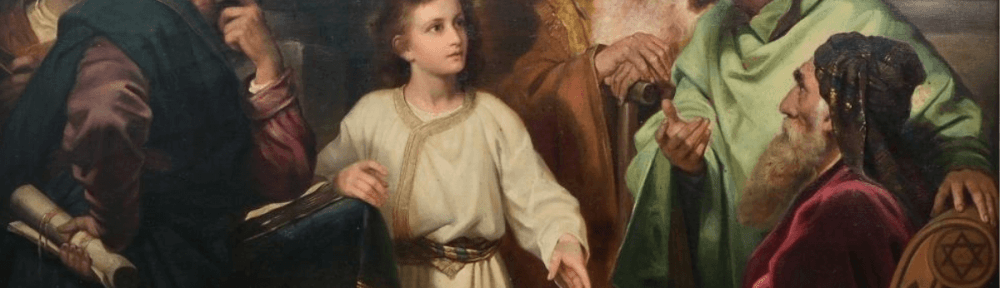
This coming Sunday is the Feast of the Holy Family with the gospel taken from Luke 2:41-52. There are major feast days dedicated to each member of the Holy Family – Jesus, Mary, and Joseph – but the Feast of the Holy Family commemorates their life together, and the celebration focuses on religious life within the family. It is a Feast that seeks to portray the Holy Family of Nazareth as the “true model of life” (cf. Opening Prayer of the Mass) from which our families can draw inspiration and know where to find help and comfort.
Because of the flight of the Holy Family into Egypt, a feast for the Holy Family has been observed by the Copts from early times. In Western Christianity, however, a veneration for the Holy Family as a group, rather than as individuals, did not arise until the 17th century and was not officially recognized until the feast day was formally instituted in 1921 under Pope Benedict XV. Originally celebrated on the Sunday after Epiphany (January 6), the Feast of the Holy Family was moved to the Sunday after Christmas in 1969, bringing it within the Christmas season.
Immediately before our gospel text, Joseph and Mary went about the process of fulfilling the requirements of the Jewish Law regarding circumcision of the child and purification of the mother (Luke 2:21-24) They received God’s blessing through the interactions with Simeon and Anna. The circumcision marked the acceptance of and entry into the covenant community (Gen 17:9-14). “Both rites, circumcision and naming, gave the child an identity…” even as it was “an act of blessing, a dedication to God, and a declaration of the child’s heritage and character.” (Culpepper, 69)
In these scenes that precede our gospel text, the words spoken to Mary and Joseph are at the center, standing in a powerful context: obedience to the Law and recognition of their faith in the promises of God to his covenant people. Simeon and Anna, exemplars of devotion and worship, are the ones who speak the words of divine blessing, giving the ceremonies meaning beyond identity and promise. Their blessing also put us on notice that this child is the one about whom the prophets spoke would come as Messiah.
While the stories of Jesus as an infant in the Jerusalem Temple serve as testimony to the exemplary piety of Joseph and Mary, by this Luke assures his patron, Theopholis and the readers, that Jesus is being raised in a devout household aligned to the promises and purposes of God. A household that participates in the annual pilgrimage to Jerusalem for celebration of the Passover.
Jesus and his parents journey to Jerusalem for the feast of Passover. Luke places Jerusalem as central to the overall narrative. The next time Luke portrays Jesus on his way to Jerusalem it will be for the Passover again (Lk 19); it will be his final trip to Jerusalem, and the Jewish feast will coincide with his own Passover. Then, Jesus is also “lost” for three days before he reappears as the victorious risen Lord. Is that an interesting happenstance, or has Luke left us a hint of things to come?
Image credit: Jesus among the Doctors | Heinrich Hoffman, 1884 | Hamburg Museum | PD-US
Discover more from friarmusings
Subscribe to get the latest posts sent to your email.
 friarmusings