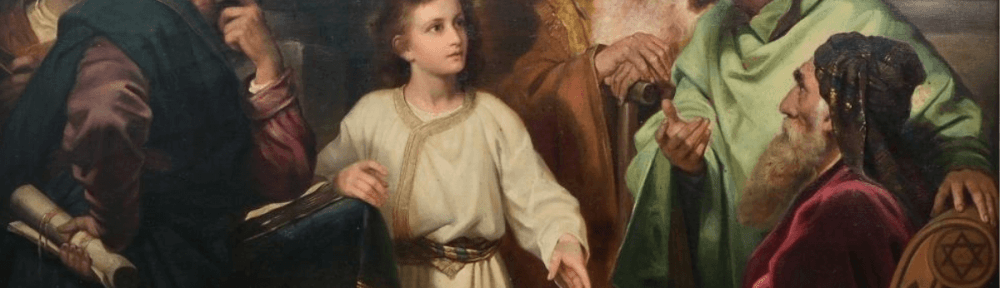
This coming Sunday is the Feast of the Holy Family with the gospel taken from Luke 2:41-52. This pericope is unique among the canonical gospels. While apocryphal gospels (e.g. Gospel of Peter, Protoevangelium of James, others) purport to convey stories of the child Jesus, they are all late 2nd century and later manuscripts of doubtful provenance. One of the development processes of growing up is individuation in which one discovers their identity apart from that described as “child of…” It does not mean that one discards family ties, religious experiences, and what came before, but it inevitably means taking on a new dimension of being an individual. It is a process of coming to know who you are and “whose” you are.
An essential aspect of that individuation is the sense of purpose and the recognition that your purpose is not independent from God. It raises the questions for us about faith in God and religious piety in the modern world. Is God central to your identity and purpose in this life, or one of several peripheral beliefs? Does faith in God shape your life in a profound way or does it largely shape Sundays as a respite from the week?
Religion in the time of Jesus offered a structured piety: family prayers, Scripture in synagogue, pilgrimages to Jerusalem for the high holy days, and special rituals such as circumcision, the Presentation (Dedication) of the First Born, and the Purification of the Mother. The parallels with modern Christianity and especially within Catholic Christianity, are evident.
As R. Alan Culpepper notes, “The observance of religious requirements and rituals has fallen on hard times.” The pressure and flow of modern life and secularism has reduced the significance of ritual observances in the life of most Christians. In some cases, the very same observances have become a refuge against the pressure and flow. But in neither case, is the inner life of purity and sincerity of heart revealed – nor a recognition of God’s claim upon one’s life.
Such divine claims may well come into tension or open conflict with the human desire for social acceptance outside the family (or even within the family), economic prosperity, and other good ideals. As many wisdom figures have noted, the challenge is not always to decide between good and evil, but to choose between options that each present worthy claims on your time and energy. Following the Commandments that begin with “thou shall not” is good and to be followed without reservation, but if that is the limit of your religious piety, it is a piety devoid of purpose. It is like the servant who buried the gold coins rather than risk losing them: there is no purpose in one’s actions.
The Gospel of Luke is replete with “searching” and “finding.” Moving one’s religious piety to the search for God in your life inevitably leads to finding a divine purpose to the life you choose. The challenge to modern Christians is to rediscover the rituals of faith that lead you to God in the ordinary as well as the special and extraordinary. The required rituals offer meaning if you will accept it, reflect upon it and let it shape your life. Consider Simeon and Anna. Their mature “obedience” (to listen through) to the required piety of their faith made them sensitive to God’s presence in the events of their time. When the Holy Family first appeared in the Temple, the blessing of Simeon and Anna gave the ritual deeper meaning – a gift that comes from the community of faith in celebration with one another.
These are the gifts that shape our identity and understanding of our purpose, open our awareness to the presence of God in the ordinary, and help understand that because of who we are we must be about our Father’s business.
Image credit: Jesus among the Doctors | Heinrich Hoffman, 1884 | Hamburg Museum | PD-US
Discover more from friarmusings
Subscribe to get the latest posts sent to your email.
 friarmusings