This coming Sunday is the 3rd Sunday in Lent, Year C. In the previous post we considered the series of admonitions and warnings that Jesus offered to the disciples, highlighting that whatever the cauldron of life brings their way, never doubt the providential care of God. And so don’t be consumed by worrying about earthly concerns, but bear fruit in what matters to God.
At the start of the gospel narrative, people bring Jesus an account of Pilate’s horrific actions among the Galileans. The Jewish historian Flavius Josephus describes Pontius Pilate in two key passages in his work Antiquities of the Jews (written around 93–94 AD). His depiction presents Pilate as a harsh and insensitive ruler, often clashing with Jewish customs and provoking unrest. Josephus recounts how Pilate offended Jewish religious sensitivities by bringing Roman military standards bearing the emperor’s image into Jerusalem. This was seen as idolatrous by the Jewish people, who protested intensely. Eventually, Pilate was forced to remove the standards to avoid a larger uprising. Later, when Pilate sought to fund a new aqueduct in Jerusalem using money from the Temple treasury the Jewish populace protested. Pilate responded by sending disguised soldiers into the crowd, who violently suppressed the demonstrators, leading to many deaths.
1 At that time some people who were present there told him about the Galileans whose blood Pilate had mingled with the blood of their sacrifices.
The story of Pilate’s brutality among the Galileans and its defilement of Jewish worship is a story worthy of denunciation, but instead it is almost as if Jesus is scolding the messengers who brought the bad news. To their accounting Jesus adds his own newsworthy event: the accidental death of the 18 people in Jerusalem. One set of deaths is caused by human choices; the other was accidental. One set of deaths is among people far from Jerusalem; the other happens to people within the holy city’s walls.
Given Jesus’ origins from Galilee, one wonders if this encounter is especially poignant in addressing a post-crucifixion sentiment among the Jersusalemites: he was from Galilee, of course he got what he deserved. God saves the righteous. God did not save him….
In the moment, Jesus addresses what likely lies on the hearts and minds of the people gathered: was all this because of their sinfulness that such tragedies befell them? Jesus challenges the popular wisdom associating disaster with punishment for sin (Job 4:7–9; John 9:2). The common understanding of sin at the time of Jesus was a cause and effect system: sin caused suffering and suffering must be the result of some sin. This popular wisdom has it roots in a particular understanding of some verses of Scripture (cf. Exod. 20:5; Job 8:4, 20; 22:5; Prov. 10:24–25) – as well as:
“Think now, who that was innocent ever perished? Or where were the upright cut off? As I have seen, those who plow iniquity and sow trouble reap the same.” (Job 4:7-8)
“His disciples asked him, “Rabbi, who sinned, this man or his parents, that he was born blind” (John 9:2)
Jesus asked the people if they “think that because these Galileans suffered in this way they were greater sinners than all other Galileans?” (v.2) and directly tells them that the answer is “no.” Perhaps the listeners do not think much of Galileans, so Jesus asks about the untimely deaths in Jerusalem. Jesus’ answer remains the same: “no!” (v.5).
The point is clear. Tragedies occur, whether intentionally by oppressive governors such as Pilate or accidentally by imperfections in the kind of world we live in. In neither case must one conclude that tragedies are necessarily an indication of divine judgment against sinners. Rather, in view of the uncertainty of life and the unpredictability of the future one must be warned to examine one’s own life and repent.
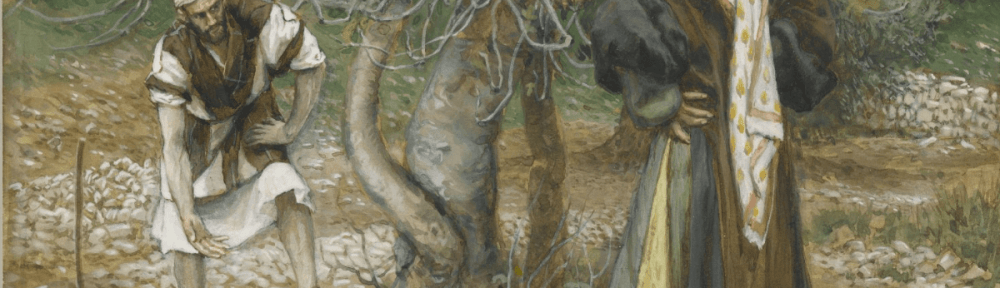
It can be understood that Jesus is asking his listeners to consider a new paradigm of righteousness before God. Their popular wisdom is simply wrong and it needs to be replaced with one that understands God’s desire is that all be saved. What is essential is repentance – and this is a major theme that occupies a good portion Luke 12, immediately preceding our text: the divine call for decision and reform. Such time is not endless. The parable of the barren fig tree presents a story about the continuing patience of God with those who have not yet given evidence of their repentance (cf. Luke 3:8).
Image credit: The Vine Dresser and the Fig Tree | James Tissot, 1886-1894 | Brooklyn Museum | PD-US
Discover more from friarmusings
Subscribe to get the latest posts sent to your email.
 friarmusings