
A day in Navy history

Some days in history are just filled with interesting events, but then there have many years and centuries – so something interesting is bound to happen on any given date. This day in history marked some significant events in naval history

In 1905 the Japanese fleet destroys the Russian East Sea fleet in the Battle of Tsushima, the only decisive clash between modern steel battleships in history. It was the first major victory of an Asian power over a European one in modern times. As a result it fueled Japanese nationalism and reinforced the belief that military strength was essential for Japan’s security and prestige. It also elevated the Imperial Japanese Navy as a symbol of national power, encouraging further investment in military expansion.

The victory boosted the influence of military leaders in government, setting a precedent for the army and navy to play a greater role in politics. Over time, military success became intertwined with Japan’s identity, laying the groundwork for the later dominance of militarists in the 1930s.

In changed Japanese view of the Western powers, justifying further expansion into Korea (1910 annexation) and into Manchuria. This was the beginning that set the stage for Japan’s imperial ambitions in East Asia and the Pacific. 35 years after Tsushima, the Japanese attacked Pearl Harbor.
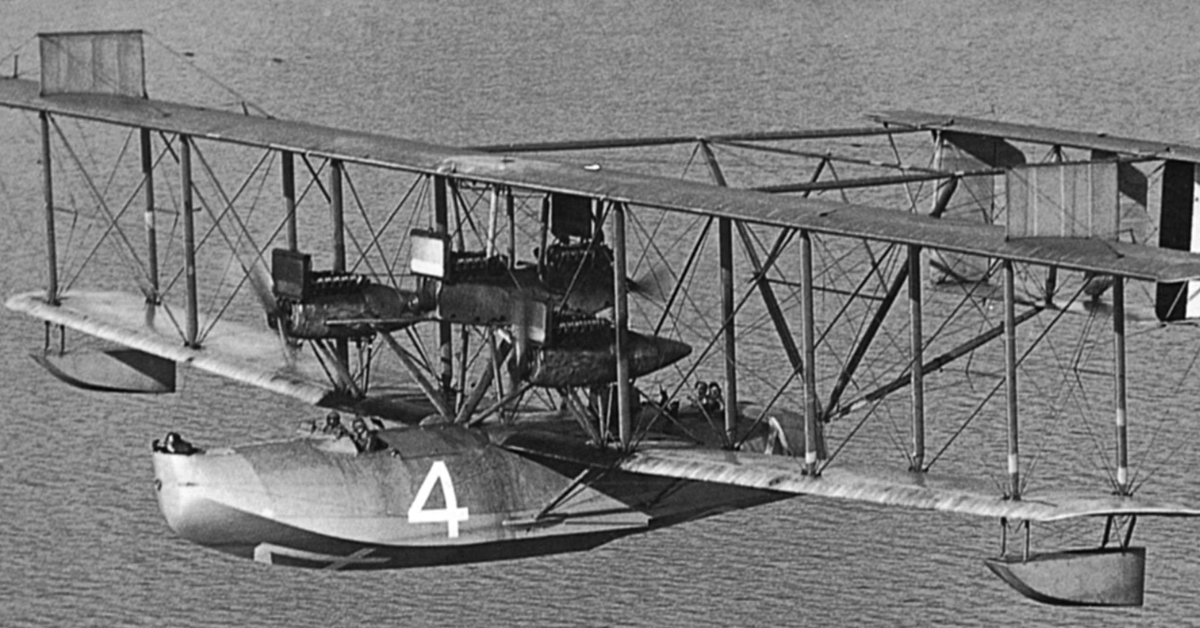
This day in history (1919) the US Navy’s NC-4 flying boat completed the first Trans-Atlantic Flight, albeit not non-stop. A crew of United States Navy and US Coast Guard aviators flew the NC-4 from New York State to Lisbon, Portugal, over the course of 19 days. This included time for stops for numerous repairs and crewmen’s rest, with stops along the way in Massachusetts, Nova Scotia, Newfoundland, and twice in the Azores Islands. Then its flight from the Azores to Lisbon completed the first transatlantic flight between North America and Europe, and two more flights from Lisbon to northwestern Spain to Plymouth, England, completed the first flight between North America and Great Britain. This accomplishment was somewhat eclipsed in the minds of the public by the first nonstop transatlantic flight, made by the Royal Air Force pilots John Alcock and Arthur Whitten Brown two weeks later.

The Navy/Coast Guard aviators became a footnote in history. Alock and Brown were were knighted by King George V and awarded 10,000 English pounds – that’s about $825,000 US (2025).

Image creator: Olaf Rahardt | Credit: ullstein bild

Also on this day in history (1941) the German battleship Bismarck sunk by British naval force sea and air forces. The Bismarck was the pride of the Kriegsmarine (German Navy)—one of the most powerful and modern battleships in the world at the time. Its loss marked a crippling setback to Germany’s surface fleet and ended its realistic hopes of challenging British naval dominance in the Atlantic. Its sinking ensured greater security for Atlantic convoys, which were vital for Britain’s survival and war effort – and was a boost in English morale in the midst of the “Battle of Britain.”

Bismarck was ultimately disabled by torpedo bombers from the aircraft carrier HMS Ark Royal, showing the growing dominance of air power in naval warfare. It marked a shift from traditional battleship-on-battleship engagements to more integrated naval operations.

After the Ascension

This coming Sunday we celebrate the Solemnity of the Ascension. The readings are taken from St. Luke’s Gospel and his Acts of the Apostles. Both the first reading and the gospel are accounts of the Ascension, making this event the lynchpin between the two works of St. Luke. Yesterday was an introductory post. Today’s post takes a bird’s eye view of the mission to the world after the Ascension.

Peter was the leading member of the Twelve (Acts 1:13, 15), and after the Resurrection and Ascension was gifted by the Holy Spirit to perform miracles in the name of Jesus (see Acts 3:1-10; 5:1-11, 15; 9:32-35, 36-42) and was the spokesman for the Christian community. In the early days of the Christian Church, it was Peter who was largely responsible for the growth of the community among the Gentile people of Israel, along with Philip. Paul eventually joined the community at Antioch, which subsequently commissioned him and Barnabas to undertake the spread of the gospel to Asia Minor. This missionary venture generally had mixed results among the Jews outside of Israel (the diaspora) but enjoyed success among the Gentiles in cities across Asia Minor, Macedonia, and Greece.

Continue reading

Land of the Free, Because of the Brave

Memorial Day 2025

“Today, we’re not just fortunate heirs of their legacy. We have a responsibility to be the keepers of their mission—that truest memorial of their lives: the actions we take every day to ensure that our democracy endures, the very idea of America endures.” (President Biden, Memorial Day, 2024)

“The Americans who rest beneath these beautiful hills and in sacred ground across our country and around the world, they are why our nation endures. Each simple stone marker arranged in perfect military precision signifies the cost of our blessings. It is a debt we can never fully repay. But it is a debt we’ll never stop trying to fully repay, by remaining a nation worthy of their sacrifice.” (President Obama, Memorial Day 2015)

Video graciously forwarded this day by a good parishioner.

The Journeys

This coming Sunday is the 7th Sunday of Ordinary Time, but in almost all of the dioceses of the United States, as allowed, the Solemnity of the Ascension is transferred from its traditional Thursday celebration to the following Sunday, replacing 7th Easter. The celebration of the Ascension offers an interesting combination of readings – each by the same author, St. Luke.  The first reading for Sunday is taken from the first chapter of Acts of the Apostles. The gospel reading is taken from Luke 24. In a way the accounts of the Ascension serve as the lynchpin between the two works of St. Luke. I will attempt to cover both during the course of the week.

Continue reading

Memory

Memory is an interesting thing.  I always secretly chuckle when someone asks me, “Father, do you remember your homily from five weeks ago?”  I generally respond, “What did you find interesting about it?”  as an alternative to the simple, “No.”  

There are many theories around the topic of memory apart from where the memory is associated with specific events, a general occurrence, personal experience, and more. Whatever the memory, we have to “register” the memory, store it and then recall it.  A recent study proposed there is a six-stage neuro-chemical process that has to occur for a memory to be retained long-term. Want an example. Consider dreams. Why can we remember some dreams in vivid and exacting detail, but other dreams just seem to dissolve into nothingness. Memory is a mysterious thing.

Continue reading

Naval Academy Commissioning Day

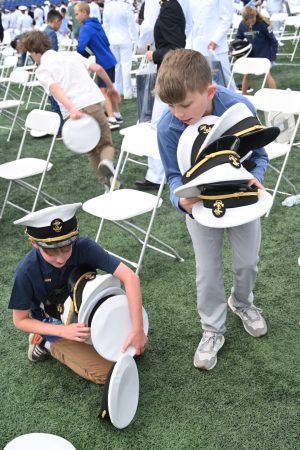
1,049 Midshipmen became Ensigns and Second Lieutenants yesterday at Navy/Marine Corps Stadium as part of the Graduation and Commissioning Ceremony for the Class of 2025. 751 men and 298 women were in the graduating class. 776 received commissions in the Navy. 258 were commissioned into the Marine Corps. Congrats and welcome to the ranks of alumni.

Ever wonder what happens to all those covers (hats)?

I’m not sure what they do with them, but possibly there are enterprising entrepreneurs and have found a secondary marketplace!


Image credit: Eye on Annapolis.

What does it all mean?

Our gospel text for the 6th Sunday of Easter comes from a section of the “Farewell Discourse” that focuses on Jesus’ departure and discusses the disciples’ relation to Jesus and their conflict with the world. Our gospel pericope falls at the end of this section.

The “Farewell Discourse” stretches over several chapters, seems to curl back on itself with repeated messages and promises – and to some extent it does exactly that. You have to remember that the disciples are in shock. Their trip to Jerusalem, the triumphal entry to the city, was not the prelude to the King Messiah creating the New Jerusalem, the New Israel.  He is leaving them. They are stunned and Jesus knows that the worst is yet to come. Within hours He will be arrested and the Passion will begin leading to death on the cross. What Jesus has told them now is not solace for the immediacy of Good Friday and Easter, it is for the “long haul” of mission to the world. When they will look back and remember why He spoke to them: “And now I have told you this before it happens, so that when it happens you may believe.

As Gail O’Day notes: “One way to think about Jesus’ words in John 14 (and the rest of the Farewell Discourse) is as Jesus’ preaching to his gathered followers. Jesus offers his disciples the good news of the love of God and of the abiding presence of God with them, even when the circumstances of their lives would indicate otherwise.  In the face of the evidence that says that the battle is lost, that death will claim Jesus, and that the hope JEsus offered them is thereby nullified, Jesus speaks words of renewed hope and assurance, “Do not let your hearts be troubled and do not let them be afraid.” (14:27)… In the preaching of Jesus in the Farewell Discourse, that refrain thus summons the disciples to believe in a life shaped not by Jesus’ absence but by the enduring presence of God.”


Image credit: Christ’s Final Address to the Apostles | Bona Duccio di Buoninsegna, 1380 | from the Maesta Altar | Siena, Museo dell’Opera del Duomo | PD-US

Love: the obedience of Faith

This is my commandment: love one another as I love you…You are my friends if you do what I command you.” (John 15:12,14)

I have to admit the words “if you do what I command you” have always struck me as somewhat “off.” These words come in the middle of a long talk Jesus is giving the Apostles. It occurs after the conclusion of the Last Supper but before the events at the Garden of Gethsemane where Jesus is arrested and begins the Passion. Is Jesus’ love and friendship going to be conditional or provisional in some way? Does this mean the statement “Jesus loves us no matter what” has some serious limits somewhere in the small print?

There is something huge being played out that gives context to Jesus’ words. Jesus is offering a relationship far deeper than that of a master-servant. He calls His disciples “friends”, not just followers or servants. This is radical —friendship with the Son of God is possible. But this friendship is not casual or superficial. It’s grounded in obedience to His commands, which center around love (John 15:12 – “Love one another as I have loved you”).

Maybe, like me, you sometimes hear this as conditional: “I’ll be your friend only if you obey.” But the long arc of Jesus’ teaching and his mission shows that He is not setting a bar they must clear to earn His friendship. Rather obedience is the evidence of that friendship. It is the fruit of abiding in the love of Jesus. Friendship leads us into His way, following His words and actions. We may not always understand, but we trust our friend. This walk with Jesus naturally leads to transformation so that we want to obey Him.. 

St. Paul talks about the obedience of faith in Letter to the Romans.  It is a phrase that reflects the covenantal nature of love. Biblical love is covenantal, not just emotional. Jesus is inviting His disciples (and us)  into a relationship that mirrors His relationship with the Father—a relationship marked by love and shared purpose. His command is not a burdensome law, but a calling to live in the fullness of divine love.

It is this obedience of faith that echoes a reading earlier this week: the parable of the Vine and the Branches. The goal is to remain in Jesus and bear good fruit. A passive faith that shows no evidence of a transformation is not what Jesus means when He says “love one another as I love you.” It is about love one another sacrificially; always seeking the good for the other.

John 15:14 is not about Jesus setting conditions for His affection. It’s about revealing the nature of true friendship with Him—a relationship of intimacy, loyalty, and obedience. To be Jesus’ friend is to walk in His love, listen to His voice, and live His way.


Image credit: Duccio di Buoninsegna (1255–1319), “Jesus taking leave of his Apostles,” ca. 1310 | Panel 4 of the Maestro, Museo dell’Opera del Duomo, Siena | PD-US

The Promise of the Paraclete

Our gospel text for the 6th Sunday of Easter comes from a section of the “Farewell Discourse” that focuses on Jesus’ departure and discusses the disciples’ relation to Jesus and their conflict with the world. Our gospel pericope falls at the end of this section.

The Advocate, the holy Spirit that the Father will send in my name—he will teach you everything and remind you of all that (I) told you.” Perhaps it best not to translate the Greek word paraclete because there are too many possibilities. While the literal meaning of the related verb (parakaleo) means “to call to one’s side,” usually asking the other for help, the noun took on a legal meaning as “helper in court”. Thus we have translations like “counselor,” “advocate,” or “one who speaks for another” as well as the too general translation of “helper”.

Continue reading

National Maritime Day

Today, May 22nd, is National Maritime Day! n 1933, Congress declared National Maritime Day to honor the US maritime industry and commemorate the American steamship Savannah’s voyage from the United States to England, marking the first successful crossing of the Atlantic Ocean with steam propulsion. During World War II more than 250,000 members of the American Merchant Marine served their country, with more than 6,700 giving their lives, hundreds being detained as prisoners of war and more than 800 U.S. merchant ships being sunk or damaged.

Maritime Day is a time-honored tradition that recognizes one of our country’s most important industries – the Merchant Mariners and the commercial ships that keep the global market running.

If you’d like to keep up with “thing” in the world wide shipping industry, I can recommend the YouTube Channel: “What’s Going On with Shipping”. The host, Sal Mercogliano is an associate professor of history at Campbell University in North Carolina and adjunct professor at the U.S. Merchant Marine Academy. He holds a bachelor of science in marine transportation from the State University of New York Maritime College, along with a merchant marine deck officer license (unlimited tonnage 2nd mate), a master’s in maritime history and nautical archaeology from East Carolina University, and a Ph.D. in military and naval history from the University of Alabama. …. he knows his stuff and he is entertaining as heck and informative too.

It can be your secret nerd channel. I won’t tell…