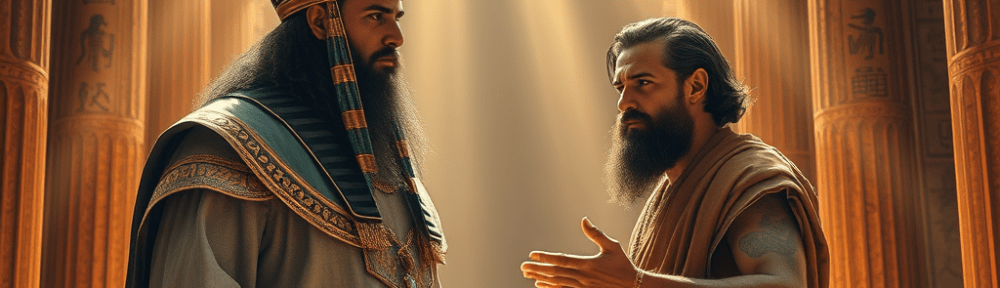
In the readings from last week and today’s first reading, we are reminded of how obstinate and hard of heart was Pharaoh. In these confrontations between Moses and Pharaoh, it is good to keep in mind that it is really a showdown between God and the mere human (Pharaoh) who would make himself to be a god.
Who is Pharaoh? Pharaoh is not one single king in Exodus. If you pay attention, you’ll see that this royal title refers to a sequence of Egyptian kings over many generations. It raises the interesting question of why the author doesn’t actually name the Pharaoh who opposed Moses (was he Thutmose II or III, or Ramses I or II?). This was almost certainly on purpose. The author doesn’t want us to focus on one single king. Rather, he wants us to see Pharaoh as an archetype of the pattern of human rebellion that began in the garden and culminated in Babylon.
This king, or sequence of kings, is the epitome of human evil. He embodies the strange and tragic turn the human heart can take when one person or society places their own values and well-being above another person or society. Pharaoh is what happens when an entire nation redefines good and evil apart from God’s wisdom. You get an Egypt building its wealth and security on the backs of an abused, oppressed, and enslaved Israel. As the story develops, Pharaoh even places his own reputation and pride above the well-being of his own people. This is a horrific situation, and it’s the Bible’s diagnosis of the human condition in corporate terms. The Egyptian empire and its Pharaoh is the Babylon of Genesis on steroids. God has to respond.
Evil Turned Upside Down. A common question readers have about this story, concerns the repeated theme of Pharaoh’s “hard heart.” Sometimes we’re told Pharaoh hardens his heart against God, but other times we read that God hardens his heart. Who is really behind all this evil? And what does this story tell us about God’s relationship to evil at other times in history, or in our own lives?
To answer this question you have to be patient, and read the story slowly and in sequence. Otherwise you’ll short-circuit the experience the author wants you to go through. In Moses’ commissioning, God first says he “knows” Pharaoh will resist the demand to let the Israelites go, so God says that he will harden Pharaoh’s heart. God knows the hearts of humans and can anticipate their responses, a sobering thought echoed throughout the Bible (see Jeremiah 17:10). God will turn Pharaoh’s evil back on his own head, but does that mean God is responsible for Pharaoh’s rebellion from beginning to end? You have to keep reading, and stay alert.
Hardening of Hearts. In Moses’ and Pharaoh’s first encounter (Exodus 7:13-14), what you understand happens in the encounter depends on what biblical translation you are reading. The Hebrew word khazaq is translated into English as the passive “became hard” leaving you wondering who caused the hardening, Pharaoh or God. The problem is that khazaq is a stative verb best translated as “Pharaoh’s heart hard.” The New American captures the correct sense when it considers the rest of the story. In the first five plagues that God sends on Egypt, the hardening of Pharaoh’s heart happens by his own will. And as such, we read in Ex 7:13 “Pharaoh, however, hardened his heart and would not listen to them, just as the LORD had foretold”
The pattern changes for the last five plagues, as we will see.
The Ten Plagues and Pharaoh’s Heart: Look for the pattern change between plagues 1-5 versus the pattern in 6-10. Text from New American Bible translation.
- Blood: Pharaoh’s heart “hardened his heart” (7:22)
- Frogs: Pharaoh “became obstinate” (8:11)
- Gnats: Pharaoh’s heart “hardened his heart” (8:15)
- Flies: “became obstinate” (8:28)
- Livestock die: Pharaoh’s heart “remained obstinate” (9:7)
- Boils: “The Lord hardened Pharaoh’s heart” (9:12)
- Hail: Pharaoh “became obstinate” (9:34) – yet see the opening of Ex 10.
- Locusts: God announces ”Then the LORD said to Moses: Go to Pharaoh, for I have made him and his servants obstinate in order that I may perform these signs of mine among them” (10:1); “The Lord hardened Pharaoh’s heart” (10:20)
- Darkness: God “hardened Pharaoh’s heart” (10:27)
- Death of the firstborn: God “hardened Pharaoh’s heart” (11:10)
The Point. Why does the author use this back-and-forth technique in describing Pharaoh’s heart? It’s all part of the brilliant diagnosis of the human condition in this story, which is about the mysterious nature of human evil. God called Pharaoh to humble himself and acknowledge that God is his authority and that he (Pharaoh) cannot redefine good and evil on Egyptian terms. Pharaoh’s response is to balk at the God of Israel. After this, God gives Pharaoh five opportunities to repent and humble himself. And five times Pharaoh hardens his own heart, becoming obstinate. The author wants us to see that even the most heinous and absurd forms of human evil are not a true threat to God’s purposes. He can steer even this kind of evil toward his plan to bless all humanity through Abraham’s family.
The Climax. At the end of ten plagues, Pharaoh wants the Israelites gone. After losing his own son, Pharaoh releases the Israelites. Not surprisingly, Pharaoh has yet another change of heart and goes back on his decision to let the Israelites go. Pharaoh musters his army and we’re told that God “hardens his heart”. We know how this story ends. The evil turn of Pharaoh’s heart turns back on himself, resulting in an empire-wide catastrophe.
St. Paul in The Letter to the Romans. Romans 9 is the lengthiest reference Paul makes to Exodus in the New Testament. Many point to this chapter to say that God was ultimately behind the evil of Pharaoh from the beginning. He writes, “What then are we to say? Is there injustice on the part of God? Of course not! For he says to Moses: “I will show mercy to whom I will, I will take pity on whom I will.” So it depends not upon a person’s will or exertion, but upon God, who shows mercy. For the scripture says to Pharaoh, “This is why I have raised you up, to show my power through you that my name may be proclaimed throughout the earth. Consequently, he has mercy upon whom he wills, and he hardens whom he wills.” (Romans 9:14-18)
Paul sees in Pharaoh’s hard heart, a pattern that was again at work in his own day, namely the rejection of Jesus the Messiah by many of his own, Jewish, people. In this passage, Paul is not offering a commentary on the complicated theme of Pharaoh’s hard heart, nor is he claiming that God alone was responsible. He is summarizing the main point of the Exodus story’s diagnosis of Pharaoh’s evil (God’s purpose to bless cannot be thwarted by heinous human evil) and applying it to an apparent tragedy in his own day. Jesus’ execution was actually part of God’s plan to bring blessing to all the nations. It is Paul’s exploration of God’s justice and mercy. The fact that God can steer evil towards his purposes does not mean he engineered it. Pharaoh is responsible for his own evil, just as Joseph’s brothers were. However, there is no force of human evil that can resist God’s purpose to bring salvation and blessing to all nations.
What did this mean for Pharaoh, and what does this mean to me?
When human evil goes unchecked, bad things happen, and bad people can sometimes turn into monsters. The author of Exodus is showing us that Pharaoh was responsible for the evil in his heart. At a clear point in the story (after plague 5), he crossed a point of no return. At this point, God re-purposes this “evil” for his own good purposes.
The point of the story is not to tell us that God engineers evil. Rather, it is a cautionary warning to you, the reader, saying, “Don’t be like Pharaoh!” Strange things happen in the human heart and mind when we let the evil urges of our broken nature go unchecked. God will always graciously offer us chances to turn back (would you have given Pharaoh so many chances?!). But sometimes a person can cement themselves in a destructive path and reach a point of no return. God can and sometimes will allow our evil to destroy us. BUT the good news is that you’re not Pharaoh! The fact that you’re asking the sobering question means that your heart is soft and wants to do the right thing. As we progress through the rest of the biblical narrative, you’ll see this theme of the hard vs. soft heart develop more. For now, let’s ponder the mysterious justice and mercy of God, who wants to save us from ourselves.
Original text by Dr. Tim Mackey with edits and additions by Friar Musings
Image credit: AI generated by WordPress
Discover more from friarmusings
Subscribe to get the latest posts sent to your email.
 friarmusings