The first reading for today is one that is often quickly passed over. In part because it is in a book of the Old Testament which seems distant, filled with too many strange names, and there is often a sentiment of “let’s just move on to Jesus.” I have read it several times, but didn’t stop to delve into the passage. Probably a good time for me to do so.
The account centers around Moses and his brother Aaron and Aaron’s wife Miraiam. At the core of the story Miriam and Aaron complained, “Is it through Moses alone that the LORD speaks? Does he not speak through us also?” As a result, the Lord “calls them on the carpet” (so to speak – actually he calls them to the Tent of Meeting) and lets them know in no uncertain terms that Moses is the one who God has commissioned to act and speak on His behalf to the Israelites. “Why, then, did you not fear to speak against my servant Moses?” So angry was the LORD against them that when he departed, and the cloud withdrew from the tent, there was Miriam, a snow-white leper!”
How are we to understand this passage? And why is only Miriam affected? As a result she is going to be placed “outside the camp” apart from family and the people. No small thing in a wilderness environment.
At a human level the true issue is envy/jealousy. Both Aaron and Miriam had prophetic roles (e.g., Exodus 15:20 describes Miriam as a prophet), but they were not content. They questioned Moses’ special authority, perhaps in part due to the recent appointment of the seventy elders in Numbers 11—Moses’ leadership is being broadened – and theirs were not. Where they were once “#2.” Now they share that role with 70 others. Where was their ‘promotion?’ Not hard to see how this might have intensified Miriam’s and Aaron’s insecurities and led to their envy.
On a divine level, Moses has a singular role in salvation history. Unlike other prophets who receive dreams or visions, Moses has a direct, intimate communion with God. This pericope establishes that prophetic gifts are not equal in authority. Moses was a prophet, but Moses more importantly had a unique vocation as the mediator of the Covenant.
God’s response to this whole incident affirms that the call to vocation is God’s gift, not something we can seize or dispute out of rivalry. God defends those He has called, not because they are flawless, but because the mission is His. Miriam and Aaron’s questioning undermines not only Moses, but the unity of the people, which is dangerous on the brink of entering the Promised Land.
Then as now, this story warns against the human temptation to compare divine vocations.
But why is Miriam struck with leprosy, while Aaron is not. Several interpretations have been proposed. One relies on Hebrew grammar. The verb “spoke against” in v.1 is in the feminine singular, suggesting Miriam was the instigator. Perhaps too, the differences in roles plays a part. Aaron, as high priest, may have been spared the impurity of leprosy to preserve his cultic function – and also he expresses repentance. Miriam has no cultic responsibilities.
It is noteworthy that Miriam’s punishment is temporary but public. She is restored after intercession, suggesting God’s justice is tempered by mercy.
The story can serve to remind us that God calls whom He wills, and that authentic leadership is marked by humility, not ambition. Miriam’s punishment is not simply harshness, but a dramatic reminder of the cost of undermining God’s appointed order. Yet even in judgment, we see mercy and restoration.
It is a simple passage, but there is a lot to consider.
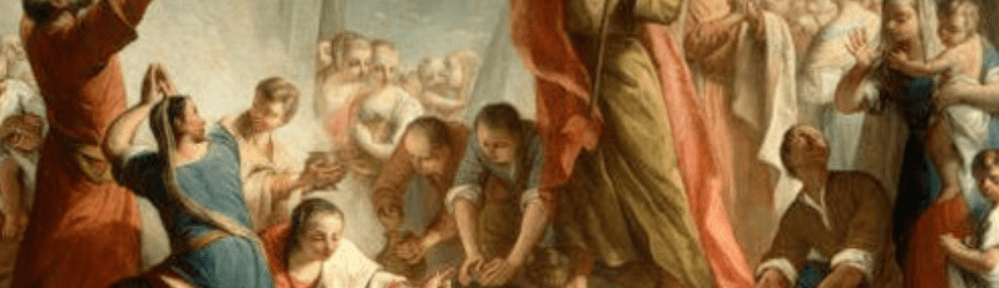
Image credit: The Manna Harvest / Giuseppe Angeli c. 1768, San Eustachio Church, Venice, Italy | Public Domain
Discover more from friarmusings
Subscribe to get the latest posts sent to your email.
 friarmusings