While perhaps familiar to many of the readers, it might be useful to offer a brief summary of the early months of the War in the Pacific. In a modification of Japan’s war plan, Kantai Kessen, on December 7, 1941, Japan launched a surprise and devastating attack on the U.S. Fleet at Pearl Harbor, Hawaii. The goal was the decisive battle that would neutralize the U.S. Pacific Fleet and secure freedom of action for the planned offensive in Southeast Asia. The results of the attack are well known, but the battle was not decisive for three major reasons: the U.S. aircraft carriers were not in port, the fuel depot was not attacked, nor was the Pearl Harbor Naval Shipyard. Had the depot and shipyard been destroyed the fleet would have withdrawn to the west coast affording incalculable time for Japan to advance and more firmly secure its war gains.
Japan rapidly expanded across the Pacific and Southeast Asia in a coordinated offensive:
- Philippines: Attacked within hours of Pearl Harbor; U.S. and Filipino forces withdrew to Bataan and Corregidor, ultimately surrendering.
- Guam and Wake Island: Guam captured quickly; Wake resisted before falling on December 23.
- Hong Kong: fell to Japan on December 25, 1941.
- Rabaul (New Britain): captured in January 1942, becoming a major forward base.
- Burma: Japan advanced to cut off the Burma Road to China – it was the main overland supply route by which the United States and British Empire provided military aid to Nationalist China in its war against the Japanese – a war initiated in 1937.
- Malaya and Singapore: Japanese forces advanced swiftly down the Malay Peninsula, capturing Singapore on February 15, 1942
- Battle of the Java Sea (Feb 27, 1942): the Allied ABDA Command (American, British, Dutch, Australian) lost the majority of its sea power leaving Java and the Dutch East Indies open to Japanese invasion
- Dutch East Indies (Indonesia): Seized for its oil resources; Java fell by March 1942.
- Doolittle Raid (April 18, 1942): U.S. bombers struck Tokyo and other cities, a psychological blow to Japan and a factor in their decision to strike Midway.
- Battle of the Coral Sea (May 4–8, 1942): a strategic Allied victory in that it stopped the invasion of Port Moresby, New Guinea – a gateway to northern Australia.
Japan planned Operation MI, an operation to lure the U.S. Navy into a decisive battle by attacking and occupying Midway Atoll, a key American base northwest of Hawaii. Their hope was for a decisive Kantai Kessen-style battle that would destroy the last Pacific assets: U.S. aircraft carriers. Victory would cement Japanese strategic dominance in the Pacific.
Station Hapo, Hawaii – using signal intelligence vs. pure code breaking – learned of the attack on Midway and in an “all-in” gamble, Admiral Chester Nimitz committed the U.S. carries to the action that stopped the tide of Japanese advance in the Pacific. At the Battle of Midway (June 4–7, 1942) Japan suffered a catastrophic defeat, losing four fleet carriers and shifting the balance of naval power in the Pacific.
War Plan Orange – greatly revised, but with key elements intact – was now free to work its way westward to prosecute the War in the Pacific on new terms and conditions.
I do not plan to work step-by-step through the war in the Pacific. I will leave the heroic battles of places such as Guadalcanal and Tarawa for you to research. As well, I do not discuss the 1942 naval engagements such as Savo Island, Eastern Solomons, Cape Esperance, Santa Cruz, sea battle of Guadalcanal and Tassafaronga – all in the defense of the Marine Division on the island of Guadalcanal. I would note that the US Navy suffered more killed-in-action than the US Marines during the Guadalcanal campaign.
Moving ahead, I will highlight key several military actions that reveal fundamental shifts in Japanese military tactics and strategy. These shifts will shape planning for an invasion of the Japanese home islands in 1945-1946, an endeavor whose potential for the loss of life – military and civilian – defied estimation.
By the end of 1942 the advance of the Japanese has been stopped. The advent of 1943 would see the allied forces move from the defense to offense. The might of American industrial power in shipping building (combatants and merchants), aircraft, ammunition, and every aspect of logistics support would “come fully on line” as the work of the US submarines interdicted needed critical war supplies from Southwest Asia to Japan.
As noted in the first post, this series is not aimed at concluding with “the atomic bomb was the lesser of all the evils about to be faced.” It is intended to hopefully provide a correct historical understanding available to the 1945 leadership who faced the impossible task of ending a war with an intractable enemy and not repeating the armistice of 1919 that became the next war.
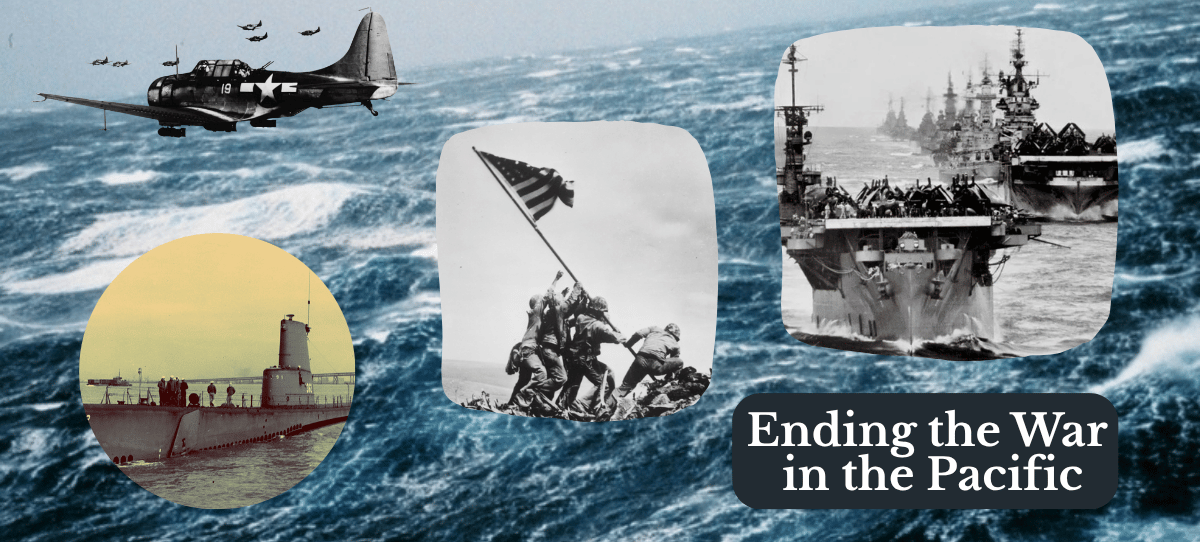
Image credit: various photographs from Naval Aviation Museum, National World War II Museum, and US Navy Archives.


 friarmusings