The island of Saipan in part of the Mariana Islands lies southeast of Tokyo at a distance of 1,450 miles. Its capture was always part of War Plan Orange because of its strategic importance. The capture of the Marianas (Saipan, Tinian, Rota, and Guam) ensured an open sea lane for logistics support from the mainland United States. Guam became one of the major supply depots in the Pacific from August 1944 to the war’s conclusion. Even today every branch of the US military operates out of Guam – notably Submarine Squadron 15/Los Angeles Class fast attack submarines and Seal Team One.
However the real prizes were Saipan and Tinian. Their location allowed the US and Allies to build multiple airfields for the B-29 Superfortress bomber which initiated sustained bombing of Tokyo and the Japanese home islands for the first time.
While Guam had been a U.S. colony, Saipan had been a Japanese colony since it was ceded to Empire of Japan by the League of Nations as a part of its mandated territory of the South Seas Mandate that transferred all Pacific territories to WWI allies – of which Japan technically was one.
This Sunday is the 21st Sunday of Year C with the gospel reading from Luke 13:22-30. The question raised is how many will be saved? Jesus does not answer directly, but urges his questioner and others (“strive” is plural) to make sure that they are in the number, however large or small it proves to be (v.24). The word “strive” is derived from a technical term for competing in the ancient Olympiad pointing to a full-hearted effort. This word is in the present continuous tense and contrasts those who “will attempt to enter” but when the door of opportunity is finally shut it will be too late (v.25). People must strive to enter now. There is inevitably a time-limit on the offer of salvation. After the master of the house has arisen and locked the door – The gospel text continues to indicate that the time is short, the kingdom is arriving even now, and thus it is important that a decision be made. Jesus’ parable of the narrow and soon shut door makes it clear that making a decision, and the right one, is crucial. It is a theme that has been consistently present since the beginning of Luke chapter 12.
How many will be saved? The question was relevant in Jesus’ time when there was a growing divergence of religious views. There is evidence that it was widely discussed (e.g. 4 Ezra 7:55ff.), and that the rabbis held widely differing views (e.g. Sanhedrin 97b). But it seems to have been firmly held that all Israel would be saved, except for a few blatant sinners who excluded themselves (Sanhedrin 10:1). In our day, this same question speaks not only to the individual decision, but also to the proclamation of the community. Here at the beginning of the third millennium, especially in the West, many people believe that there are many ways to God – perhaps.
In the best of scenarios, the two warring factions agree to meet in the open away from cities, away from civilians, and decide the end result without involving the innocents. Scenes from “Braveheart” come to mind. But even then the winning army goes on to lay siege to the castle while ransacking towns and villages. Whatever the victor’s intent, war has its own purpose and passion. Revenge and retribution seem more powerful than reconciliation. And some things can not be unseen or forgotten by war fighters or witnesses.
The goal of this post is to make the reader aware of one element that was a critical factor in the decision whether (and how) to invade the Japanese home islands in the autumn of 1945 and spring of 1946. But also to let us remember it is individuals who fought the wars in our name and in many cases faced unspeakable evil. They carry the scars of combat – images and memories that challenge their humanity. Catholic just war teaching acknowledges the moral weight is most often borne by those who carry arms. While the national leaders may determine that a war is just, the individual soldier carries the burden of action, decision, and consequence.The dual responsibility of the war fighter — obedience and moral discernment — can place the war fighter in situations of profound moral tension and leave them with life-long memories. The cost of war is carried beyond the battlefield: moral injury, post-traumatic stress, and a deep spiritual dislocation. The battlefield lingers in memory and emotion long after the fighting ends.
Such was the case of the U.S. Marines who witnessed needless civilian deaths on the island of Saipan. While civilians caught in the cross fire is perhaps an inevitability of modern warfare, the intentional blurring of the difference between soldier and civilian by an enemy crosses a line of moral behavior and essential humanity. The disregard of civilian lives by the Imperial Japanese Army (IJA) before the June 1944 invasion of Saipan is well documented. The scope of civilian deaths at the hands and instigation of the IJA staggers the imagination.
Civilian deathscaused by Japanese military actions from 1936 to 1945
To be sure it is difficult to account precisely due to incomplete records, wide geographic scope, and ongoing historical debate. However, historical estimates, based on scholarship, war crimes tribunals, and national archives, provide the following approximate figures:
The above information is provided, not as a means of establishing the basis for punishing the Nation of Japan as punitively as possible nor to justify a wholesale invasion of Japan’s home islands. The post-war tribunals addressed the war crimes and those responsible. But it is presented to reveal the mindset, practice and history of field-level commanders in the Imperial Japanese Army (IJA), especially those operating in the far-flung corners of the Japanese empire.
Among the “junior officers” there was a history of rebellion, assasination, and “taking the initiative” in ways unimaginable in the allied armed forces. It is believed (not proven) that junior officers were most responsible for the July 1937 escalation of armed forces involvement from the incident at the Marco Polo Bridge that is considered the beginning of the Second Sino-Japanese War.
Another glaring example is the forging of orders given to Major General Tomitarō Horii to cross the virtually impassable Owen Stanley Range via the Kokoda Track to attack Port Moresby in Papua New Guinea. The attempt resulted in ~5,000 deaths from combat, disease, exposure, or starvation. Among them were scores of forced laborers from Korea and China.
A concern of the Allied Leaders in July 1945 was the reaction of the IJA outside the home islands in the event of invasion of their homeland. Would there be retaliatory strikes against local civilian populations in Japanese occupied territories? Also, in the event of Japanese surrender, would the IJA surrender arms inside and outside of Japan? Mutinies initiating within the ranks of the IJA had been well documented.
Civilian non-combatant deaths did not become a point of US military experience until the invasion of Saipan in June 1944. The experience of Saipan not only greatly clouded the question of whether “civilian non-combants” were a separate and distinguishable group, but also left indelible marks on the US Marine witnesses. The experience of the invasion of Iwo Jima and Okinawa added to and amplified the Saipan experience. All this justifiably raised the issue of what were the expectations in an invasion of the main home islands as regards “civilians.”
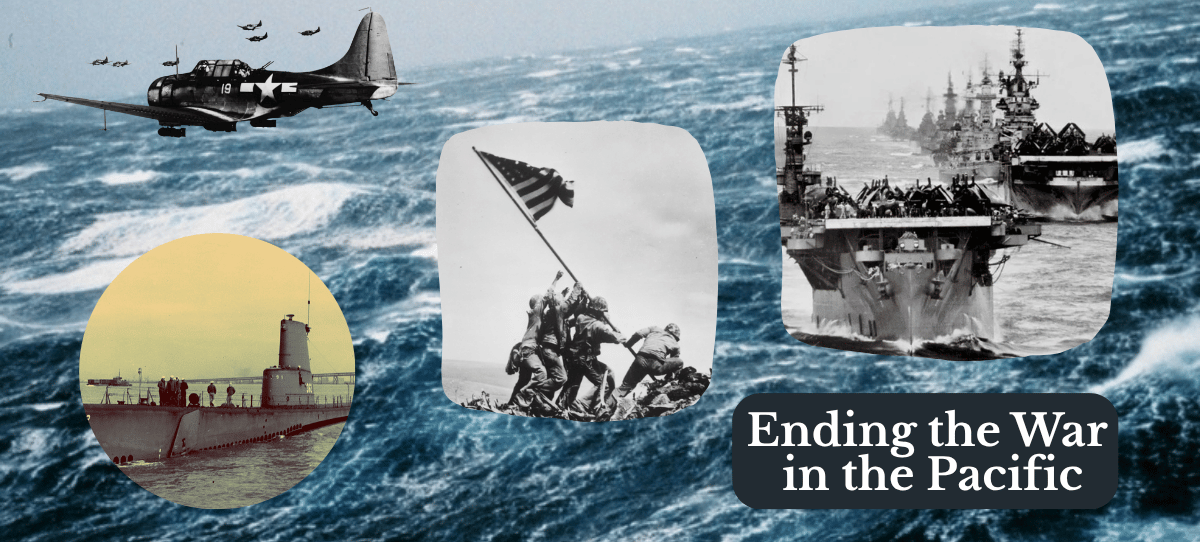
Image credit: various photographs from Naval Aviation Museum, National World War II Museum, and US Navy Archives.
This Sunday is the 21st Sunday of Year C with the gospel reading from Luke 13:22-30. This section continues Jesus’ formation of his disciples for their time to take up the mission of the proclamation of the kingdom of God. Jesus makes several references to the seriousness of the proclamation of God’s reign and to the need for a sober decision of discipleship to undertake the journey to Jerusalem with Jesus, a journey that will end in suffering and death (9:22–23).
The question that initiates Jesus’ response is short, pointed, and seems to summarize the unnamed disciple’s impression of the verses that have come before this Sunday gospel passage. A short summary of the preceding messages might be: (a) courage under persecution, (b) warning about foolish acquisition about what matters not to God, (c) remaining vigilant because judgment is coming, (d) reading the “signs of the time,” and (e) a direct call for immediate repentance. Is it any wonder that…
23 Someone asked him, “Lord, will only a few people be saved?” He answered them, 24 “Strive to enter through the narrow gate, for many, I tell you, will attempt to enter but will not be strong enough. 25 After the master of the house has arisen and locked the door, then will you stand outside knocking and saying, ‘Lord, open the door for us.’ He will say to you in reply, ‘I do not know where you are from.’
Prior to the attack on Pearl Harbor there was no blockade of Japan. Five months before the Pearl Harbor attack the Dutch, English, and Americans announced an embargo on the sale of oil, steel and scrap metal. An embargo is not an act of war; it is an economic and political tool, enforced primarily through laws, regulations, and diplomatic pressure. Its intent is always to solicit acceptable behavior, which in July 1941 meant for Japan to cease its war actions in Manchuria, China, and Indonesia. All this before Pearl Harbor.
A naval blockade is an act of war. Naval blockades come in two forms: the embargo of selected items and a complete shutdown of ships with cargo of any type. World War I was enmeshed in the endless slugfest of trench warfare when Britain instituted a complete naval blockade to cut off Germany’s access to food, raw materials, and supplies. The Royal Navy blockaded the North Sea, intercepting ships heading to Germany and occupied countries in Europe. This led to severe food shortages and malnutrition among German civilians. It is estimated that 400,000–750,000 German civilian deaths were due to starvation and disease. The blockade contributed significantly to domestic unrest and the eventual German collapse in 1918. The blockade continued even after the armistice (Nov 11, 1918) until the signing of the Treaty of Versailles (June 28, 1919).
Germany’s unrestricted submarine warfare in WWII was an attempt to blockade England from receiving needed supplies including food. Before the war, 70% of Britain’s food supply was imported. In 1942, as German U-boat attacks during the Battle of the Atlantic reached their peak, imports of meat, sugar, fruit, and cereals were drastically cut. This led to severe rationing. Britain successfully avoided famine through a mix of rationing, domestic production, and American aid which began to increase significantly by late 1942 as the Battle of the Atlantic began to turn in favor of the allies.
Here in Year C readings, our gospel suddenly moves from Luke 12:49-53 (last week) to this gospel, passing over 12:54-13:21. In between, the warnings and admonitions regarding the coming judgment that began with 12:1 reach their conclusion with a sobering call for repentance. Just as the debtor on the way to court (12:59) is warned to make every effort at reconciliation, so also Jesus uses the sayings about calamity in 13:1–5 and the parable of the unproductive fig tree in 13:6–9 to make the same point:
read the signs of the time and judge correctly;
repent now, the time is short; and
be assured of the full measure of judgment.
The sayings from this gospel of Jesus follow upon the parables of the kingdom (Luke 13:18–21) and stress the same points as above, adding, that great effort is required for entrance into the kingdom (Luke 13:24) and that there is an urgency to accept the present opportunity to enter because the narrow door will not remain open indefinitely.
In the second reading today from the Letter to the Hebrews, the author tells us “persevere in running the race that lies before us.” It is an apt sports metaphor for life. Perseverance in life – the needed persistence in doing something despite difficulty or delay in achieving success. We know all things in life take preparation and practice. Even then things don’t always go as planned.
In the 1968 Mexico City Olympic Marathon, one of the runners from Tanzania was John Akhwari. During the race he fell, dislocated his kneecap, injured his shoulder, and was bruised and bloodied. After receiving medical attention, he continued the race. He finished more than 1 hour after the winner. By the time he finished, the medals for the Marathon had been awarded. Most people had left as darkness drew over the stadium, but people had heard there was one more competitor on the course, injured but persevering. He entered the stadium to complete the lap that would finish the race – there were still 7,000 spectators remaining. He finished, cheered on by a “great cloud of witnesses” giving him a standing ovation. Later he was asked why had not quit, why he continued, he replied, “My country did not send me 7,000 miles around the world to start the race, but to finish it.”
God did not send you into this life just to start the race, but to be able to join with St. Paul, “I have competed well; I have finished the race; I have kept the faith.” (2 Tim 4:7)
By early 1942, Japan had established a vast defensive perimeter across the western Pacific, including the Philippines, Dutch East Indies, and parts of New Guinea. After seizing Tulagi in the southern Solomon Islands in May 1942 the Japanese began construction of an airfield on Guadalcanal an island near the southwest end of the Solomon chain. Completion and operation of this airfield would threaten Allied supply and communication lines between the U.S., Australia, and New Zealand – effectively isolating the Allies from each other and placing Australia at risk of invasion.
The U.S. victory at Midway in June 1942 represented the first time Japanese offensive power had been thwarted and opened the possibility for limited Allied offensives. Admiral Ernest King, Commander in Chief of the US Fleet, proposed an offensive in the Solomon Islands and New Guinea. The Joint Chiefs of Staff approved the plan in July 1942. The first phase was the seizure of Guadalcanal, Tulagi, and surrounding islands to deny Japan their strategic airfield. The Guadalcanal operation was codenamed Operation Watchtower. Military historians have suggested that it should have been called Operation Shoestring. Initially planned as a limited operation by the U.S. Marines to preempt the Japanese airfield on Guadalcanal, it evolved into a protracted campaign that lasted from August 1942 to February 1943.
This last post moves beyond the Sunday gospel (Luke 12:48-53) to include the following verses:
54 He also said to the crowds, “When you see (a) cloud rising in the west you say immediately that it is going to rain—and so it does; 55 and when you notice that the wind is blowing from the south you say that it is going to be hot—and so it is. 56 You hypocrites! You know how to interpret the appearance of the earth and the sky; why do you not know how to interpret the present time? 57 “Why do you not judge for yourselves what is right? 58 If you are to go with your opponent before a magistrate, make an effort to settle the matter on the way; otherwise your opponent will turn you over to the judge, and the judge hand you over to the constable, and the constable throw you into prison. 59 I say to you, you will not be released until you have paid the last penny.” (Luke 12:54-59)
The illustration (vv.54-55) seems to point to the weather patterns in the Near East. The Mediterranean Sea was to the west and winds from that direction brought rain. The desert was to the south and winds from that direction brought heat. It is not clear whether these words were spoken on the same occasion as the preceding verses. There is no direct connection. Matthew gives a similar saying in response to a request for a sign. Still, it is interesting to note that here, while Jesus is encouraging, exhorting people to “see,” he again uses the accusatory “hypocrite.” Jesus has only used this expression once before in Luke’s gospel: “How can you say to your brother, ‘Brother, let me remove that splinter in your eye,’ when you do not even notice the wooden beam in your own eye? You hypocrite! Remove the wooden beam from your eye first; then you will see clearly to remove the splinter in your brother’s eye” (Luke 6:42).
Much of our religious consciousness is affected by art; we have inherited specific images that are more artistic than biblical. For example, we always imagine St. Paul being knocked from a horse on the Damascus Road. There is no mention of the horse in scripture. Is that a bid deal? Perhaps not. But when Caravaggio placed Paul on the horse, a sign of privilege or royalty, he removed Paul from the midst of Corinth, the hard-scrabbled sea port town, from among the drunks, slackards, ner-do-wells, and people who sorely needed salvation. Continue reading →


 friarmusings