
Although overly simplified, for our purposes, State Shinto and the person of Emperor Hirohito form an imperial ideology that became a central pillar of Japanese foreign policy in the days leading up to the War in the Pacific – or as several historians rightly assert, the Asia Pacific War.
After Korea’s annexation and incorporation into Japan’s sphere (1910–1920s), there was an intentional program to consolidate the idea of “Sacred Rule.” In Korea, Taiwan, and other territories, Japan built Shinto shrines and required participation in rituals, symbolically binding colonial subjects to the emperor. School curricula emphasized emperor worship and loyalty, teaching that Japan’s overseas expansion was the natural extension of the divine nation’s growth. The slogan “Hakko ichiu” (“the eight corners of the world under one roof”) — drawn from Shinto mythology — began to circulate, suggesting Japan had a divine mission to unify the world under the emperor’s benevolence.
This led to a period throughout the 1920s and 1930s that saw a profound rise in ultranationalism. The global economic depression and Western restrictions (e.g., naval treaties limiting Japan’s fleet) fueled resentment. Right-wing groups, backed by State Shinto ideology, claimed Japan had a unique destiny as leader of Asia, free from Western domination. Shinto myths were increasingly politicized: the emperor as a living god, Japan as the “center of the world.” and colonial expansion framed as the divine spreading of imperial virtue. By the 1930s, this ideological framework hardened into the justification for military aggression in Manchuria (1931) and full-scale war in China (1937).
Manchuria and the “Sacred Mission” – When the Kwantung (Japanese) Army seized Manchuria in 1931, propaganda presented it not just as a strategic or economic necessity, but as a holy task: protecting Asia from chaos and Western exploitation. The creation of the (puppet) nation of Manchukuo (1932) was wrapped in Shinto rhetoric: the emperor of Japan “extending divine order” across East Asia. Local Shinto shrines were built to enforce the symbolic inclusion of Manchuria under Japan’s sacred imperial rule.
The Greater East Asia Co-Prosperity Sphere was Japan’s idea during the 1930s and World War II that Asian countries should come together under Japan’s leadership to be free from Western colonial powers (like Britain, France, and the U.S.). On paper, it sounded like a partnership — “Asians helping Asians.” Japan said it would bring prosperity, unity, and independence to Asia. In reality, though, it mostly meant that Japan would dominate the region, control its economies, and use its resources for Japan’s benefit. So instead of being true cooperation, it was more like Japan building an empire with kinder and gentler language and imagery.
There was the “promise” and then there was the “reality” of it.
- “Asia for Asians” – the promise was to free Asia from Western colonial powers (Britain, France, U.S., Netherlands). In reality, Japan replaced Western rulers with itself, becoming the new imperial power.
- Shared prosperity – the promise was that all Asian nations would benefit together through trade and cooperation. In reality, Japan took raw materials (oil, rubber, rice, metals) for its war effort; locals often went hungry.
- Mutual respect and cultural unity – the promise was that Japan would honor Asian traditions and cultures. In reality, Japan forced the teaching of Japanese language, rituals, and State Shinto; local cultures were suppressed.
- Economic development – the promise was to modernize colonies with railways, factories, and schools. In reality, some infrastructure was built, but mainly to serve Japanese needs (military transport, resource extraction).
- Partnership under Japan’s leadership – the promise was a family of nations working together. In reality, Japan treated others as subordinates, not partners.
This was all supported by the ideology of the Emperor and kokutai of the nation – which were one in the same. This was the foundation of the “eight corners of the world.” This was the accelerant that supercharged Japanese imperial expansion in the opening months of the Asia Pacific War. It changed the map of Asia and the Western Pacific

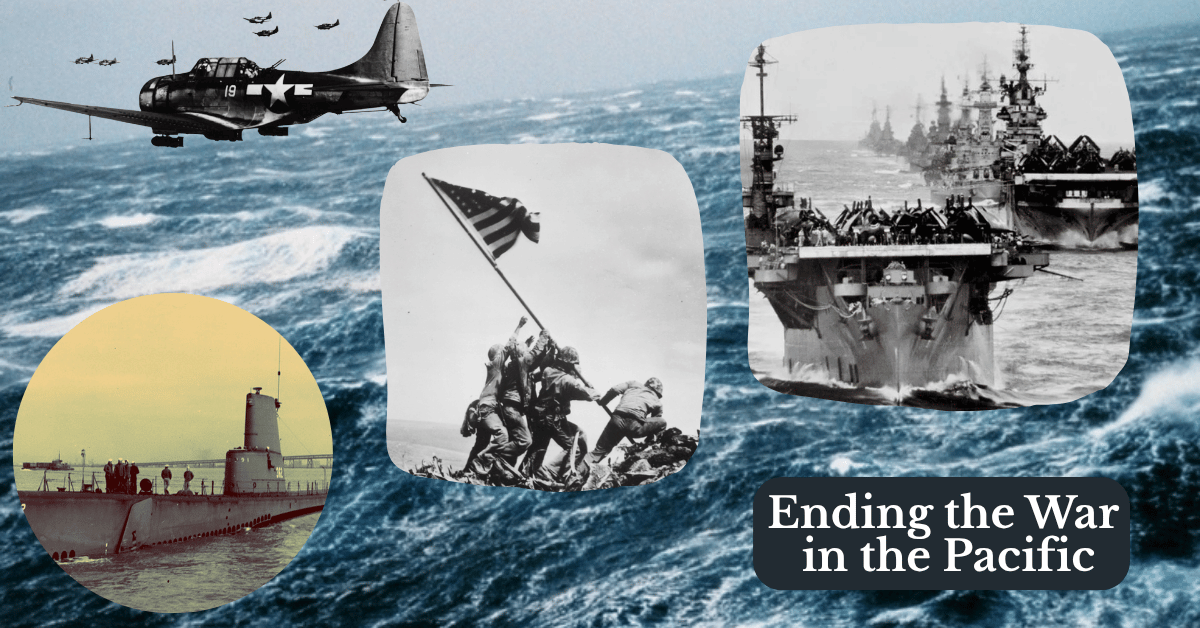
Image credit: various photographs from Naval Aviation Museum, National World War II Museum, and US Navy Archives. Map of Japanese Empire – Wikicommons | CC-0
Discover more from friarmusings
Subscribe to get the latest posts sent to your email.

