This coming Sunday – the 26th Sunday, Year C – we continue in the Gospel of Luke with more of Jesus’ amazing parables. Recall that in successive weeks we have heard the parable of the Prodigal Son (15:11-32) followed by the story of the Dishonest Steward (16:1-13) – both stories featuring rich men and concern the handling of money (among other key topics). This week our reading again features a rich man but this time in contrast to the poor Lazarus (16:19-31). The in-between verses, vv.14-18, begin with the phrase, “The Pharisees, who loved money.” Jesus describes these people as an “abomination” (bdelygma) before God (v.15). Johnson (Luke, Sacra Pagina, 255) writes about this word:
Its first and most obvious reference is to “idolatry” in the biblical tradition. But the term is also used in two other important connections in Torah, once in condemning financial misdealing (Dt 25:16), and once in condemning a divorced man cohabiting again with his former wife (Dt 24:4). Idolatry, money, and divorce are joined by the term bdelygma.
This directly speaks to the Pharisees as ones who are ignoring the warning of v.13 “You cannot serve God and mammon.” Since they love money, they are not serving God. Allan Culpepper (Luke, 312) notes that vv.14-15 introduces the first part of the parable of the Rich Man and Lazarus, while vv.16-18 in turn foreshadows the reference to the law and the prophets in the second part of the parable.
Perhaps our parable is better titled “Rich Men and Lovers of Money” in order to convey its thematic unity and serve as an apocalyptic warning to those who pursue the treasures of earth; they are “an abomination in the sight of God” (v.15). Certainly that is the fate of the rich man in our parable and the fate that awaits his five brothers. Tempting as the title is, the title then also runs the risk of losing sight of Lazarus, the parable’s protagonist who never speaks a word. While such an emphasis points to the rich man’s torment as a fulfillment of the earlier warning: “His winnowing fan is in his hand to clear his threshing floor and to gather the wheat into his barn, but the chaff he will burn with unquenchable fire” (3:17) one may lose sight of the fulfillment that the kingdom of God belongs to the poor and the hungry (6:20-26).
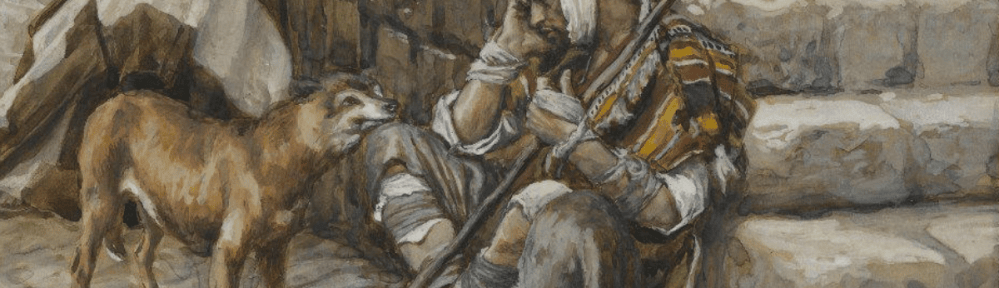
The Poor Lazarus at the Rich Man’s Door | James Tissot, 1886–1894 | Brooklyn Museum | PD-US
Discover more from friarmusings
Subscribe to get the latest posts sent to your email.
 friarmusings