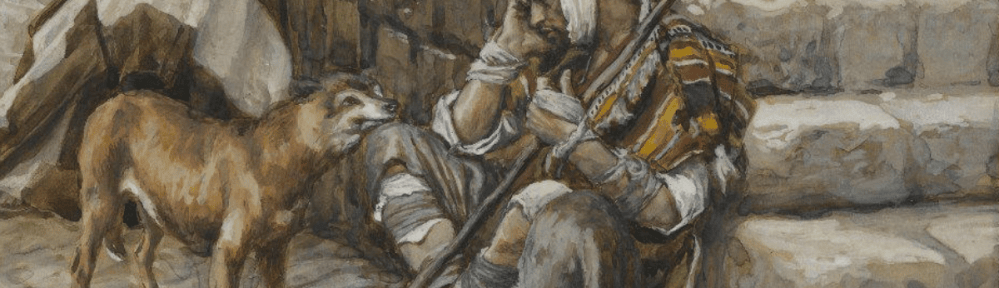
This coming Sunday we continue in the Gospel of Luke with Jesus’ parable of the Rich Man and Poor Lazarus. Culpepper well describes this parable as a drama in three acts (Luke, 316):
- Act 1 – a tableau during which the characters are introduced and their way of life is described, but nothing happens
- Act 2 – a reversal: the rich become poor and the poor become rich as each character has died and received their eternal reward
- Act 3 – narration give way to dialogue, but between the rich man and Abraham, in three exchanges: about the finality of judgment, about the witness of Moses and the prophets, and about the blindness that prevents even the Resurrection from leading to conversion
Act 1 – The Tableau: The first three verses contain a sharp contrast in description between Lazarus and the unnamed “lover of money.”
- The rich man is clothed in purple and fine linen where Lazarus is covered with sores or ulcers
- The rich man “dined sumptuously each day” while Lazarus longed to eat what fell from the table, but couldn’t.
- The rich man lives a privileged life while Lazarus ebeblêto pros ton pulôna, literally, “had been thrown before the gate” of the rich man’s house.
It is perhaps noteworthy that the first word in a Greek phrase is a position of stress, as is the last word in a phrase. Even the Lucan grammar seems to stress the contrast between the two men:
- The first word in v. 19 is anthropos = “a person” and the last word in the phrase is plousios = “rich”
- where the first word in v. 20 is ptochos = “poor,” the last word in the phrase is “Lazarus,” a name meaning “God helps”
Perhaps Luke is making the point that “the poor” were not considered “people;” as well the rich depend upon themselves whereas the poor depend on God.
The rich man is splendidly robed and feasts on the finest foods (see Note below re: v.19) – a clear echo of the parable of the Rich Fool who is well satisfied: “Now as for you, you have so many good things stored up for many years, rest, eat, drink, be merry!” (12:19). As the parable makes clear the flash and pomp of the rich man’s life in no way reflects the eternal glory that awaits the faithful.
Lazarus is the only character ever named in a parable. As mentioned above, the name means “God helps” and thus foreshadows Lazarus’ liberation even as its ironically contrasts his life – no one in this life helps Lazarus. He has been cast away at the rich man’s gate. He is a cripple beggar covered with sores and in the end dies. Green [606] comments about names:
… the fact that this poor, crippled man has a name at all is highly significant. The poor man’s only claim to status is that he is named in the story; this alone raises the hope that there is more to his story than that of being subhuman. The wealthy man, on the other hand, has no name; perhaps this is Jesus’ way of inviting his money-loving listeners to provide their own!
In our tableau the two characters live with a “stone’s throw” of each other and yet they never meet, never speak, nor are in any way neighbors. One is reminded of Jesus’ question to scribe (scholar of the law) in the parable of the Good Samaritan: “Which of these three [priest, Levite, Samaritan], in your opinion, was neighbor to the robbers’ victim?’ He answered, ‘The one who treated him with mercy.’ Jesus said to him, ‘Go and do likewise.’” Our two main characters loved entirely separate lives, divided at table and divided by a gate.
The Poor Lazarus at the Rich Man’s Door | James Tissot, 1886–1894 | Brooklyn Museum | PD-US
Discover more from friarmusings
Subscribe to get the latest posts sent to your email.
 friarmusings