This coming Sunday we continue in the Gospel of Luke with Jesus’ parable of the Rich Man and Poor Lazarus. We are describing the parable as a drama told in three acts. This is Act 3. To a first century hearer of the parable, the fates of the two would have been surprising for it went against the grain of the common wisdom: blessings in this life were a sign of God’s favor while illness, poverty, and hardship were a sign of God’s curses. Yet the one well “blessed” in his lifetime is now tormented in the netherworld (see the Note on 16:23 below) where he can see Lazarus and Abraham across the great chasm that divides them (v.26).
The First Exchange. 24 And he cried out, ‘Father Abraham, have pity on me. Send Lazarus to dip the tip of his finger in water and cool my tongue, for I am suffering torment in these flames.’ 25 Abraham replied, ‘My child, remember that you received what was good during your lifetime while Lazarus likewise received what was bad; but now he is comforted here, whereas you are tormented. 26 Moreover, between us and you a great chasm is established to prevent anyone from crossing who might wish to go from our side to yours or from your side to ours.’
Some things never change. The rich man, who surprisingly knows Lazarus’ name, making his lack of charity perhaps worse, still thinks of Lazarus as someone below his station in life, someone to serve his personal needs: “Send Lazarus to dip the tip of his finger in water and cool my tongue, for I am suffering torment in these flames” (v.24). The rich man stills thinks of himself as a “son of Abraham” since he addresses Abraham as “Father” (cf. 13:16; 19:9)
And he is. Abraham addresses him as “child” in v.25; however, such a relationship is no guarantee that one will dwell with Abraham in paradise. The theme of the Lucan “great reversals” (cf. Luke 6:20-26, the Beatitudes and other vv.) is now complete. Where table and gate once divided them in life, now a great chasm (v.26) separates them and confirms the finality of judgment – “prevent anyone from crossing who might wish to go from our side to yours or from your side to ours.” In life indifference and apathy shut the rich man off from Lazarus and now no one can reach him.
“The irony of the story is that he now requests ‘mercy’ (eleos) who did not show mercy in almsgiving (eleemosyne) to the poor man” [Johnson, 252]. There are contrasting fates for both men in this section.
- The rich man had received good during his life, now torment. Lazarus had received evil during his life, now is comforted.
- The rich man had eaten his fill of good things during his life, now he can’t even get the water that would drip off a finger.
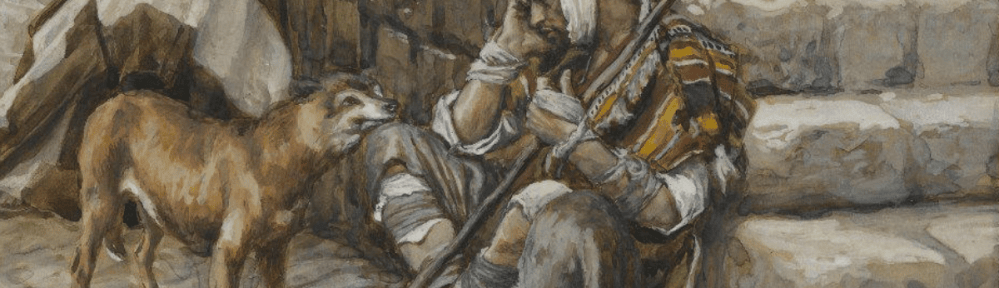
The Poor Lazarus at the Rich Man’s Door | James Tissot, 1886–1894 | Brooklyn Museum | PD-US
Discover more from friarmusings
Subscribe to get the latest posts sent to your email.
 friarmusings