Every so often it is good to “check in” with the Patriarchs of the early Church to see their reflections on the parable of the Rich Man and Poor Lazarus. Here is a sample of their thought
St. John Chrysostom (late 4th century AD) – often used this parable to warn that failing to aid the poor is itself a form of robbery. “Not to share our own wealth with the poor is theft from the poor and deprivation of their means of life; we do not possess our own wealth, but theirs.” (Homily on Lazarus and the Rich Man, 1) Chrysostom He stresses that the rich man’s sin was not that he had wealth, but that wealth without mercy leads to condemnation
St. Augustine (late 4th and early 5th century AD) focused on the end of the parable: “They have Moses and the prophets. Let them listen to them.” (Luke 16:29). In his Sermon 115, Augustine warns that waiting for miraculous signs is foolish when the Word of God is already sufficient: “If they do not hear Moses and the prophets, neither will they believe if one rises from the dead.” (v. 31). For Augustine the matter that has always plagued humankind in our relationship to God is hardness of heart. The hardness of heart we display for those around has its own measure in the hardness of our hearts to follow the Word of God.
Just later in the same period, St. Cyril of Alexandria highlights the “great chasm” (v. 26) as symbolic of the irreversible separation between the righteous and the wicked after death. In his Commentary on Luke, he says this teaches that the opportunities for repentance and charity belong to this life alone: “For once we have departed from here, there is no longer time for repentance, nor can we cross from the place of torment to the bosom of Abraham.” Our realization of the great reversal will be too late and God’s justice final.
Modern Christian commentaries — Catholic, Protestant, and ecumenical — generally see Luke 16:19-31 as a parable with several intertwined lessons that still speak directly to today’s spiritual and moral challenges. A summary of modern thought is reflected in the commentary herein as well as reflective of the thoughts of the early church. Some key points each of us are called to reflect upon include:
The moral danger of wealth without compassion – The parable is not an indictment of wealth itself, but of indifference to the suffering of others. Silence becomes its own kind of sin when the poor are close enough to see, yet unseen in the heart. We can’t let affluence insulate us emotionally from the needy; discipleship calls for active, intentional charity.
The great reversal in God’s kingdom. Many commentaries note that this parable echoes Mary’s Magnificat (Luke 1:52-53): God “has filled the hungry with good things, and the rich he has sent away empty.” Earthly privilege is just that “earthly.” Despite the assertions of “name it and claim it” Christianity” current comfort is no guarantee of divine favor; God’s justice upends human social orders.
As always there is an urgency for repentance in this life. Nothing too esoteric: the “great chasm” (v. 26) illustrates the finality of one’s moral stance after death. The time to change, reconcile, and act in mercy is now, not after death. Procrastinators beware. God’s mercy is offered in the present, and can not be indefinitely deferred.
Like Augustine and others, modern commentators uniformly point to the sufficiency of God’s Word. In the parable Abraham says: “They have Moses and the prophets. Let them listen to them” (v. 29). Again it is a warning about procrastination. How many times have you said, “I need to get more into the Bible…”? The Bible is the Word of God and carries sufficient witness for leading a person to the Lord. Lack of faith can be many things, but too often it is a matter of will, not lack of evidence. Don’t wait for dramatic signs; respond to the truth God has already revealed.
A theme stressed more intensely in modern commentaries, perhaps reflecting our society, is personal responsibility for our neighbor’s welfare. In modern life, too often we do not know the name of our immediate neighbors – or even the people who sit in the pew behind us each week. It is often pointed out that the rich man knew Lazarus’s name (v. 24) — a subtle sign that he was aware of him in life and unless he was blind, knew his needs. Modern interpreters stress that knowing about need and failing to act makes one accountable. One only need consider Matthew 25: when you did for the least of them, you did it for me. Faith demands a concrete response to the people whose needs are right in front of us.
Like the early writers, moderns also warn of the eternal consequences of our choices. Thus, the parable is more than a social commentary — it is an eschatological warning. What we do with our resources, time, and attention has lasting, eternal implications.
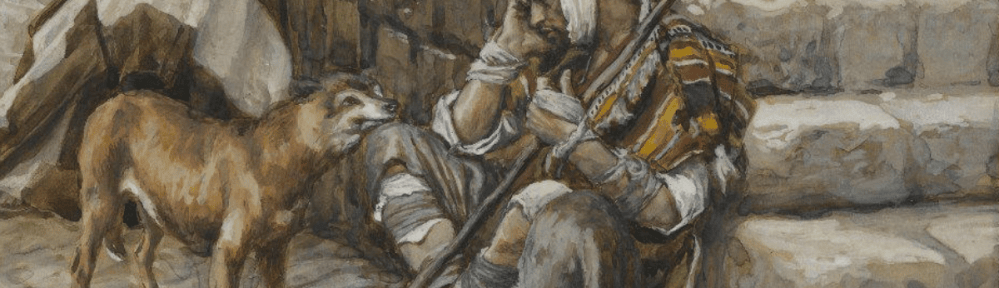
The Poor Lazarus at the Rich Man’s Door | James Tissot, 1886–1894 | Brooklyn Museum | PD-US
Discover more from friarmusings
Subscribe to get the latest posts sent to your email.
 friarmusings