What does the expression “church membership” bring to your mind? The expression carries different meanings across Christian denominations, depending on their theology, governance, and ecclesial identity. For mainline Protestant denominations (Methodists, Lutherans, Presbyterians, and Episcopalians) membership typically involves Baptism, Confirmation or profession of faith, and often, a formal joining ceremony. Members may be listed on membership rolls and such affords one voting privileges in congregational meetings and eligibility for leadership roles.
In Evangelical Churches (e.g. Baptists, Assemblies of God, or independent Bible churches) church membership is often voluntary, distinct from baptism (though baptism is usually a prerequisite). It involves a public profession of faith in Jesus Christ, believer’s baptism (by immersion), completion of a membership class, and a congregational vote or pastor’s approval. The emphasis is placed on active participation, accountability, and sometimes church discipline. Pentecostal and Charismatic Churches are similar to Evangelicals, but with more focus on the Holy Spirit’s work.
What about the Catholic Church? Church membership is not a voluntary affiliation but a sacramental reality; one becomes a member through Baptism with full communion via the Sacrament of Confirmation and participation in the Eucharist. There’s no formal “joining” ceremony later in life for baptized Catholics. There is OCIA for adults coming to the Church as either unbaptized or from other Christian traditions. Parish registration is sometimes called “membership” in practice, but it is administrative and not sacramental.
In the previous post we considered the Regent Hirohito and the time in which he lived before ascending the throne. It was a time where the founders and elder statesmen of the Meiji Reform were dying or being assassinated. There were centers of power/influence all seeking more power and influence: the military, civil government, the Diet (Parliament), the Imperial Court, and leaders in civil society. In a way this story is as old as time, but in Japan the democratic institutions were new and offered levers of power and influence that were not necessarily part of the fabric of Japanese history and life.
To understand how we arrive at the ultra-nationalist and militaristic Japan of the 1930s, we need to look at the Meiji Reforms and the role the Western powers played in the transformation of Japan.
This coming Sunday is the 23rd Sunday (Year C) with the gospel from Luke 14:25-33. These two parables are unique to Luke and are without parallel. Jesus draws attention to a simple observation: a prudent person would not begin a project until being sure it can be finished – neither a builder nor a king. In the first parable Jesus says, “Sit down and consider whether you can afford to follow me.” In the second he says, “Sit down and surmise whether you can afford to refuse my demands.” In the same way, God has not entered a redemptive process without being prepared to complete it. Jesus did not set his face to Jerusalem (9:51) without knowing and being prepared for his own Passion.
The two parables move from the lesser to the greater. In the first, the threat is that of embarrassment before one’s peers and neighbors. In the second, the consequence is the defeat at the hands of an enemy. In continuing the movement to the even greater, the implication is that one’s network of family or simply membership in a religious tradition is inadequate to assure one’s status before God. What is required is fidelity to God’s only Son.
As the War in the Pacific moves into 1945 it is clear that the Asia Pacific War will not end in victory for Japan. How will it end? For the Allies, the 1943 Casablanca Conference has already stated that the war in the Pacific will end in unconditional surrender as it soon will for Germany. But the nature of that war is different. Germany is virtually landlocked and is being pressed on its eastern, western and southern fronts. Japan is an island fortress. Japan sees the path leading to a decisive battle where either Japan wins or extracts such allied losses that the war ends at the negotiating table. It is like a high stakes hand of poker. The Allies have a strong hand but are they willing to go “all in” and invade the home islands as necessary. Japan is already committed to “all in” – or so it seems. But who is the hand holding the cards for Japan? Is it the Emperor, the Supreme War Council, the Military General Staff, or the Imperial Japanese Army across the far-flung empire?
We are at a point in this series when it is time for us to pause and return to the beginning to make sure we know the “hand holding the cards.” A good question is “how did it start.” And the answer is far more complicated than “when they attacked Pearl Harbor.”
This coming Sunday is the 23rd Sunday (Year C) with the gospel from Luke 14:25-33. The expression carry his own cross is a metaphor of discipleship. In terms of dedication, one is to live as already condemned to death, “oblivious to the pursuit of noble status, find no interest in securing one’s future via future obligations from others or by stockpiling possessions, free to identify with Jesus in his dishonorable suffering” [Green, 566].
Many scholars interpret “carrying the cross” as a vivid metaphor for complete renunciation of self-will and self-preservation. Roman crucifixion was public, humiliating, and painful. In the Roman world, carrying one’s cross was literally the path to execution—a condemned man would carry the beam of his own instrument of death. So Jesus’ words suggest that following Him requires being willing to lose one’s life, ambitions, or status. It is a stark image suggesting to his followers that a disciple should expect to walk as Jesus did: a path of suffering, shame, and possible martyrdom.
A previous post offered a brief discussion of a complicated issue – the governance of wartime Japan. Such governance was a complicated, ritual process involving Emperor Hirohito and the Supreme War Council (“Big 6”). In the shadows of the ritual were the Lord of the Privy Seal (Kido) and other confidants of the royal family. Rather than detail the process, it is perhaps best explained by decisions around Ketsu Go.
On January 20, 1945 there was an Imperial audience in which senior Army and Navy leaders briefed the Emperor on the strategic concept for Ketsu Go. This was not a formal Gozen Kaigi (Imperial Conference), but an Imperial audience in which senior Army and Navy leaders briefed Hirohito. The principals in attendance were War Minister Anami and Army Chief Umezu – both hardliners – and Navy Chief Toyoda who at his point was supportive of the Army’s position.
It was not a detailed plan, but a strategic overview of Ketsu-Go in the context of the war: Leyte Island in the Philippines had fallen, there was no doubt that Iwo Jima and Okinawa would soon be invaded, and routine bombing of the home islands by B-29s had begun. All indications were that the southern island of Kyushu would be invaded in the late-summer to early-autumn of 1944. Most likely after the end of typhoon season which traditionally “ended” November 1st.
This coming Sunday is the 23rd Sunday (Year C) with the gospel from Luke 14:25-33. Jesus’ command of love makes it unthinkable that he commands hating one’s family all the while commanding to love those we do not know and are even our enemy. As Culpepper [292] notes, one should understand the Semitic hyperbole always uses stark differences so that the contrast is more clearly seen. The term misein (hate) denotes attitudes and modes of action rather than emotions. The point is not how one feels towards one’s parents, but rather one’s effective attitude when it comes to the kingdom.” This becomes clearer in 16:13, “No servant can serve two masters, he will either hate one and love the other, or be devoted to one and despise the other. You cannot serve God and mammon.” This continues Luke 12:49-52 regarding division with the household caused by the proclamation of the reign of God.
Other scholars argue that “hate” is a Semitic expression meaning “love less” or “put in second place.” For instance: Genesis 29:30–31 says Jacob loved Rachel more than Leah, and in the next verse, Leah is said to be “hated.” This sense of “hate” aligns with Matthew 10:37: “Whoever loves father or mother more than me is not worthy of me…” — a softer but similar idea.
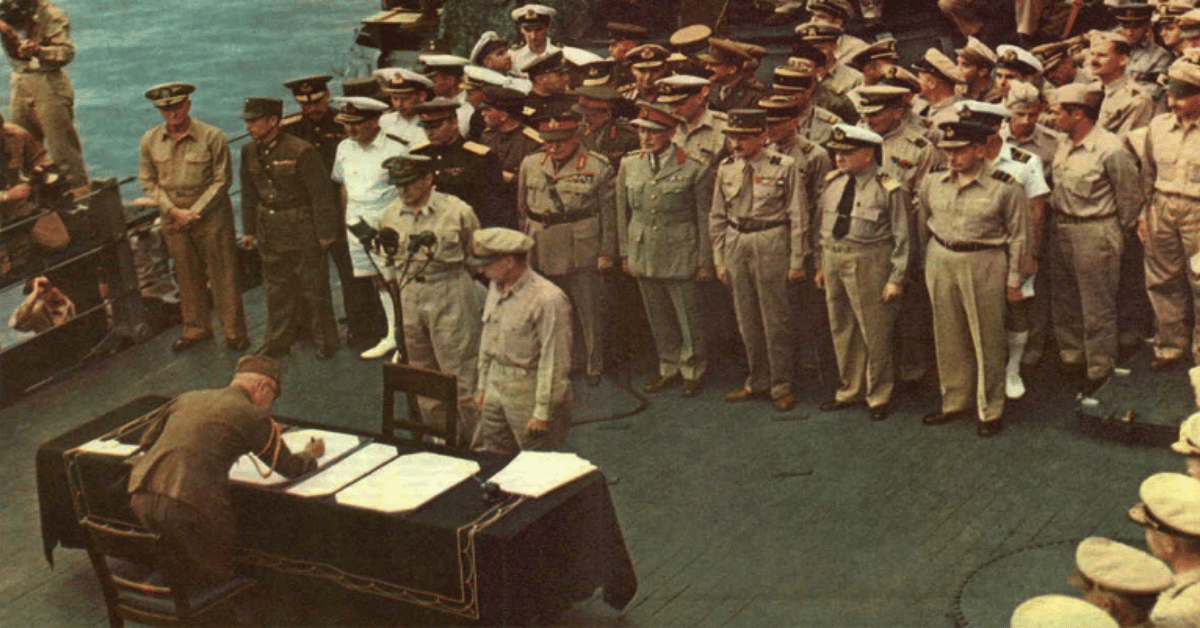
80 years ago today, September 2, 1945, the leaders of Japan signed the articles of surrender, ending the War in the Pacific. The treaty was signed aboard the USS Missouri anchored in Tokyo Bay. The document was signed by by representatives from Japan and from the Allied nations: the United States, Australia, New Zealand, China, the United Kingdom, the Netherlands, the Soviet Union, Canada, and France.
The document was first signed by the Japanese foreign minister Mamoru Shigemitsu and by General Yoshijirō Umezu, Chief of the Army General Staff. Both were later convicted of war crimes. Shigemitsu served 7 years but later served again as Japan’s foreign minister. Umezu was sentenced to life in prison. He died in prison from cancer on less than a year into his sentence.
The majority of all Japanese representatives present at the signing were later convicted of war crimes. Emperor Hirohito was not present at the ceremony.
Ketsu-Go (“Operation Decisive”) was Japan’s final defense plan in World War II. It outlined the defense of the Japanese home island. At this point in the war the plan is an Imperial Army-led plan with the Imperial Navy playing a limited role apart from Naval Aviation. As noted in the previous post, as from the outset of the war the Imperial Army was “in charge” – not only in the Supreme War Council but in operational planning.
The goal of Ketsu-Go was to mass Japan’s remaining troops, planes, and special attack units (kamikaze) to repel the invasion, especially on the southern island of Kyushu, expected to be the first invasion point – as it would be in the Allied plan for invasion. The hope of Ketsu-Go was to make the battle so bloody and costly for the Allies that they would lose the will to continue the invasion and offer better surrender terms than complete and absolute surrender. At stake was Kokutai, an expression that literally means “national body” or “national essence”. This is explored in greater detail in the next post, but sufficient for now, this concept was not differentiated from the Emperor and the royal household.
In Ketsu-Go there was a fundamental realization that this would not be a repeat of their 1905 naval victory at Tsushima but only a last ditch effort to achieve what was always the goal of the original Kantai Kessen – an armistice with the United States that left Japan and its early war gains intact. Ketsu-Go would run head-long into the Allied demand for unconditional surrender that had no intention of leaving Japan militarized or with any of its early war gains. The allied demand for unconditional surrender had already been decided at the Casablanca Conference two years earlier (January 1943).
In addition there was a more fundamental issue at play: the idea of surrender. For the western soldier, surrender was not good, but it was logical. When the circumstances indicated that you’d run out of options the only “reasonable” options were retreat (live to fight another day) or simply live and place yourself at the mercy of your captor. For the Japanese soldier, surrender was the greater shame. The view was grounded in a complex mix of military indoctrination, cultural values, and fear of dishonor. Surrender was considered not only shameful but a betrayal of one’s duty to the Emperor and nation – to the Kokutai.
This difference was clear from the beginning of the war. Consider General Wainwright’s decision to surrender the Bataan Peninsula (Philippines) at the beginning of the war. The Filipino and American troops were out of ammunition and food; further resistance meant sure death. Their Japanese captors considered them shameful cowards who had betrayed their country – and were treated as such, the Death March of Bataan giving ample evidence.
The Japanese resolve to not surrender was experienced in every land battle from Guadalcanal to Okinawa. In campaigns such as Tarawa, Biak, Kwajalein, Saipan, Tinian, Guam, Peliliu, Iwo Jima, and Okinawa fewer than 2% of the Japanese garrison was captured. The remainder fought to the death. At the same time the casualty rates among allied ground troops in the Pacific were rising especially in comparison to the European Theater of Operations. Here are comparative casualty rates:
D-Day Normandy France – 6-7%
Tarawa – 20%
Peliliu – 35%
Iwo Jima – 37%
Okinawa – 27%
These differences were well known to the American public.
From the high-levels of strategy to the on-the-ground reality of war, the mindset of the warring parties could not be farther apart. Ketsu-Go was not a strategy to win a battle or defend the Japanese home islands from devastation and death. It was a strategy to exact a high price of Allied casualties to avoid the shame of surrender. Ketsu-Go reflected a mindset that, if implemented, would extract an unimaginable price in human life and leave the survivors with scars for a lifetime.
Ketsu-Go was first presented to the Emperor in January 1945. In the background of the plan was the uniquely Japanese concept of kokutai.
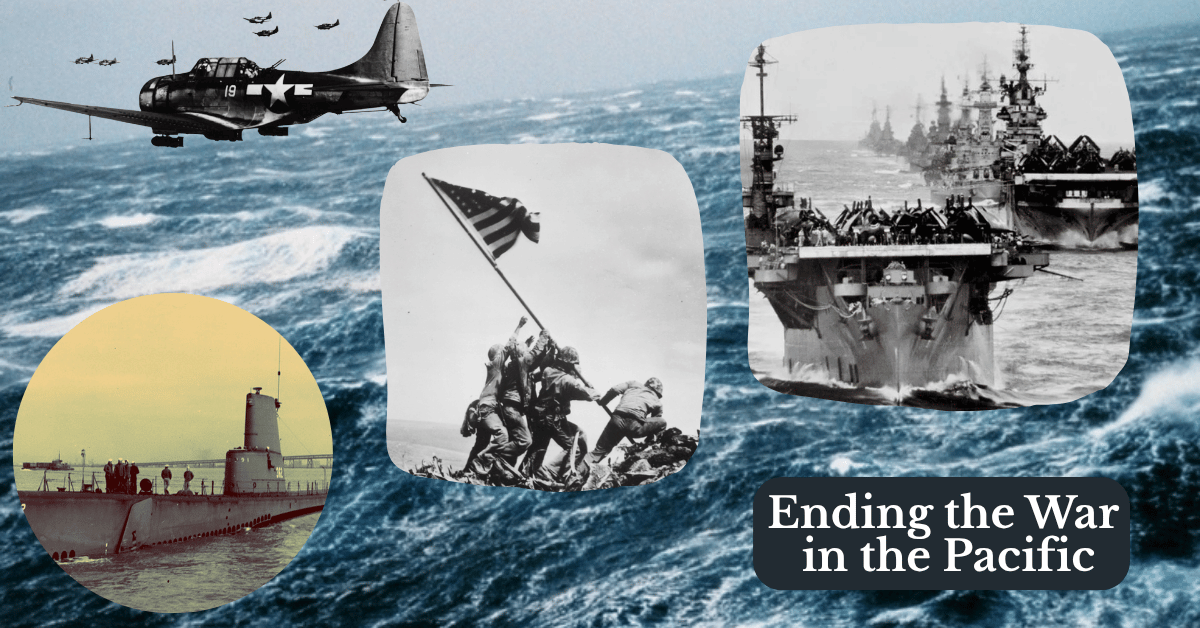
Image credit: various photographs from Naval Aviation Museum, National World War II Museum, and US Navy Archives.
This coming Sunday is the 23rd Sunday (Year C) with the gospel from Luke 14:25-33. Many scholars tag these verses as “The cost of discipleship.” They are unique and peculiar to Luke, focusing on the total dedication necessary for the disciples of Jesus. It must be remembered that Jesus is on the way to Jerusalem and has already predicted his death; so too should the disciples be prepared to leave all behind and make their commitment to the journey that will unfold before them.
Joel Green [564] notes that there are “important topical connections between the current narrative unit and the preceding one. Particularly in Jesus’ story of the great banquet (vv 15–24), he had introduced the possibility that one’s ties to possessions and family might disqualify one from enjoying the feast. As Jesus turns to address the crowds traveling with him, he lists allegiance to one’s family network and the shackles that constitute one’s possessions as impediments to authentic discipleship. Albeit for a different audience, then, Jesus posits the necessity of a corresponding transformation of life in both instances. This conjunction of emphases reminds us that the new practices counseled by Jesus in vv 7–14 are not isolated behaviors but, from Luke’s perspective, must flow out of a transformed disposition, reflecting new commitments, attitudes, and allegiances. That is, the conversion that characterizes genuine discipleship is itself generative, giving rise to new forms of behavior.”
It is here among the crowds of people that Jesus continues to teach discipleship to would-be disciples. Jesus makes no attempt to lure them, rather he makes clear that the way is not easy. Several phases reoccur in these verses:
“If any one comes to me [and does not] … he cannot be my disciple”(v.26)| “Whoever does not … cannot be my disciple.” (v.27) “everyone of you who does … cannot be my disciple.” (v.33)
The three conditions laid down concern renouncing family ties that would prevent one from becoming a disciple, bearing one’s cross, and forsaking possessions. Between the second and third sayings twin parables illustrate the folly of failing to consider the cost of an undertaking: the tower builder (vv.28-30) and the king going to war (vv.31-32). The form of the question points to the expected answer for each, “No one, of course” (cf. 11:5, 11; 14:5; 15:4, 17:7). Verse 33 is the conclusion: we must renounce all that keeps us from the fullness of discipleship.

 friarmusings