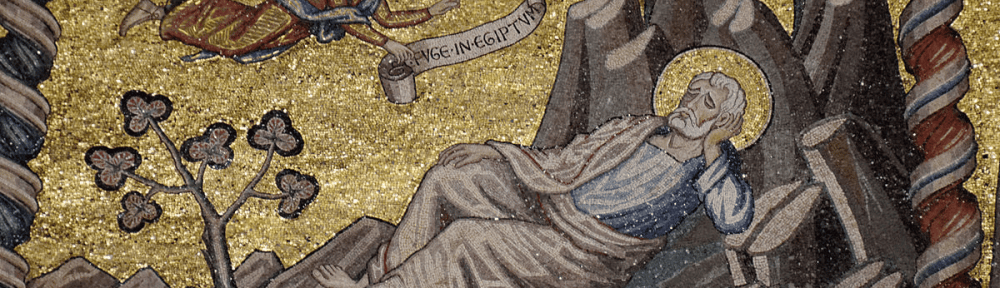
Our gospel is the traditional reading for the 4th Sunday of Advent (year A) and thus, in addition to its biblical context, this reading also carries a seasonal meaning.
A Seasonal Context: The Fourth Sunday of Advent always tells part of the story that just precedes the birth of Christ. These familiar episodes set the stage for one of the Bible’s best-known passages, the story of Christmas. This reading, as well as the gospels for the 4th Sunday in Advent in the other years, aligns well with the readings of the seven days of Advent that immediately precede Christmas. Not only do the readings for the daily Masses just before Christmas include the beginnings of the Gospel infancy narratives (Matthew 1 on Dec. 17-18; Luke 1 on Dec. 19-24), but we again get to hear the traditional “O Antiphons,” at Mass.
Most familiar these days from the popular hymn, “O Come, O Come, Emmanuel,” the “O Antiphons” are more than a thousand years old. Curiously, the first verse of the familiar hymn is actually the last of the traditional “O Antiphons” while the other verses of the hymn (in the order printed in most hymnals) correspond to the Antiphons for Dec. 17 to 22:
Dec. 17: O Sapientia / O Wisdom from Evening Prayer
Verse 2: O Come, Thou Wisdom, from on high from the popular hymn
Dec. 18: O Adonai / O Sacred Lord of ancient Israel
Verse 3: O Come, O Come, Thou Lord of might
Dec. 19: O Radix Jesse / O Flower of Jesse’s stem
Verse 4: O Come, Thou Rod of Jesse’s stem
Dec. 20: O Clavis David / O Key of David
Verse 5: O Come, Thou Key of David, come
Dec. 21: O Oriens / O Radiant Dawn
Verse 6: O Come, Thou Dayspring from on high
Dec. 22: O Rex Gentium / O King of all the nations
Verse 7: O Come, Desire of nations…
Dec. 23: O Emmanuel / O Emmanuel
Verse 1: O Come, O Come, Emmanuel
The gospel readings for the 4th Sunday, the gospels for those weekday readings, and the “O Antiphons” all begin to answer the question of Advent: who is coming? Our gospel reading for the 4th Sunday of Advent (Year A) provides it contribution to the larger answer: Jesus Christ (v.18), son of Mary (v.18), adopted son of Joseph (v20), son of David (v.20), named Jesus (v.21), the one who will save his people from their sins (v.21), and Emmanuel…God with us (v.22).
An Old Testament Context
A key element of the biblical context is Matthew’s use of Isaiah 7:14 in v.23 of the gospel. In the Christian understanding we are called to see the prophecy given centuries before to Isaiah now come to messianic fulfillment in Jesus. The first reading for this Advent Sunday, Isaiah 7:10-14, contains the kernel of the Matthean reference: The LORD spoke to Ahaz, saying: Ask for a sign from the LORD, your God (Is 7:10)
King Ahaz. Ahaz was the great-great-grandson of Saul, the first king of the tribes of Israel. Ahaz reigned as King of Judah (“the southern kingdom”) in the mid-to-late 8th century BC. His name (˒āḥāz) is a shortened form of names such as Ahaziah and Jehoahaz, “the LORD holds.” These names probably reflect confidence in God’s imminent presence, as in Ps 73:23, “I am always with you, you hold (˒āḥaztā) my right hand.”
The opening verse of Isaiah 7 refers to the campaign of Syria (Aram) and northern Israel (Ephraim, “the northern kingdom”) against Judah during the reign of Ahaz. The campaign in question took place between 735 and 733 BC (see 2 Kings 16) and is known as the Syro-Ephraimite war. Syria and Israel had already been paying tribute to Assyria since 738 BC but had now decided to revolt by withholding payment. Judah had refused to join the alliance. As yet Ahaz had no quarrel with Assyria, and in any case hopes of success were remote. Israel and Syria then attempted to overthrow Ahaz and replace him with a king more amenable to their wishes.
What is important to our understanding is that rather than rely upon God, Ahaz submitted to Assyrian power as its protector. While that enabled Judah to survive the catastrophe which overtook the northern kingdom in 722 BC, it took the God’s chosen people farther from the covenant. It was not only in this matter that Ahaz led the people astray. The Books of 2 Kings and 2 Chronicles detail his reign and provide an assessment of King Ahaz:
- He placed an altar from Damascus into the Jerusalem temple (2 Kings 16:10–16) and began to introduce Canaan indigenous cultic worship, thus perverting the worship of God. Ahaz’s sacrificial cult is described in 2 Chronicles 28:23 as being carried out in honor of the “gods of Damascus.”
- Ahaz is also seen as reviving the cult of child sacrifice associated with Molech. The phrase “he made his son pass through the fire” is taken as a reference to child sacrifice rather than some ritual ordeal.
- He is condemned with the standard assessment that “he did not do what was right in the eyes of the LORD …,”
- Even further, as a King of Judah, is further reviled by being compared in his wickedness to the kings of the north/Israel/Ephraim (2 Kings 16:3; see 2 Kings 8:18).
Ahaz added significantly to this spiral of decline of the covenant people – so much so that 2 Kings and 2 Chronicles devote significantly more verses to his condemnation than the usual reign of a Judean king. The significance of 2 Kings 16 is that it stands immediately before the important editorial section in 2 Kings 17 detailing the destruction of the Northern Kingdom (“Israel”) for its apostasy. The present context, therefore, highlights that the Southern kingdom is progressing at an ever increasing rate to be an apostate state, soon to meet a similar fate.
Image credit: Ceiling detail Battistero di San Giovanni | Florence | 13th century | photo by Marie-Lan Nguyen |Wikimedia Commons | CC-BY 2.5
Discover more from friarmusings
Subscribe to get the latest posts sent to your email.
 friarmusings