In the previous post we spent a good deal of time introducing King Ahaz – he was not the best of kings. That was being nice. He was awful. He was judged to be comparable in wickedness to all the wretched kings of Judah and Israel. In this context it is easy to see why the prophet Isaiah views Ahaz as one who lacks faith and trust in God, and in this way the king becomes a symbol of the people of God, who in the face of the Assyrian threats are becoming a people who also lack faith and trust in God. The king and the people depended upon the legacy of the Davidic dynasty as the sign of their “covenant” with God. Their ideology professed a sublime confidence God would protect his chosen king and city…no matter what. This can be seen in Psalm 46:1–4:
God is our refuge and our strength,
an ever-present help in distress.
Therefore we fear not, though the earth be shaken
and mountains plunge into the depths of the sea . . . .
The Lord of hosts is with us;
our stronghold is the God of Jacob.
Such a profession is easily made when there is no immediate danger. Faced with an actual invasion, however, “the heart of the king and the heart of the people trembled, as the trees of the forest tremble in the wind” (Isa 7:2).
At this juncture Isaiah goes to meet Ahaz, who is apparently checking his water supply in anticipation of a siege. Isaiah is accompanied by his son, whose name, Shear-jashub, means “a remnant shall return” – perhaps ironically pointing to the future days of exile? Isaiah’s advice to the king is startling. He does not suggest the course that Ahaz would eventually take, to appeal to Assyria for help (2 Kings 16:7). Instead, he tells him to “remain tranquil and do not fear” (7:4) because the attack will not succeed and the state of northern Israel will soon come to an end. The divine commitment to make the Davidic line “firm” (2 Sam 7:16) is conditional on the faith of the king.
The Birth of a Child. Isaiah then offers Ahaz a sign to assure Ahaz that if he remains faithful to God and trusts in the power and ways of God, then Ahaz’s reign will remain firm. The king knows that to ask for a sign means he must give up control and trust God. Isaiah proceeds to give it even when the king refuses to ask for it. The sign is that a young woman will bear a son who will be “living on curds and honey by the time he learns to reject the bad and choose the good” (7:15). The mother is called an almah in the Hebrew, that is, a young woman of marriageable age, though not necessarily a virgin. The Greek translation of Isaiah used the word parthenos, which means “virgin” unambiguously, and this translation is cited in Matt 1:22–23 and formed the basis of the traditional Christian interpretation of this text as a prophecy of the birth of Christ. The Hebrew language version of Isaiah, however, does not suggest that the birth in itself was miraculous.
Since the sign was given to Ahaz, we must assume that the young woman in question was known to him. There are two possible identifications. The first is the prophet’s wife. We know that the prophet gave symbolic names to his children. The second is the king’s wife. The name Immanuel, “God is with us,” could serve as a slogan for the Davidic house. While the prophet could predict the name of his own child more confidently, a royal child would be the more effective sign for the king. While either identification is possible, it seems more probable that the woman in question was one of Ahaz’s wives.
The child about to be born will be “living on curds and honey by the time he learns to reject the bad and choose the good” (7:15). While this is a disputed point, the majority of scholars hold that “by the time” refers to a young child of 3 to 6 years old. This gives the sign some urgency, “For before the child learns to reject the bad and choose the good, the land of those two kings whom you dread shall be deserted.” In other words, if Ahaz is patient and trusts, within a few years his two enemies, Syria and Israel/Ephraim will be defeated
The Meaning of the Sign. The land of Israel was proverbially “a land flowing with milk and honey” (Exod 3:8; 13:5; Num 13:27; Josh 5:6). Such food would appear abundant to nomads from the wilderness; it would surely seem spartan to a king accustomed to live in luxury. The implications of the diet of curds and honey can be seen in Isa 7:21–25: those who remain in the land will have to live on its natural produce, since cultivation will be impossible. Curds and honey will be the only available food. The phrase “On that day” (7:20, 21) suggests that the coming destruction is “the day of the Lord,” but it is clear that the instrument of destruction is “the razor hired from across the River” (7:20) — the Assyrians. Isaiah not only predicts that Syria and Israel will be destroyed but also that Judah will suffer “days worse than any since Ephraim seceded from Judah” (7:17). It would seem from 7:18–20 that the real menace to Judah is seen to come from the Assyrians rather than from the Syro-Ephraimite coalition.
What, then, is signified by the birth of Immanuel? Evidently the name “God is with us” is not a promise that God will shelter the king from all harm if only he has faith; rather, it is an ambivavlent sign. The presence of God is not always protective. It can also be destructive, as on the “day of the Lord.” Yet it is not entirely destructive. The birth of a child is perhaps the most universal and enduring symbol of hope for the human race. The newborn child does not contribute to military defense or help resolve the dilemmas of the crisis, but he is nonetheless a sign of hope for a new generation. The prophet predicts that he will reach the age of discernment, however bad the times may be. Even if cultivation becomes impossible, people will survive on curds and honey. Moreover, they can recall a time at the beginning of Israel’s history when such a diet was seen as a bountiful gift of God. Isaiah prophesies that the vineyards, worth thousands of pieces of silver, will be overgrown with thorns and briers. This would be a loss to the ruling class but not necessarily to the common people. The demise of the vineyards might mark a return to a simpler lifestyle, in which Israel and Judah would be less wealthy, but also less torn by social oppression and less entangled in international politics.
Isaiah’s advice to Ahaz, then, is to wait out the crisis, trusting not for miraculous deliverance but for eventual survival. The prophet probably feels that there is no need to fight against Syria and Israel, Assyria will take care of them. Reaching out to Assyria is probably also unnecessary and would bring Judah directly into subjection. In the meantime Judah might be ravaged and reduced to near wilderness, but life would go on, and the society would be purified in the process.
Ahaz, of course, does not follow Isaiah’s advice. He sends gold and silver to the king of Assyria and becomes his vassal. Damascus is destroyed. Samaria survives only because a coup puts a new king on the throne, but even then it survives for a mere decade. The politics of Ahaz seem to work well enough for the present, but Isaiah would surely hold that they do not go to the heart of the matter.
The figure of Immanuel in Isaiah 7 is not presented as a messianic figure, although he probably was a royal child. Nothing is said of his future reign. Instead, he is a symbol of hope in weakness, of new life in the midst of destruction. When early Christianity read this passage as a prediction of the birth of Jesus, it implied an analogy between the two births. In the Gospels, too, a birth in inauspicious circumstances was nonetheless taken as a sign of the presence of God.
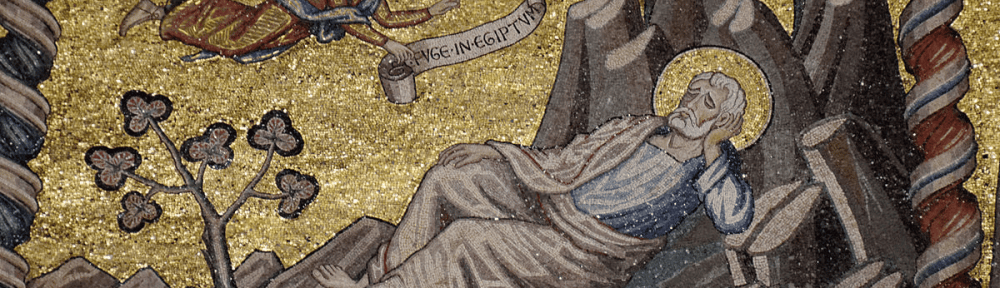
Image credit: Ceiling detail Battistero di San Giovanni | Florence | 13th century | photo by Marie-Lan Nguyen |Wikimedia Commons | CC-BY 2.5
Discover more from friarmusings
Subscribe to get the latest posts sent to your email.
 friarmusings