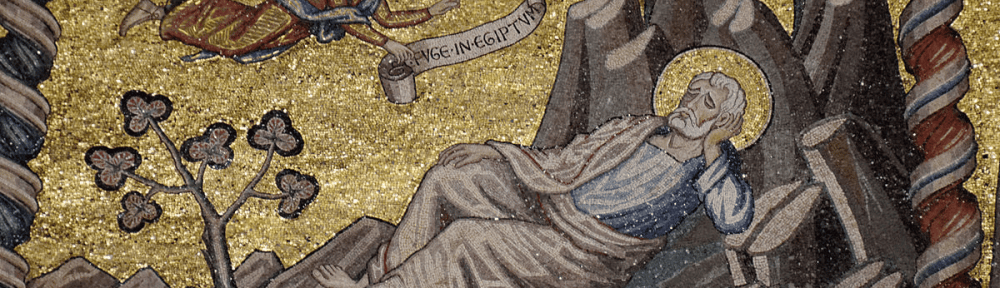
The two previous posts did a “deep dive” into the first reading for the 4th Sunday of Advent (Isaiah 7:10-14) – “the Lord himself will give you this sign: the virgin shall conceive, and bear a son, and shall name him Emmanuel” – as a means to provide the Old Testament background for Matthew’s use of the quote as fulfillment. Keep in mind that our passage follows immediately upon Matthew’s genealogy of Jesus (1:1-17) – which notably says in v.9, “Jotham the father of Ahaz, Ahaz the father of Hezekiah.” Our gospel and Matthew’s genealogy are intentionally connected by Matthew. Our translation in Mt 1:1 is “The book of the genealogy of Jesus Christ, the son of David, the son of Abraham.” A more literal translation would be, “A book of the genesis of Jesus Christ, son of David, son of Abraham.”
Matthew could have used other words for “genealogy” or “birth,” but he used this word, which is also the Greek title of the first book of scriptures. Similar wording is in the LXX at Gn 2:4 “This is the book of the genesis of heaven and earth;” and in 5:1 “This is the book of the genesis of human beings. In the day God made Adam, according to the image of God he made him.” Matthew intended a connection between these two sections of chapter 1 and with the first book of scriptures. This is a new beginning, a new creation.
In this new creation there is something different. Throughout verses 1-16a, Matthew has used egennesen 39 times (aorist, active of gennao, which means: when used of the male role = “to beget,” or “to become the father of”; of the female role: “to give birth”). In 16b the grammar changes. He does not write, “Joseph begat Jesus,” which we might expect after 39 times; but rather he uses egennethe (aorist, passive of gennao) “the father of Joseph, the husband of Mary. Of her was born Jesus who is called the Messiah.” We already have a hint that there is something different about this birth from all those that went before.
The genealogy at the beginning of the Gospel establishes Jesus’ place within the Jewish tradition. Jesus is the son of Abraham and of David as well as the continuation of David’s line after the exile of 587 BC Israel’s history is traced from its beginning with Abraham (v.2), through its high point with King David (v.6) and its low point in the Babylonian Exile (v.11), to its fulfillment in Jesus the Messiah (v.16). Thus the genealogy of Jesus stresses the continuity of Jesus with the great figures of God’s people (“son of Abraham … son of David”), and it also prepares for the very irregular and indeed unique birth narrated in verses to follow.
Joseph and Jesus
Matthew’s gospel does not describe the birth of Jesus, but explains his origin (the virgin conception) and his name in relation to a specific Old Testament prophecy. The passage concentrates entirely on the experiences of Joseph rather than those of Mary. Even the miraculous conception of Jesus is related only as its discovery affected Joseph. This remarkable concentration, compared with the complete silence on Joseph elsewhere, indicates Matthew’s concern to establish Jesus’ legal lineage through Joseph, i.e. to explain how the preceding genealogy applies to Jesus the son of Mary.
Jesus is “son of David” because of his genealogy, yet Joseph didn’t “begat” him! The Davidic descendancy is not transferred through natural paternity but through legal paternity. “By naming the child, Joseph acknowledges him as his own. The Jewish position on this is lucidly clear and is dictated by the fact that sometimes it is difficult to determine who begot a child biologically. Since normally a man will not acknowledge and support a child unless it is his own, the law prefers to base paternity on the man’s acknowledgment. The Mishna Baba Bathra 8:6 states the principle: ‘If a man says, “This is my son,” he is to be believed.’ Joseph, by exercising the father’s right to name the child (cf. Luke 1:60-63), acknowledges Jesus and thus becomes the legal father of the child” (Brown, p. 139).
Image credit: Ceiling detail Battistero di San Giovanni | Florence | 13th century | photo by Marie-Lan Nguyen |Wikimedia Commons | CC-BY 2.5
Discover more from friarmusings
Subscribe to get the latest posts sent to your email.
 friarmusings