That Jesus was conceived by a virgin mother without the agency of Joseph is clearly stated throughout this section, and is the basis for the introduction of the quotation in vv. 22–23.
22 All this took place to fulfill what the Lord had said through the prophet: 23 “Behold, the virgin shall be with child and bear a son, and they shall name him Emmanuel,” which means “God is with us.”
In the text this not so much argued or even described, but assumed as a known fact. There may be an element of apologetic in Matthew’s stress on Joseph’s surprise, his abstention from intercourse, the angel’s explanation of Jesus’ divine origin, and the scriptural grounds for a virgin birth, due perhaps to an early form of the later Jewish charge that Jesus’ birth was illegitimate (see Brown, pp. 534–542). But the account reads primarily as if designed for a Christian readership, who wanted to know more precisely how Mary’s marriage to Joseph related to the miraculous conception of Jesus, and Christians who would find the same delight that Matthew himself found in tracing in this the detailed fulfillment of prophecy.
The suggestion that the virgin birth tradition is an imaginative creation by Matthew or his predecessors on the basis of Isaiah 7:14 is precluded not only by this assumption of it as a known fact in Matthew’s narrative, but also by its appearance in a completely different form in Luke 1:26–56; 2:5. Further, vv. 22–23, where Isaiah 7:14 is introduced, are clearly an explanatory addition to the narrative, which would flow smoothly from v. 21 to v. 24 without these verses, and not the inspiration for it. Suggestions that the tradition derives from pagan stories of gods having intercourse with women ignore both the quite different tone of such stories, and the impossibility of their being accepted in a Palestinian Jewish setting; yet the Gospel accounts are both intensely Jewish in their contents and expression.
Betrothal
Engagement or betrothal in Jewish society of Jesus’ time involved a much stronger commitment than it does in modern Western society. The description of Joseph’s embarrassment and his plans in vv.18–19 may presume his suspicion that Mary had been raped or seduced. As a devout observer of the Old Testament law, Joseph could not take Mary as his wife (see Deut 22:23–27). Not wishing to subject Mary to the shameful trial of the woman suspected of adultery (Num 5:11–31), he decided to forgo the public procedure and took upon himself the responsibility for the divorce. (The “Notes” section contains more information on Jewish betrothal/marriage customs and divorce.)
The dreams of Scripture
Dreams are an important means of divine communication in both the Old and New Testaments. They often mark moments when God intervenes to reveal His will, warn, or guide individuals in salvation history. Here are some prominent example:
Abimelech, King of Gerar: “But God came to Abimelech in a dream one night and said to him, ‘You are about to die because of the woman that you have taken; for she is a married woman.’” (Gen 20:3) God warns Abimelech not to take Sarah, Abraham’s wife. The dream protects the covenant promise through Sarah’s integrity.
Jacob’s Ladder: “Then he had a dream: a stairway rested on the ground, with its top reaching to the heavens; and God’s angels were going up and down on it.” (Gen 28:12) Jacob dreams of a connection between heaven and earth is the message that God is renewing the Abrahamic covenant with him, which marks Jacob’s awakening to God’s ongoing presence.
Joseph, Son of Jacob: “Once Joseph had a dream, and when he told his brothers, they hated him even more.” (Gen 37:5) and also “Then Pharaoh said to Joseph: ‘I had a dream… no one can interpret it.’” (Gen 41:15) Joseph’s dreams foretell his rise and his family’s dependence on him; later, his gift for interpreting Pharaoh’s dreams saves nations from famine. Joseph becomes a model of divine wisdom revealed through dreams.
These are just a few examples of dreams conveying God’s messages to people. Other OT examples are Gideon (Judges 7:13–15), Solomon’s Dream of Wisdom (1 Kings 3:5–15), the Prophet Daniel’s experience with Nebuchadnezzar (Daniel 2, 4, 7) and his own vision of the coming of the Son of Man (Dn 7:13). There are New Testament examples also such as Pilate’s wife’s dream about the innocence of Jesus (Matthew 27:19), Paul’s dream to go to Macedonia (Acts 16:9), Paul’s dream in which the Lord tells him: ‘Do not be afraid. Go on speaking, and do not be silent, for I am with you.’” (Acts 18:9–10)
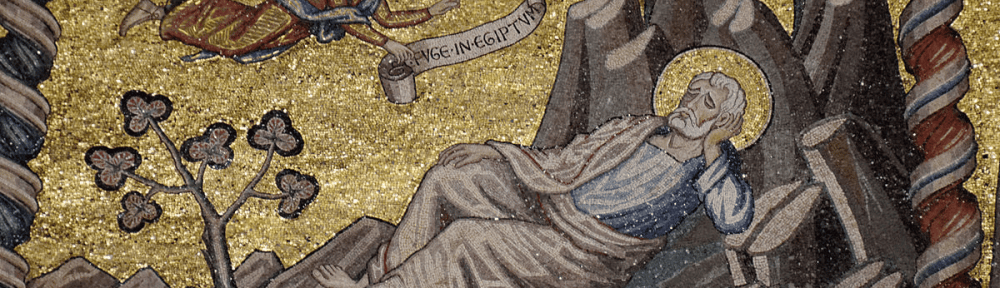
Then there are the four dreams in which Divine Intention comes to Joseph.
First dream: In Matthew 1:20–21, Joseph is told not to be afraid to take Mary as his wife, because she has conceived by the Holy Spirit. (See also the Annunciation in Luke 1:26–38, when an angel visits Mary and she agrees to conceive “through the power of the Most High”.)
Second dream: In Matthew 2:13, Joseph is warned to leave Bethlehem and flee to Egypt.
Third dream: In Matthew 2:19–20, while in Egypt, Joseph is told that it is safe to go back to Israel.
Fourth dream: In Matthew 2:22, because he had been warned in a dream, Joseph awakens to depart for the region of Galilee instead of going to Judea.
Image credit: Ceiling detail Battistero di San Giovanni | Florence | 13th century | photo by Marie-Lan Nguyen |Wikimedia Commons | CC-BY 2.5
Discover more from friarmusings
Subscribe to get the latest posts sent to your email.
 friarmusings