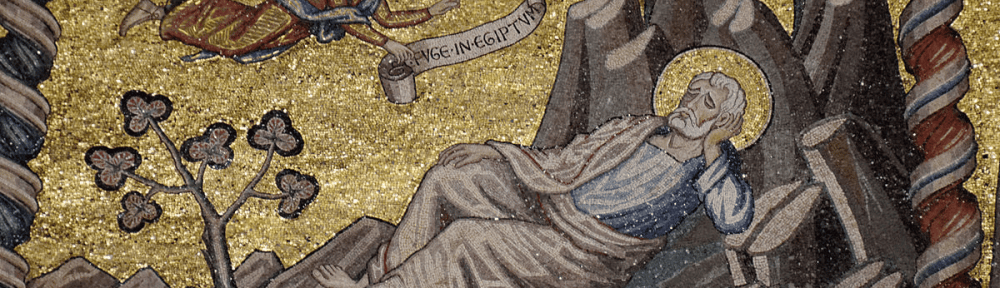
24 When Joseph awoke, he did as the angel of the Lord had commanded him and took his wife into his home. 25 He had no relations with her until she bore a son, and he named him Jesus.
All Christian denominations adhere to the Virgin Birth of Jesus; it is essential orthodoxy. The controversy about the perpetual virginity of Mary arises out of later interpretations of “until” in v. 25. Some argue that afterwards normal marital relations existed. In the English use of “until” something is negated up to a point in time, occurrence after that time is normally assumed. However, the expression (heōs hou) and its Semitic counterpart have no such assumption. In any case, the immediate Matthean context should be taken as silent on any future implication given Matthew’s stress on Mary’s virginity so that the Isaian prophecy is fulfilled.
The Virgin Birth was universally held in the earliest Church and confessed in The Apostles’ Creed and The Nicene Creed (325 A.D.) and its expansion at Constantinople (381 A.D.). These creeds enshrine the doctrine, showing it was not under dispute at the time but affirmed as essential to Christian faith — particularly as a testimony to Christ’s true humanity and divine origin. To be clear, The Nicene Creed says:
“He was incarnate and was made man.” The phrase “born of the Virgin Mary” appears in the expanded Creed of Constantinople. The council was not addressing the Virgin Birth itself but the Arian heresy, which denied the full divinity of the Son.
“..until she bore a son..” is the verse which gives rise to controversy. The Perpetual Virginity — that Mary remained a virgin before, during, and after the birth of Jesus — is not explicitly stated but inferred by early Christians from Scripture and reverence for the Incarnation. The non-canonical, apocryphal, Protoevangelium of James (ca. 150 A.D.) presented Mary as a temple virgin, vowed to perpetual chastity, and her virginal integrity is miraculously preserved during childbirth. While not canonical, this text may have shaped early Christian imagination and Marian devotion — it’s the first clear literary witness to belief in her perpetual virginity. In their writings Irenaeus of Lyons (Against Heresies 3.22.4, 180 A.D.) and Clement of Alexandria (Stromata 7.16, 200 A.D.) are not explicit, but seem to point to perpetual virginity.
In Commentary on Matthew 2:17, Origen defends the idea that Jesus’ “brothers” were not children of Mary but of Joseph from a previous marriage: “They thought they were sons of Joseph, but in truth they were not sons of Mary.” This is the first explicit defense of her virginity after Jesus’ birth in an exegetical context.
In Discourse Against the Arians 2.70, Athanasius (c. 360 A.D.) wrote: “He took a body of the Virgin Mary, who ever remained a virgin.” In On Holy Virginity 4, Augustine wrote: “Mary remained a virgin conceiving her Son, a virgin bearing him, a virgin pregnant, a virgin bringing forth, a virgin perpetual.” Augustine’s formula became the standard Western expression of the doctrine.
There were local synods (e.g. Milan, 390 A.D.) that affirmed the teaching as well as the Second Council of Constantinople (553 A.D.), referring to Mary as Aeiparthenos (“Ever-Virgin”). But the first Ecumenical Council to declare a formal, conciliar definition was the Lateran Council (A.D. 649): “If anyone does not, in accord with the holy Fathers, confess that the holy and ever-virgin and immaculate Mary … conceived by the Holy Spirit without seed, and incorruptibly bore, and her virginity remaining indestructible, let him be anathema.” The doctrine was affirmed by the Second Council of Lyons (1274) and Florence (1439) which repeated the phrase “ever virgin.”
Other notable Scripture passages that raise questions include “first-born son” (Luke 2:7) implying there were later children. But the Greek prototokos (“first-born”) was a legal title for the male child who opened the womb, even if there were no later children (cf. Ex 13:2). Also, the expression “brothers of Jesus” (e.g., Mark 6:3; Matt 13:55) is raised. St. Jerome responded to this challenge noting that the Greek adelphoi can mean kinsmen or step-brothers. In Against Helvidius Jerome argues these “brothers” were either cousins (children of Mary of Clopas) or Joseph’s children by an earlier marriage.
Some Reflections
The virginal conception of Jesus can not stand as a proof of the Christian claim that Jesus is the “Son of God.” It is not a matter of “proof” but trust. Nor does Matthew seem to intend it as such. Matthew bases no theological claims upon the virgin birth and the birth is never again a reference in his gospel. Yet the claim of supernatural conception is not incidental. It is one of the ways Matthew has of confessing that Jesus is the Son of God. Matthew has others, e.g. the Apostle Peter confesses the fundamental Christian faith that Jesus is “the Christ, the son of the living God” (16:16) because it was revealed to him by God in heaven. In the whole of Scripture, for Matthew, the story of Jesus is speaking about God – that God is with us.
Matthew begins and ends his narrative with the fragile human life of Jesus surrounded by God in both the birth story and the Passion account – each of which points to God as the hidden actor of the deeper story.
A simple message often gets lost in commentaries – even this one! We are to look to the example of Joseph’s obedience. The narrative emphasises Joseph “rose from sleep and did as the angel commanded” (v24). Joseph’s response to God’s message is immediate. There is no hesitation, no weighing of alternatives, no delay. In quiet faith, he rises from sleep and acts. His obedience is not merely compliance but trust — trust that what God asks, God will also sustain.
In that moment, Joseph becomes a model for all believers. He teaches us that godliness is not measured by eloquent words or lofty feelings, but by ready obedience. When God speaks, be it through Scripture, conscience, or circumstance, the holy person listens and acts without delay.
Joseph’s swift obedience protects the mystery of the Incarnation itself. Because he did not postpone his response, the Child and His Mother were safe, and God’s plan moved forward in time through a man’s humble faith. In the same way, every time we act promptly on God’s word, His grace advances in our lives and in the world. The holy person is one who, like Joseph, wakes and acts.
Image credit: Ceiling detail Battistero di San Giovanni | Florence | 13th century | photo by Marie-Lan Nguyen |Wikimedia Commons | CC-BY 2.5
Discover more from friarmusings
Subscribe to get the latest posts sent to your email.
 friarmusings
Sleep and dream in the Bible is my favourite… I always say my nighttime prayer “Come Holy Spirit come, come into my dreams.” Thank you for the commentary.