This coming Sunday is the celebration of The Epiphany of the Lord. In the previous post we considered a non-traditional look at the magi. Today we consider the star they followed.
The idea that the birth and death of great figures were accompanied by astral phenomena was widely accepted in ancient societies. The “star at its rising” has been variously interpreted as a new star (supernova), a comet, or the conjunction of the planets Jupiter and Saturn. Matthew likely draws upon the Old Testament story of Balaam, who had prophesied that “A star shall advance from Jacob” (Numbers 24:17), though in that verse the star means not an astral phenomenon but the king himself. The magi saw the star ‘at its rising’
Attempts to identify the ‘star’ as a regular astronomical phenomenon have generally focused on three possibilities: (1) A planetary conjunction (of Saturn and Jupiter) in 7 bc. (2) A comet, usually Halley’s, which unfortunately appeared too early, in 12/11 bc. (3) A nova (a star which, owing to an explosion, appears temporarily with extraordinary brightness). But no known astronomical phenomena account for the movement of the star as described in v. 9 – something the Egyptian astronomers were consistent in records. This perhaps indicates that what Matthew describes is guidance by a miraculous occurrence, even if the initial interest of the magi was aroused by some cosmic phenomena.
Magi understood stars; they looked for and understood signs in the sky. A special star (new star? comet?) made sense to them. In addition, the text tells us that they came from the east and that they saw the star at its rising. The sign came to them where they were; in a way that they understood and in the place where they were at.
Brown (Birth of the Messiah,170) writes:
Matthew’s age would not have found bizarre the claim that a star rose to herald the birth of the King of the Jews and subsequently guided magi-astrologers in their quest to find him. Virgil (Aeneid II 694) reports that a star guided Aeneas to the place where Rome should be founded. Josephus (Jewish Wars VI v 3; #289) speaks of a star that stood over Jerusalem and of a comet that continued for a year at the fall of the city. He says (v 4; ##310, 312): “God has a care for men and by all kinds of premonitory signs shows His people the way of salvation,” and relates this to the Jewish belief that “someone from their country would become ruler of the world” (see also Tacitus Histories V 13). It is true that Pliny (Natural History II vi 28) combats the popular opinion that each person has a star which begins to give light when he is born and fades out when he dies; yet the thesis that at least the births and deaths of great men were marked by heavenly signs was widely accepted.
Thus, much of what we might find strange in this text, would have been considered quite natural to the first readers of Matthew.
From time to time there are astronomers or other interested parties that begin to research the background and possibilities of the astrological phenomena that may be behind “his star at its rising.” Given Matthew’s overall motif in this passage – foreigners and leaders of a non-Jewish religious cult – and Matthew’s use of “fulfillment” passages regarding the Messiah, one should first look to Number 24:17. This is the story of Balaam, a magus from the east who is supposed to curse Israel but instead bless it: “I see him, though not now; I behold him, though not near: A star shall advance from Jacob, and a staff shall rise from Israel” (Num 24:17). Here Matthew finds fulfillment.
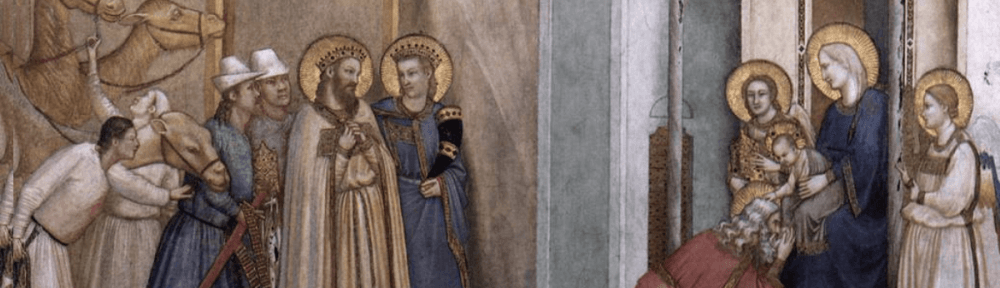
Image credit: The Adoration of the Magi | Giotto, 1310 | Basilica inferiore di San Francesco d’Assisi | Assisi, Italy | PD-US
Discover more from friarmusings
Subscribe to get the latest posts sent to your email.
 friarmusings