
Control vs. Trust

One of the enduring tensions in the life of faith is the tension between control and trust.

In the first reading, the elders of Israel come to Samuel with what sounds like a reasonable request: “Appoint a king for us to govern us, like all the nations to judge us.” They want stability, predictability, and protection. Their request is not irrational. Samuel himself is aging, and his sons have failed. The future is not looking so good. But God’s response reveals what lies beneath the request: “They have rejected me as their king.”

Israel is not simply asking for leadership; they are asking for control. I think that is something we can all relate to. We want something visible, centralized, and predictable. They want a system they can manage, even if it comes at a cost. Samuel patiently warns them of that cost: a king will take their sons, their daughters, their land, their labor. Control always demands payment. And still, the people insist.

Be careful what you wish for.

In the Gospel, we encounter a very different posture. The paralytic’s friends bring him to Jesus, but they cannot control the situation. The house is crowded. The path is blocked. There is no obvious solution. Yet instead of forcing outcomes, they trust. But notice it is not passively waiting in trust. They take some creative action as they continue to trust. They open the roof (Luke’s description is a little more vivid: they dig up the roof). With the passage cleared, they lower their friend into Jesus’ presence. At that point, they relinquish control, but not hope.

Jesus responds first not with a command to walk, but with words of forgiveness. This unsettles the scribes, who are deeply invested in controlling how forgiveness is mediated and who is authorized to offer it. Their objection sounds theological, but it is rooted in fear of losing control of their religious authority and status. Jesus exposes the contrast by asking: “Which is easier?” The real issue is do they trust that God is acting freely among them, or must everything remain contained within familiar structures?

The irony is striking. Israel asks for a king who will take from them, and God reluctantly allows it. A paralyzed man is brought to Jesus who gives everything: forgiveness, healing, restoration. Jesus asks nothing in return.

And what about us? These readings invite us to look honestly at our own lives. We, too, are tempted to trade trust for control. We want certainty before commitment, guarantees before obedience, clarity before faith. We prefer plans we can manage over dependence that leaves us vulnerable. It is a very human and natural inclination.

But the trust we are speaking about is very divine and supernatural. We know from our own experience that control offers only the illusion of safety and leaves us closed.  The harder thing is trust but the upside is that trust opens us up to God’s grace.

The friends of the paralytic do not control the outcome.  Heck they don’t even speak. But their trust speaks volumes and creates an opening where healing can happen. Israel, on the other hand, insists on control and receives exactly what they asked for, along with its burden.

The question these readings pose to us is simple and searching: where are we clinging to control when God is inviting us to trust?

God’s reign is never imposed through force or fear. It is proposed and received through faith. The kind of faith willing to open roofs, let go of certainty, and place what we cannot fix into God’s hands.

And when we do, we often discover that what God gives is far more freeing than anything we tried to control.


Jesus heals a paralytic | mosaic from Sant’Apollinare Nuovo – Ravenna | photo by José Luiz Bernardes Ribeiro | CC BY-SA 4.0
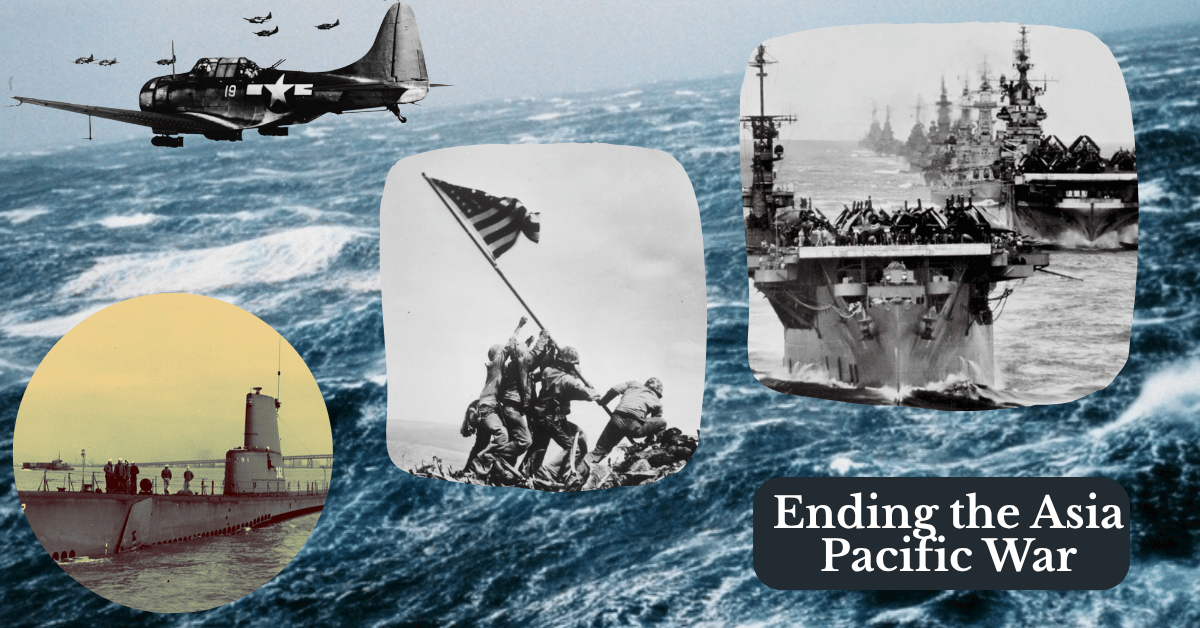
The United States in the Central and Western Pacific

In the previous post we considered Japan’s 19th century transition from the Tokugawa Shogunate to the Meiji Restoration which transformed the nation of Japan to an outward facing nation, under the Imperial guidance of the divine Emperor, with a moral obligation to bring order and harmony to the Asian world in the face of western colonial power.

In this post, we need to “back up” and catch up with U.S. activities since the time of Admiral Perry’s 1853 visit to Tokyo Bay. In a previous post we noted that making the journey to China and maintaining the U.S. presence there also required a network of ports extending across the Pacific Ocean, and as such, the China trade soon drove the United States to expand its presence throughout the Pacific region.  At its root, Perry’s primary mission was to establish a foothold that would strengthen the U.S. position for trade and diplomacy in the region. In other words, the United States opened relations with Japan in large part to enhance its status in China. On a smaller scale, as U.S. merchants began to stop at many of the Pacific Islands to replenish supplies and acquire goods to trade with Chinese merchants, the U.S. Government appointed consuls to several of these places. For example, consulates were established in Fiji in 1844, Samoa in 1856, and the Marshall Islands in 1881. 

There was a lot going on in the period 1889-1900. I will mention some of the key events in order to keep them in context – and then go on to mention some later events with the United States – before returning the series to a more orderly arrangement.

  • The First Sino-Japanese War (1894-1895)
  • The U.S. annexation of Hawaii in 1898
  • The defeat of Spain in the the Spanish-American War of 1898

The China trade led to a growing U.S. presence in Hawaii that grew out of the need for a substantial base of maritime operations in the Pacific to support U.S. interests in China. Ultimately this need became so great, and the U.S. presence so large, that the United States annexed the islands in 1898. We will cover the annexation of Hawaii in its own post.

Following the defeat of Spain in the Spanish-American War of 1898, the United States acquired overseas colonies in the Caribbean and the Pacific. The two key Pacific acquisitions were the Philippines, Wake Island, and Guam in the Mariana Islands. Overnight the U.S. was solidly ensconced in the Central Pacific. 

In one year the U.S. was in possession of locales that would be critical places in the Asia-Pacific War: Hawaii, Wake Island, Guam, and the Philippines. U.S. possession of Guam and the Philippines would be of principle concern for Japan.

In its new status as a global power, the United States pursued a series of policies designed to protect American territories and aggressively expand its international commercial interests. These policies included the promotion of the “Open Door” policy in China and the attachment of the Roosevelt Corollary to the Monroe Doctrine that formally announced the intention to use military force to defend the Western Hemisphere against European incursions. It was in this same period that President Theodore Roosevelt oversaw the construction of the Panama Canal, which would have profound economic implications for American trade and ease the movement of merchant and military shipping between Atlantic and Pacific regions. In just over a decade, the United States had redefined its national and international interests to include a large overseas military presence, overseas possessions, and direct engagement in setting priorities in international affairs.

It is noteworthy that from 1909 to 1913, President William Howard Taft and Secretary of State Knox followed a foreign policy characterized as “dollar diplomacy.” Taft shared the view held by Knox, a corporate lawyer who had founded the giant conglomerate U.S. Steel, that the goal of diplomacy was to create stability and order abroad that would best promote American commercial interests. Knox felt that not only was the goal of diplomacy to improve financial opportunities, but also to use private capital to further U.S. interests overseas. “Dollar diplomacy” was evident in extensive U.S. interventions in the Caribbean and Central America, especially in measures undertaken to safeguard American financial interests in the region. In China, Knox secured the entry of an American banking conglomerate, headed by J.P. Morgan, into a European-financed consortium financing the construction of a railway from Huguang to Canton. In spite of successes, “dollar diplomacy” failed to counteract economic instability and the tide of revolution in places like Mexico, the Dominican Republic, Nicaragua, and China. But the idea reflects the underlying principle: diplomacy, military capability, and business were at the root of America’s international interests.


Image credit: various photographs from Naval Aviation Museum, National World War II Museum, and US Navy Archives. Source credit: “Dollar Diplomacy, 1909–1913” | Office of the Historian, Department of State.

The Witnesses

As noted above, this gospel lays out the story of a new creation that flows through the “next day” of our gospel reading and into the remainder of the first chapter. In that vein, Flannagan notes that a similar story is unfolding as witnesses to Jesus are gathered. It is the “new creation” of the people of God. No longer defined by ethnic association, but by belief in Jesus as the Son of God. Flannagan continues:

“There is another purpose that John, a man of rich creative genius, may have intended. His list of characters in this first act/period of seven days seems to typify the basic personal elements of the Christian community. In order there appear: (1) John the Baptist, precursor to the new creation, whose sole function is to witness; (2) the Savior; (3) disciples who hear, follow, look for, and stay; (4) Peter, the rock; (5) missionaries like Andrew arid Philip who spread the good news; (6) Nathaniel, the true Israelite in whom there is no guile, who, as some Jewish traditions expressed it, studied law under a fig tree and was rewarded. With this, the founding elements of the community are assembled.”

The Testimony. The Baptist makes clear that until seeing the descent of the Spirit upon Jesus, he did not know Him. This is not to say he had no idea about who Jesus was – after all they were cousins. Given that Jesus was brought up in Galilee and John in the Jerusalem area, perhaps they never met, or perhaps it had been since they were children and so Jesus was not recognizable. But by the time of this testimony, it is clear that the Baptist knows of Jesus and has a sense of his mission – even indicating “he existed before me…” We know the baptist is older than Jesus (cf. the Visitation story in Luke). Does the Baptist have an idea of the existence of Jesus before time itself? With all that is being revealed to the Baptist (by the Spirit?) it is no wonder that he remarks: “I did not know him” akin to “who is this guy, my cousin, I guess I really didn’t know him! But now I see…”

but the reason why I came baptizing with water was that he might be made known to Israel.” 32 John testified further, saying, “I saw the Spirit come down like a dove from the sky and remain upon him.  33 I did not know him, but the one who sent me to baptize with water told me, ‘On whomever you see the Spirit come down and remain, he is the one who will baptize with the holy Spirit.’ 34  Now I have seen and testified that he is the Son of God.”

Unlike the Lukan account, this gospel does not say whether the sign of the dove was included in the original revelation, or whether he simply recognized the dove for what it was when he saw it alight on Jesus. But what is clear is that he was given a divinely appointed sign, and that he knew Jesus by that sign. The Baptist is the one disciple who received true illumination about Jesus; every other disciple is dependent on another human witness.

John goes on to describe him as “the One who will baptize with the Holy Spirit.” The other three gospels make this point; Jesus came that people might be brought into contact with the divine Spirit who leads people into the infinite divine spiritual resources. This had not been possible previously, for there is a quality of life that Christ and none other makes available. Baptism with water in John’s time was a form of cleansing and an outward sign of repentance. Baptism with the Spirit portends a new thing. It is the bestowal of new life in God. In the Catholic understanding of Sacramental Baptism, both are accomplished. A person is cleansed of all sin and given the Spirit. It is an outward sign of an inward reality.


Image credit: Saint John the Baptist Preaching to the Masses in the Wilderness | Pieter Brueghel the Younger | Galerie de Jonckheere, Paris | Wikimedia Commons, PD-US