In the first reading, great care is taken to describe the moment when the Ark of the Covenant is brought into Jerusalem. This is not simply a religious procession; it is a profound statement of faith. The Ark represents the dwelling place of God among the people. Where the Ark is, God is near. David dances, sacrifices are offered, and blessings are shared because God who has journeyed with the people since the time of the Exodus, continues to dwell with Israel and now in the holy city of Jerusalem.
Yet even here, something important is already beginning to shift. The Ark is not a talisman, charm, or amulet with magical powers. It does not guarantee blessing by its mere presence. What matters is how the people respond. Will they respond like King David with reverence, joy, obedience, and trust? David’s relationship with God is revealed not by possession of the Ark, but by his willingness to place God at the center of Israel’s life.
In the Gospel, Jesus completes this movement in a startling way. When told that his mother and relatives are waiting outside Jesus takes the moment and redefines what it means to a member of his family. “Whoever does the will of God is my brother and sister and mother.” He is not rejecting his biological relationships, but pointing to something that is intentional and will endure beyond this lifetime.
With these words, Jesus moves us from a sacred object to a sacred community. God’s dwelling place is no longer an ark carried on poles, nor a tent or a temple. God now dwells in a people shaped by obedience to his will. The presence of God is revealed wherever lives are aligned with the Father’s purpose.
This is also where Jesus reshapes kinship. Belonging to God is not determined by bloodline, religious proximity, or external markers. True kinship is formed by obedience. It is formed by listening, trusting, and living according to God’s word. Mary herself is not excluded by this definition; she is its first and finest example. She belongs to Jesus not only because she bore him, but because she said, “Let it be done to me according to your word.”
These readings quietly challenge us. It asks us to examine our own religious thinking and practice. The Catholic Church has an amazing treasure of rituals, traditions and things sacred. Have we let our focus fall on those things in such a way that we remain distant from the heart of God? It is possible to honor holy places, rituals, and symbols — all good and necessary — without allowing them to shape how we live.
Jesus invites us deeper. He invites us to become a community where God truly dwells, not because we gather around holy objects, but because we choose obedience, day by day. When we forgive, when we act justly, when we place God’s will above our own preferences, we become the living dwelling place of God.
Like David, we are called to rejoice in God’s nearness. Like the disciples, we are called to hear Jesus say that we belong, not because of who we are connected to, but because we choose to do the will of the Father.
In that obedience, we discover something astonishing: we are not just servants of God. We are family.
At this point in the series we have reached 1905. The Russo-Japanese War had just concluded with a peace settlement reached, moderated by the United States. China was technically at peace, but as we’ll explore later in this post, there was a lot of conflict ongoing within China’s borders – foreign states fighting one another and internal actors seeking to overthrow the Chinese Qing Dynasty government (the last of the Chinese imperial governments established by the Manchu people of northern China). What becomes confusing is the ebb-and-flow of the control of “areas” of China in the first half of the 20th century. This post will attempt to offer a primer in area and names that will be bandied about in the following posts.
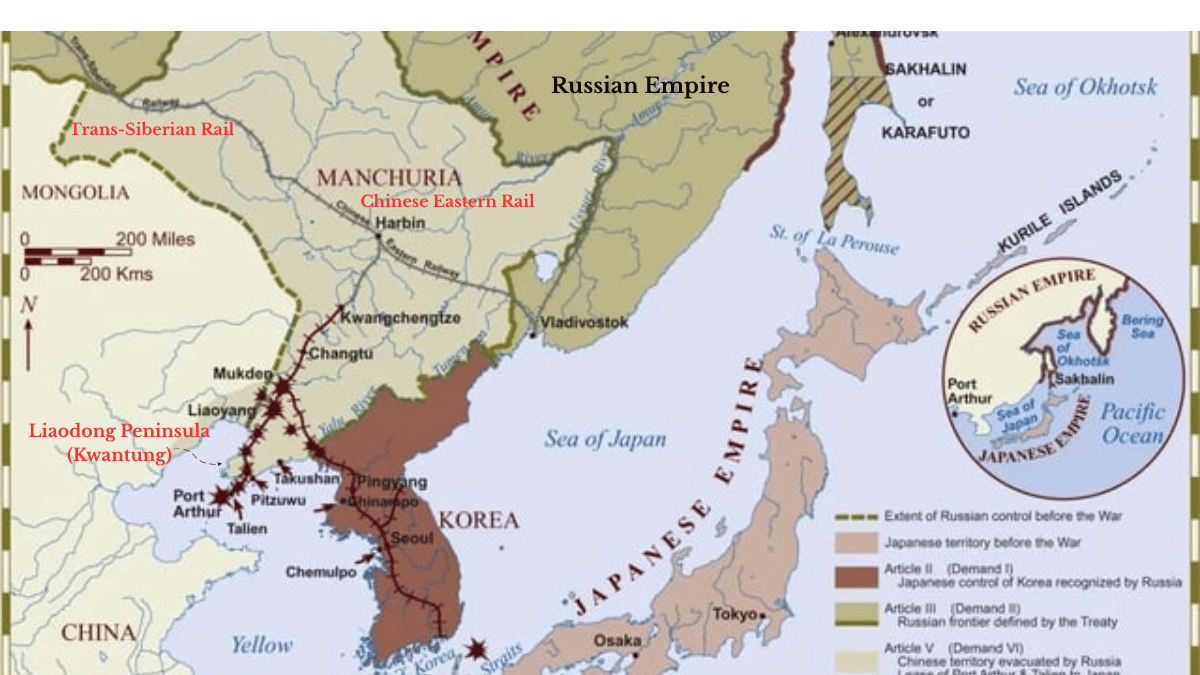
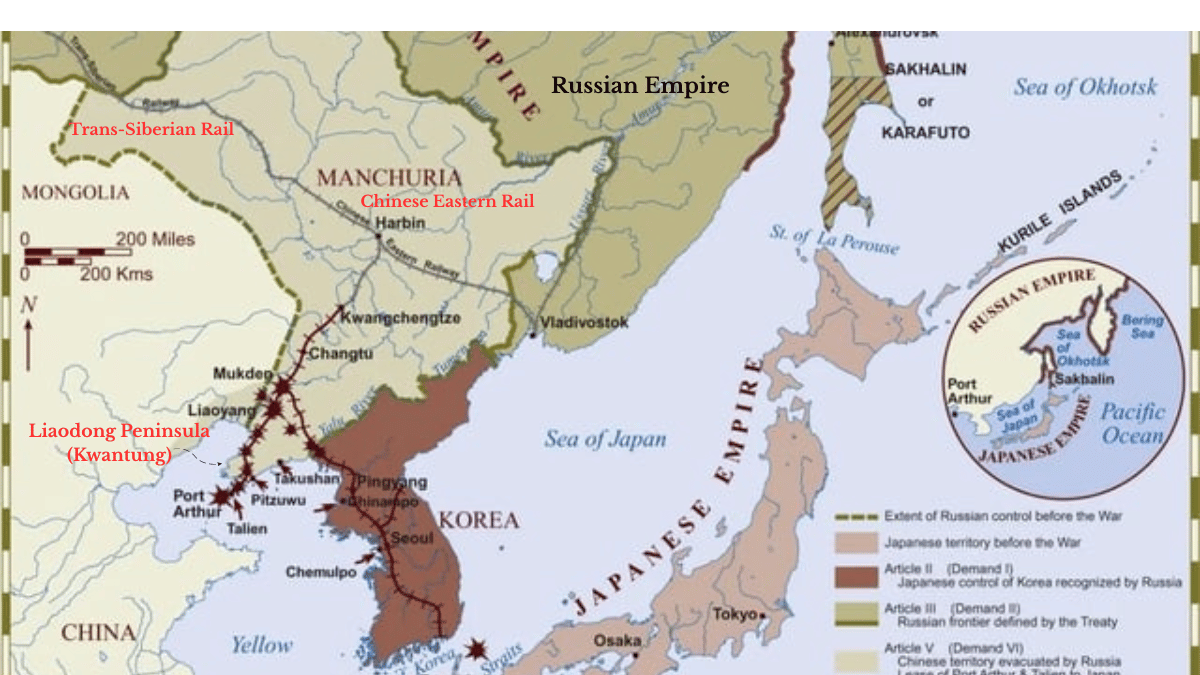
The major “areas” are as follows – and some of the nomenclature is mine in an attempt to (hopefully) make it easier to follow the storyline:
China: the southern part of the nation nominally in control of the Chinese government(s) and unoccupied by a foreign power. Under the China “Open Door” policy (not a treaty but a working understanding) most European powers had enclaves in port cities and important cities of the interior prior to WW2.
Manchuria: the traditional area in the northernmost bounds of the nation of China that was occupied, reoccupied, and in conflict between non-Chinese nations for the first half of the 20th century. It shares a border with Korea and Liaodong to the south and Siberia to the north. Importantly the railroad across Manchuria connected the TransSiberian Railroad to Russia’s eastern port of Vladivostok.
Northern China: a “made up” term that will be used to describe the area south of Manchuria and north of the rest of China. It is the area during the Second Sino-Japanese War (b. 1937) and incidents leading up to that conflict in which Japanese and Chinese forces clashed. While not exactly accurate, it is an area north of the Great Wall of China.
Inner Mongolia: a crescent shaped area north of “Northern China” and west-southwest of Manchuria. It largely borders Mongolia (a Russian state) with some shared border area with Russia (Siberia)
Laiodong (Kwantung): a peninsula west of Korea peninsula that is important for its warm water ports (notably Port Arthur) and the terminus of a railway system that connected the ports to the Trans-Siberian Railroad. The Chinese Eastern Railroad will later be called South Manchurian Railroad and later designated the North Manchurian Railroad
Korea: the boundaries then are the same as now. In the early 20th century it was technically an independent nation with its own king and queen.
Formosa: now known as Taiwan.
Korea
Korea has its own rich and varied history, but for purposes of this post, by the 20th century Korea was either a tribute state subject to China or a battleground for China, Russia, and Japan. Korea had once been a land of the “Three Kingdoms” – Goguryeo, Paekche (Baekje), and Silla. At the height of its powers the three kingdoms occupied the entire peninsula and roughly half of Manchuria and small parts of the modern Russian Far East. Goguryeo controlled the northern half of the peninsula, as well as Liaodong Peninsula and Manchuria. Paekche and Silla occupied the southern half of the peninsula.
Paekche was a great maritime power and was instrumental in the dissemination of Buddhism and its culture/skills to ancient Japan. This included Chinese written characters, Chinese and Korean literature, and technologies such as ferrous metallurgy and ceramics, architectural styles, sericulture (silk worms) and Buddhism.
The history of Korea is far more complicated than the “Three Kingdom” but that was the foundation that became modern Korea (after many twists and turns!) In the late 19th century, the government implemented a strict isolationist policy, earning Korea the nickname “Hermit Kingdom”. Like Japan, the policy had been established primarily for protection against Western imperialism, but soon the ruling dynasty was forced to open trade, beginning an era leading into competing Chinese and Japanese pressures. Prior to the First Sino-Japanese War, Korea was a tribute state to China. The 1895 post-war settlement gave them independence and the King became the Emperor of Korea.
Japan, Russia and China were the major foreign powers with interests in Korea, but at the end of the Russo-Japanese War in 1905, the Korean Empire effectively became a protectorate of Japan. At point of great contention, then and now, is that the 1905 Protectorate Treaty promulgated without the Emperor. It was not dissimilar to the U.S. annexation of Hawaii in 1898. Japan annexed Korea in 1910 and so things remained until 1945 and the defeat of Japan.
There is a long history of animosity between Korea and Japan stemming from the 1905-1945 period. Even today, Korea feels that Japan has not sufficiently acknowledged numerous injustices from the period, with grievances focusing on an alleged lack of a clear, straightforward admission of historical wrongdoing, denial of specific atrocities, and failure to provide appropriate reparations to individual victims. The list of injustices includes:
Sexual slavery (“comfort women”): the forced recruitment of tens of thousands of women, mostly Korean, into Japanese military brothels across Asia and the Pacific as sexual slaves.
Forced labor: millions of Koreans were forced to work in harsh conditions in mines, factories, and on construction sites in Japan and its colonies with little to no payment.
Cultural suppression: Japan implemented policies aimed at erasing Korean national identity, including banning the Korean language in schools and public spaces, forcing Koreans to adopt Japanese names, burning Korean historical documents, and converting Korean temples to honor Japanese deities.
Massacres and war crimes: Koreans highlight several mass murders and atrocities committed by Japanese forces, such as the Gando and Kantō massacres, not acknowledged by Japan.
Legality of annexation: There is an ongoing dispute over the legality of the 1910 Annexation Treaty itself, which many Koreans view as having been signed under duress and therefore invalid.
Japan and Korea
Japan had long been interested in Korea, “the dagger pointed at the heart of Japan.” Neutrality was not an option. Japan wanted control as part of its vision of strategic buffers. But in addition, Japan needed Korea’s food production, natural resources, and land for Japanese emigrants due over population concerns in the home islands.
Image credit: various photographs from Naval Aviation Museum, National World War II Museum, and US Navy Archives. | Map courtesy of MapWorks 2005
This coming weekend is the Fourth Sunday in Ordinary Time. The gospel is the beginning of Matthew’s well known “Sermon on the Mount.” In yesterday’s post we cover the context for the Sermon as well as some overarching views of the Sermon regarding its context and audience. Today we consider the nature and alternative outlines of the Sermon.
The Beatitudes, which begin the “Sermon on the Mount” have a tendency to lead readers/hearers of the text to assume that Matthew has constructed a general ethical code which forms the core message. Craig Keener (A Commentary on the Gospel of Matthew, 160) notes that there are more than thirty-six discrete views about the sermon’s message. He summarizes 8 of them:
The predominant medieval view, reserving a higher ethic for clergy, especially in monastic orders;
Martin Luther’s view that the sermon represents an impossible demand like the law;
the Anabaptist view, which applies the teachings literally for the civil sphere;
the traditional liberal social gospel position;
existentialist interpreters’ application of the sermon’s specific moral demands as a more general challenge to decision;
Schweitzer’s view that the sermon embodies an interim ethic rooted in the mistaken expectation of imminent eschatology;
the traditional dispensational application primarily to a future millennial kingdom; and
the view of an “inaugurated eschatology,” in which the sermon’s ethic remains the ideal or goal, but which will never be fully realized until the consummation of the kingdom.”
It is perhaps the ethical view that is most common. Many scholars trace this popular predominance to the influence of Russian novelist Leo Tolstoy whose literal interpretation of the ethical teachings of Jesus centered on the Sermon on the Mount (The Kingdom of God Is Within You). But this ethical reading alone does not do justice to the whole of Matthew’s text. Jesus is describing a standard that is nothing less than wholeness/completeness, being like God (5:48). As St. Irenaeus wrote in the 2nd Century, “The glory of God is the human person fully alive.”
Appearing in today’s gospel is a passage that is sure to lead to questions: “Amen, I say to you, all sins and all blasphemies that people utter will be forgiven them. But whoever blasphemes against the holy Spirit will never have forgiveness, but is guilty of an everlasting sin.” (Mark 3: 28-29) It is a question I am regularly asked. Sometimes out of curiosity; sometimes out of concern for their souls. Perhaps beneath the question is seeking assurance they are not somehow guilty of a sin that is unforgivable. My first response to the question is the very fact that they are worried and essentially asking“Have I done this?” is itself a strong sign that they have not. But let’s explore the question.
First of all one has to discern the context of the words. In Mark 3, Jesus speaks of “blaspheming the Holy Spirit” in response to a very specific situation. The scribes are witnesses of undeniable acts of healing and liberation, they recognize that something extraordinary is happening, and yet deliberately claim that this work of God comes from Satan. It is one thing to wonder about who is this person able to do the works of God. That would be the spirit of inquiry even if accompanied with a measure of confusion or doubt. But that’s not what they do. They willfully misname God’s saving work. They have closed their hearts to the Spirit of God – for what? To protect power, status, and control? Jesus’ warning arises from this hardened posture.
It is important to clear away common fears, misconceptions, and poor catechesis. Blaspheming the Holy Spirit is not a sudden angry thought, a careless word spoken in frustration, a season of doubt or questioning, falling into serious sin, feeling distant from God, or even rejecting God for a time and later returning. Think about it. Peter denied Jesus, Paul persecuted the Church, David committed grave sin and all were forgiven.
Across Scripture, the Fathers, and the Catechism, there is remarkable consistency. Blaspheming the Holy Spirit is a settled, persistent refusal to accept God’s mercy by rejecting the Spirit who offers it. St. Augustine put it this way: “The sin is unforgivable because it refuses forgiveness.” The Catechism (CCC 1864) says: “There are no limits to the mercy of God, but anyone who deliberately refuses to accept his mercy by repentance rejects the forgiveness of sins.”
In other words, the Holy Spirit’s role is to convict the heart, reveal truth, move us toward repentance, and open us to grace. To blaspheme the Spirit is to shut the door from the inside.
The heart of the issue is why is it called “unforgivable?” It is not that God refuses to forgive. It is that the person refuses to be forgiven. Forgiveness requires recognition of sin, openness to grace, and willingness to be changed. Blaspheming the Holy Spirit is the deliberate choice to say: “I do not need mercy,” “I will decide what is good and evil,” “God is wrong; I am right.” As long as that stance remains, forgiveness cannot take root not because grace is absent, but because it is rejected.
One thing that always needs to be said pastorally and clearly in order to give the person reassurance is that anyone who is worried about having committed this sin has not committed it. Why? Because fear, sorrow, regret, and concern for reconciliation are movements of the Holy Spirit, not signs of blasphemy. The unforgivable sin is marked by certainty, not anxiety; self-justification, not repentance; hardness, not fear; and indifference, not longing. A closed heart does not ask for reassurance.
Jesus is not trying to terrify fragile consciences. He is warning hardened ones. He is saying be careful not to explain away grace, to label God’s work as threatening or to protect yourself so fiercely that you refuse to be converted. This warning is itself an act of mercy. It is a final attempt to shake open a heart that is closing.
The last word is always this. As long as a person can still say, “Lord, have mercy,” then mercy is already at work. God’s forgiveness is inexhaustible. The only real danger is refusing or denying it.
And so when parishioners ask, “Have I done this?” My answer is “No. The very fact that you’re asking means the Spirit is still speaking, and your heart is still open. But tell me more.” That last part of the response very often leads to the grace of the Sacrament of Reconciliation.
One of the most subtle spiritual dangers is not outright rejection of God, but the slow closing of the heart, intentionally or not, in what amounts to some form of self-protection.
In his letter to Timothy, Paul writes with urgency and tenderness. He knows how easily fear can cause a believer to retreat from the fullness of gospel living. Perhaps we pull back on ministry or sharing our faith in parts of our lives where we might be judged or dismissed. That is why he reminds Timothy that God did not give us a spirit of fear, but of power, love, and self-control. We know the experience of being in love, how it opens our hearts. We know the experience of fear when we close in and begin to shield or protect some part of ourselves. Perhaps it is to protect our reputation, our safety, our comfort, or our standing in the community. Faith quietly loses its courage.
The Gospel shows what happens when self-protection hardens into resistance. The scribes are confronted with undeniable evidence of God’s power at work in Jesus. Rather than allowing the truth to challenge them, they reinterpret it in a way that preserves their authority. They choose explanation over conversion. In doing so, they close themselves off from the very grace meant to heal them.
Jesus’ warning about blaspheming the Holy Spirit is not about a single careless word. Let me suggest it is about a settled refusal to recognize God’s work when it stands plainly before us. A closed heart no longer seeks truth; it seeks justification. Once that happens, repentance becomes impossible not because God withholds mercy, but because the heart will no longer receive it. Paul tells us “and hope does not disappoint, because the love of God has been poured out into our hearts through the holy Spirit that has been given to us.” (Romans 5:5) We have closed off our hearts and refused entry to the Holy Spirit.
Paul offers a different path. From prison, stripped of security and status, he refuses self-protection. He entrusts himself to God and encourages Timothy to do the same. His confidence does not come from being safe, but from being faithful. The truth of the Gospel is worth the cost, even when it leads to suffering.
You might think, “I don’t think I have a closed heart.” A closed heart often begins as a cautious heart, a heart that wants to avoid risk. Where are we cautious? Where might we be choosing comfort over truth, silence over witness, control over trust?
The Gospel does not grow in protected spaces. It grows where people are willing to be changed.
Today we are invited to pray for hearts that remain open; open enough to be challenged, open enough to repent, open enough to trust that God’s Spirit is at work even when it unsettles us. Because truth received brings life, but truth resisted for the sake of self-protection slowly shuts the door to grace.
May the Lord keep our hearts open, courageous, and free. May our hearts not be governed by fear, but shaped by the Spirit who leads us into all truth. The Spirit that is poured into our hearts.
The First Sino-Japanese war marked Japan as a military power – but was Japan capable of engaging a western military power? That question would be put to the test in the Russo-Japanese War of 1904–1905.
In the previous post we noted that the transfer of Liaodong Peninsula and its warm water Port Arthur were ceded to Japan in the treaty that ended the First Sino-Japanese War. Via the “Triple Intervention,” (of which Russia was the primary animator), Japan reluctantly agreed to return Liaodong to China in 1895, the same year the war ended. In 1898 the ports of Liaodong and Port Authur were leased to Russia. The news was not received well in Japan. Beyond the humiliation, this meant the very thing Japan feared: a western imperial power gaining a foothold in what Japan considered its “security zone.” But Japan also realized Russia’ long term goals and objectives were even more ominous.
Russia had a similar view of Japan and sought to construct “security zones” that provided protection, strategic depth while providing economic and diplomatic leverage. Russia’s Far Eastern policy aimed at the warm-water port of Port Arthur. In addition Russia wanted to extend its influence southward from Siberia into Manchuria and Korea. This would link the Pacific coast firmly to European Russia.
All this brought Russia even more deeply and directly into Japan’s perceived security zone.
Precursors to War
After 1895, Russia steadily entrenched itself in Manchuria as it had gained rights to build the Chinese Eastern Railway across Manchuria to connect to the Trans-Siberian Railway. In 1898 the aforementioned lease of Port Arthur was secured and in 1900 the Russian military took advantage of conflict and occupied Manchuria during China’s Boxer Rebellion. Then Russia failed to fully withdraw from Manchuria afterward, despite repeated promises. Japanese leaders interpreted this as bad faith and evidence of permanent annexation plans. All this transformed Russia from a distant empire into a direct territorial rival.
Although Manchuria was vital, Korea was the emotional and strategic trigger. After 1895, Russia increased diplomatic, financial, and military involvement in Korea. Russian advisers appeared at the Korean court. Russia was giving all the signs and indications that their goal was for Korea to become a Russian protectorate, mirroring what had happened in Manchuria. Japan was willing to compromise on Manchuria; it was not willing to compromise on Korea.
From 1901–1904, Japan sought negotiated settlements, proposing that Japan recognize Russian predominance in Manchuria in exchange for Russian recognition of Japanese predominance in Korea. Russia repeatedly delayed responses and when they did reply the concessions or counters were vague or conditional. At the same time the Russians continued strengthening their military position. Japan rightly concluded that Russia was using diplomacy to buy time.
Internal pressures pushed Japan toward war. After the Triple Intervention, Japan believed its status as a great power depended on resisting further humiliation. Many Japanese believed they must fight before Russia completed the Chinese Eastern Railway and achieved overwhelming superiority – it was now or never – and the nation, for 20 years, had been investing in the military for a contingency just like this. Further delay favored Russia and so “now” seemed to be the window for victory; a window that might soon close. War increasingly appeared to be the least bad option.
How to understand the Russo-Japanese War
The Triple Intervention’s legacy went beyond immediate grievance. It convinced Japan that international law and diplomacy favored the strong, hardened Japanese elites against reliance on Western goodwill, and reinforced the belief that only decisive force could secure Japan’s place. The Triple Intervention was not a cause of war, but a lesson learned.
Other world powers had their own concerns about Russia. Britain and the United States preferred a strong Japan to check Russian expansion and applied no serious pressure on Japan to back down. In addition the Britain–Japan Alliance (1902) reassured Japan that it would not face a multi-power coalition. And so Japan did not fear diplomatic isolation in the way it had regarding the First Sino-Japanese War. All of this gave indications that perhaps Japan was being accepted as a world power or at least acknowledged as the preeminent Asia power.
Meanwhile, Russia never prepared for war. On one hand Russia was far more concerned with European matters and internal court intrigue. On the other, Russia severely underestimated Japan’s military power, the existential threat they were imposing upon Japan, its willingness to attack a European power, and other factors that likely included racial and cultural assumptions that Japan was a “second-rate” power. Besides, time was on their side; or so they believed.
Over time, historians have developed different views of the war. In part, because more primary source information became available and the lenses of understanding changed between generations. Up until the 1950s, the understanding was that Russian aggression and imperial expansion were the primary causes; Japan fought a defensive, pre-emptive war. It was believed that Japan exhausted diplomatic options and struck only when delay became fatal. Overall, the clash is viewed as a case of a rising regional power resisting European imperialism. Any Japanese imperial ambitions are downplayed and priority is given to the perceived threat from Russia.
In the 1960s the assertion was that Japan deliberately chose war to secure imperial expansion. Russia was cautious, divided, and often defensive while Japan overstated the Korean security threat to justify expansion. Captured by internal politics, Tokyo rejected workable compromises to avoid diplomatic limits on its freedom. At the same time, military and naval elites used war to secure budgets, cement political influence and validate the expenses of the modernization efforts. Russia, lacking a coherent Far Eastern strategy, repeatedly sought delays. This view underplays how threatening Russian actions appeared to Japanese decision-makers at the time.
From the 1990s onward the view judges that the war resulted from mutual imperial ambitions, compounded by misperception, bureaucratic politics, and structural insecurity. This approach does not split blame cleanly but asks, “Why did compromise fail when it seemed possible?”
The general conclusion is that diplomacy failed because Russia’s bureaucracy was fragmented causing delays which Japan interpreted as deception. Both sides believed time favored the other, creating a commitment trap. Along with other factors, war was not inevitable, but once certain thresholds were crossed, it became likely.
When one looks at the analysis of the later Asian-Pacific War, you will discover elements of the same pattern. Often these phases are described as orthodox, revisionist, and modern (sometimes followed by neo-orthodox). It is especially in the last phases, when more primary source documents become available that specialists begin to view through specific lenses reflecting what the historian thinks is the primary driver: economics, diplomacy, policy, politics, security, and more.
Why do I mention this? Because later in this series we will review that same morphing historiography as concerns Pearl Harbor and the Asia-Pacific War.
The War
After years of failed diplomacy, Japan launched a surprise attack on the Russian fleet at Port Arthur in February 1904. Japan quickly seized the initiative on land and sea, winning major battles at Liaoyang, Mukden (remember this name), and decisively at the naval Battle of Tsushima, where Japan destroyed Russia’s Baltic Fleet. Tsushima turned a prolonged war of attrition into a rapid path to Japanese victory.
Despite Russia’s larger population and resources, she suffered from poor leadership, long supply lines, and domestic unrest all of which crippled her war effort. Japan’s modernized army and navy achieved rapid, coordinated victories but at high cost. The war ended with the Treaty of Portsmouth (1905), mediated by the United States, recognizing Japan’s predominance in Korea, transferring Port Arthur and southern Manchuria to Japan, and confirming Japan as the first Asian power to defeat a European great power in modern war.
The Aftermath
The Japanese victory in the Russo-Japanese War is described as coming “at high cost” because military success pushed Japan close to the limits of its manpower, finances, and social cohesion, even while it won on the battlefield. The costs were real, visible, and politically destabilizing, leaving deep scars beneath the triumph.
Japan won most major engagements, but often through frontal assaults against entrenched Russian positions. The losses (deaths and casualties) were exceptionally high for a small nation. Total casualties (killed, wounded, missing) were 70,000–80,000. While the Russian losses were higher in absolute numbers, the losses were not as devastating or proportionally large. Further, for Japan the losses fell heavily on young, conscripted males, straining villages and families. The army began to fear it was winning battles faster than it could replace men.
Japanese doctrine emphasized an offensive spirit and tactical mindset regardless of the cost. While it worked tactically in this war, attrition favored Russia in the long run. Japan’s leaders quickly came to understand that they could not sustain another year of fighting. By early 1905 ammunition stockpiles were low, replacement soldiers were less well trained, and the army was nearing exhaustion. Victory arrived just before exhaustion became defeat.
In a certain sense Japan lost the war. Japan had financed the war largely through Britain and U.S. loans supplemented by heavy domestic taxation. As a result national debt skyrocketed as war expenditures consumed well over half of government spending. Japan emerged victorious but financially dependent on international credit, and most importantly, had no leverage to impose a punitive peace as it had done after the First Sino-Japanese War. Punitive peace was the expectation of the people after such a great sacrifice.
But unlike earlier wars, Russia had suffered casualties and loss, but overall their army and navy were still substantial, no Russian territory was occupied, and the regime of Russia was not really threatened, nor was the Trans-Siberian Railway. In addition, the U.S. had moderated the treaty/settlement. President Roosevelt’s priorities were ending the war quickly, preserving a balance of power in East Asia and avoiding Russia’s complete humiliation which might destabilize Europe. Roosevelt pressed Japan to drop indemnity demands and accept territorial and political concessions instead
Japan accepted because it needed peace more than money.
Back home, the public expected indemnity payments, territorial expansion of more than Korea and southern Manchuria, and some step-up in recognition. The perceived gap between sacrifice and reward sparked riots in Tokyo and a growing disillusionment with the current political leaders. Victory felt incomplete, even humiliating to some.
The war reinforced dangerous lessons for the Japanese military that cemented the bushidō philosophy in their ranks. It became, not just an understanding, but doctrine that bushidō spirit could overcome material disadvantage. Also, that decisive victory required willingness to accept massive losses. These lessons contributed to later tolerance for extreme casualties in future wars. In a way, the cost was not only human and financial, but ideological. And to the western mind, irrational.
Image credit: various photographs from Naval Aviation Museum, National World War II Museum, and US Navy Archives.
This coming weekend is the Fourth Sunday in Ordinary Time. The gospel is the beginning of Matthew’s well known “Sermon on the Mount.” In today’s post we cover the context for the Sermon as well as some overarching views of the Sermon regarding its context and audience.
From the 4th through the 9th Sundays of Year A the Catholic Lectionary covers most of Chapters 5-7 of the Gospel according to Matthew – popularly known as the “Sermon on the Mount.” These verses are the first, the longest and the most carefully structured discourse in Matthew’s narrative. Roughly 27 percent of Matthew’s discourse is shared with Luke 6:20-49, a further 33 percent has parallels elsewhere in Luke, and 5 percent in Mark, while the remaining 35 percent is unique to Matthew. In Matthew it is a lengthy collection of authoritative teaching with a parallel of authoritative deeds following in Matthew 8-9. But the Sermon does not simply appear. Matthew has established the groundwork for its message.
By way of preparation for the Sermon on the Mount, Matthew has established Jesus’ superiority to John the Baptist (3:1–12), recounted the divine acknowledgement of Jesus as the Son of God (3:13–17), and shown what kind of Son of God Jesus is (4:1–11). The scene has been set: the Messiah had begun to preach in Galilee as Scripture foretold (4:12-17). The Son of God has begun to form a new messianic community via the calling of the four disciples (4:18-22).
Note: winter’s wicked winds are headed this way. The milk and bread shelves are empty in the local stores. Our church is located on a hill with a steep entrance and exist. The projected sleet and ice make the prospect of transiting the hill potentially perilous. And in an abundance of caution, our Sunday Masses have been cancelled. .. I have a homily holiday … so I posted this from the trove of homilies past
I remember when I was a kid, I was fascinated with a place of mystery called Timbuktu. I loved the sound of the name and the possibility of being as far away from home as Timbuktu. No doubt it was a place of mystery, intrigue, and stories. There were tales of gold, riches, and the place where East Africa and Saharan Africa met. The stories abound so much that in 1855, the French Geographic Society offered a major prize to the first European to go there and report back. What amazing, fantastic stories could be in Timbuktu!
I have always been drawn to stories of people and places, adventures and mystery, where fates and fortunes were found, lost, and again pursued. In time, my appreciation of stories broadened to include narratives of all kinds. Stories told of love and love lost; stories of wisdom and tomfoolery; never-ending stories and stories with no end; stories that entertained and ones that pressed the mind to an inner exploration of meaning.
In my homily of last Sunday, I shared my experience of growing up in the Baptist South and attending tent revivals. In its own way, the tent revivals were as far from my Catholic experience as Timbuktu was from my front door. I described the experience as one in the well of stories, “Where men stood up and testified, words honed by years of practice. There were epic tales of sin and redemption wherein Jesus pulled them from the devil’s grasp and washed them in His blood. Women spoke of love betrayed, and of loss and pain and joy so fierce that it almost seems to slice apart the humid summer air. Everyone praised the times Jesus saved them from despair, raised them up, wiped away their tears, and set them on the road to righteousness.” This was a very specialized form of storytelling: giving witness, giving testimony – but storytelling, nonetheless.
Today we celebrate “Word of God” Sunday. There are so many things that could be said about the Word of God, but I would say this: it is a collection of God’s stories as God reveals Himself to his people and the world. It is the greatest stories ever told and our most basic job is to be people who tell these stories to our family, our loved ones, our friends, our neighbors, and folks on the highways and byways of life. When historians consider simple letters and other written items from the first and second centuries, they have described the spread of Christianity – not as simply the evangelical efforts of the big-name people like St. Paul and others – but as people telling stories over the backyard fence.
To know, tell, and share the stories in our own voices is to weave the stories into the fabric of our lives. So much so that in the shared knowledge of the stories, they can be shared with simple phrases: “O say can you see…” Simple, short and brings to mind the story of Ft. McHenry, the War of 1812 and Francis Scott Key’s composition of our nation’s anthem. Our connection to the Bible, the Word of God, is the same way. Think of the stories of Scripture you know and are brought to mind with simple words or expressions: the Good Samaritan, the Good Shepherd, the Prodigal Son, Garden of Gethsemane, Calvary, River Jordan, and so much more. The stories are already there in the fabric of your life. Share them!
…and then the hesitation begins… “Do I really know the story?” My experience is that people are really asking themselves, “Can I quote the story?” Over the backyard fence, “quotologists” are not needed. Story tellers are needed.
Isaiah was the one who told a story in the first reading when he spoke of “the land of Zebulun and the land of Naphtali.” For folks in Isaiah’s time, the reference was as clear as “oh say can you see.” They heard the phrase and instantly knew of that these were two of the tribes of Israel that were conquered by the Assyrians – but in the gloom of their fate, they were given the promise of a Savior and a new light to cover their lands, rescuing them from the darkness of their enslavement. This is a story of our shared history and the promise given.
In the second reading, St. Paul reminds us all that between here and the final there, the final land of light where joy and great rejoicing reside, there will be suffering. Christ suffered and so we should not be surprised if we too suffer at points in our life. St Paul’s story reminds us that the promise endures, but only in the name of Christ. This is the life: sent to live the Gospel.
The Gospel? Today’s story is about the Call and Mission. Today we hear of the account of Simon Peter, Andrew, James and John – it is but a reminder that the promise is carried to ends of the earth by people just like you and me. The Word is carried from the lake region of Galilee to the end of the earth – even to Timbuktu!
We are called to people who carry the Word of God in our lives. Maybe you are called to carry it only so far as the end of the driveway – then do that. It is in reading children’s bible stories; it is reminding yourself to be a good Samaritan; it is receiving and accepting the prodigal son or daughter – it is reading, listening to our family stories. From the land of Naphtali, to Galilee, to your house, to Timbuktu.
And then telling them in your words, as your stories, over the backyard fences of your life.
Then just as we have enthroned the Word of God in a special way this weekend, you will enthrone the Word of God in your life.
This coming Sunday is the 3rd Sunday in Ordinary Time. In the previous post we discussed the phrase: “the kingdom of heaven is at hand.” Today we summarize the gospel as a prelude to the Sermon on the Mount – the gospel for the 4th Sunday. 24 His fame spread to all of Syria, and they brought to him all who were sick with various diseases and racked with pain, those who were possessed, lunatics, and paralytics, and he cured them. 25 And great crowds from Galilee, the Decapolis, Jerusalem, and Judea, and from beyond the Jordan followed him.
Although Jesus’ activity is confined to the region of Galilee, word of it spreads to the whole province of Syria. The outward movement of Jesus’ reputation as a teacher and healer results in the movement of many people toward him. People suffering from all kinds of diseases are brought to him, and they are cured (v. 24). People from every region of Israel except Samaria join the crowds that follow him (v. 25). Such people, along with the disciples, form the audience for the Sermon on the Mount.
Matthew 4:23–25 encapsulates the ministry of Jesus. It may be viewed as a concluding summary of Jesus’ early ministry in Galilee, or as the introduction to the Sermon on the Mount. It is noteworthy that 4:23 is repeated almost verbatim in 9:35. Both 4:23 and 9:35 are located just before major discourses of Jesus, and they serve to summarize his deeds as the context for his words. But there is likely more to the repetition than that. Taken together, 4:23 and 9:35 form an inclusio, a set of literary bookends, which summarize Jesus’ words and deeds at the beginning and end of two sections that present his words (Matt 5–7) and deeds (Matt 8–9) in detail. Significantly, both the words and deeds demonstrate Jesus’ Kingdom authority, an authority he passed on to his disciples. As his words and deeds proclaim and demonstrate the Kingdom, so will the words and deeds of his disciples (10:7–8; 24:14).
By way of preparation for the Sermon on the Mount, Matthew has established Jesus’ superiority to John the Baptist (3:1–12), recounted the divine acknowledgement of Jesus as the Son of God (3:13–17), and shown what kind of Son of God Jesus is (4:1–11). He has also explained why Jesus taught and healed in Galilee (4:12–17) and how he attracted an inner circle of disciples (4:18–22) and a larger circle of interested followers (4:23–25). The Sermon on the Mount (5:1–7:29) will reveal what a powerful teacher Jesus is.
Image credit: Detail of Domenico Ghirlandaio: Calling of the First Apostles | 1481–82 | Sistine Chapel, Vatican | PD-US
The series to this point has attempted to “paint a picture” of the nation of Japan at the doorstep of the 20th century. In one way it can be viewed as Japan’s experience and reaction to the western world. There was a point in time when Japan, as the apprentice, looked to China as the master of knowledge, spirituality, statecraft, governance, and the model of Japan’s aspirations. But by the late 9th century AD, the apprentice had matured and the master diminished. Japan stopped official missions to China. For the next 800 years or so, until the late 16th or early 17th centuries, the relationship was largely trade with occasional moments of diplomacy when one side or the other wanted something. As Japan entered the Edo Period, as mentioned in an earlier post, Korea became a point of contention between China and Japan with a series of wars in the 1590s fought on the Korean peninsula. It was at this point that Japan entered the Tokugawa Shogunate period and the nation of Japan implemented severe maritime policies that isolated the nation and the people from outside contact – which at this point meant the western powers and proselytizing Christian denominations. When Japan emerged from isolation with the fall of Tokugawa and the rise of the Meiji era, the world of Asia was radically changed. The once great China had been humbled and reduced to a near vassal state under the power of western commerce supported by its military.
This is when the theory of social darwinism left its mark on Japan. The leaders of Japan concluded that nations are competing organisms with only two outcomes: domination or eradication. China was the proof. Japan’s national strategies began to coalesce around this idea, especially buffer zones and strategic depth. Korea was described as “a dagger pointed at the heart of Japan.” And since conflict was inevitable, preemptive expansion was critical and the first goal was Korea. Leadership and thinkers concluded that if Japan did not dominate Korea, another power would. Japan rapidly modernized along Western military, industrial, and administrative lines. The most recent posts outlined the transformation of Japan’s military in support of these conclusions.
Meanwhile, China was a shell of its former self but Korea was still a tribute state dependent upon them.
Korea would be the flash point. The First Sino-Japanese War (1894–1895) did not arise from a single crisis but from the collision of long-term structural change and immediate political triggers, centered above all on Korea.
Changes in Asian Dynamics
For centuries China presided over a tributary system in which Korea was a loyal client. By the late 19th century Western imperialism shattered this system and Japan has evolved into a nation ready to resist that same Western force to maintain its sovereignty even as China was losing theirs. Critical to Japan’s sovereignty was control of the “dagger pointed at the heart of Japan” – Korea. Japanese elites concluded that China was structurally incapable of defending Korea and that delay would allow Western powers or Russia to intervene. If Korea fell under hostile control, Japan would be exposed. Control of Korea, not its independence or vassalage to China was acceptable. Control of Korea was non-negotiable to Japan. Under such assumptions, diplomacy would fail and war was inevitable.
During the late 19th century, Korean society faced various social problems such as inequality, corruption, and excessive taxation. These problems later sparked a series of peasant-led rebellions culminating in the 1894 Donghak Peasant Rebellion. In the decade before this uprising, China and Japan signed the Tientsin Convention (1885) agreeing to withdraw their troops from Korea and agreed to notify each other before future deployments. During the rebellion, the Korean government requested troop support from China, who did not notify Japan. Soon enough Japan deployed army and navy assets to Korea – in far greater numbers than China’s deployment. Japan quickly captured and occupied Seoul and installed a pro-Japanese government.
Japan demanded joint Sino-Japanese reform of Korea and an end to Chinese vassalage. China rejected these terms and insisted on traditional authority. With terms and conditions far apart, Japan feared that further delay would give Western powers space to insert themselves into the problem. China feared humiliation. Negotiation collapsed, military incidents happened, fighting intensified and eventually war was formally declared. The First Sino-Japanese War resulted from the collision of Japan’s modern, survival-oriented strategy and China’s declining tributary authority, with Korea’s instability transforming long-term rivalry into unavoidable armed conflict (1894-95)
One step forward, one step back
I leave the details of the fighting to others. Japan won and extracted major concessions from China (Treaty of Shimonoseki):
China transferred full sovereignty of Taiwan (then called Formosa), the Pescadores (Penghu Islands) and the Liaodong Peninsula including Port Arthur, a warm water port.
China agreed to pay 200 million taels of silver which was about twice Japan’s annual budget.
Opening of ports to Japan with the same favored-nation status as the western powers. In addition Japan could operate factories and industries in treaty ports meaning they could engage in manufacturing, not just trade
For the first time in history, the two nations exchanged ambassadors – Japan was now one of the great powers.
This was a great step forward for Japan.
Immediately after the terms of the treaty became public, Russia, with its own designs and sphere of influence in China, expressed concern about the Japanese acquisition of the Liaodong Peninsula and the possible impact of the terms of the treaty on the stability of China. Russia persuaded France and Germany to apply diplomatic pressure on Japan for the return of the territory to China in exchange for a larger indemnity.
At the end of 1895 Russia, France, and Germany (the Triple Intervention) pressured Japan to return Liaodong to China. Russia had the most to gain from the Triple Intervention. In the preceding years, Russia had been slowly increasing its influence in the Far East and had built a warm water port in the Russian east, Vladivostok. The construction of the Trans-Siberian Railway and the acquisition of another warm-water port on the China Seas would enable Russia to consolidate her presence in the region and further expand into Asia and the Pacific. Port Arthur falling into Japanese hands undermined its own need for the additional warm-water port in Asia. France and Russia agreed to help for their own reasons.
Japan complied but felt humiliated calculating it would not be able to resist a military takeover. The Liaodong episode radicalized Japanese attitudes toward Western powers and China. The Japanese public was outraged, especially after Russia obtained a 25-year lease on the peninsula in 1898. The reaction against the Triple Intervention was one of ongoing diplomatic conflicts with Russia.
One step back.
Implications and observations
The Treaty of Shimonoseki marked China’s transition from being the regional power broker to that of a semi-colonial state. At the same time, it confirmed Japan as a modern imperial power and set the stage for Japan’s later continental expansion outlined in its “strategic buffer” policy.
The First Sino-Japanese war marked Japan as a military power – but was Japan capable of engaging a western military power? That question would be put to the test in the Russo-Japanese War of 1904–1905.
One of Japan’s conclusions about western powers is the pattern of unequal treaties that were forced upon China. Ironically, when one considers the Treaty of Shimonoseki, the terms heavily borrowed the mechanisms of Western unequal treaties but applied them with greater strategic finality. Where Western powers sought access and influence, Japan sought territory, hierarchy, and regional leadership. For China, this made the treaty uniquely traumatic: it confirmed not only military defeat but the collapse of an entire worldview in which China stood at Asia’s center.
In their treaties with China, western powers sought territorial concessions that were limited (e.g., Hong Kong) and strategic enclaves rather than full provinces. Japan demanded entire territories that were permanently transferred and then governed directly as colonies. Japan replicated Western economic imperialism but compressed its demands into a single treaty having learned all the lessons that came before. The treaty directly dismantled China’s tributary system, its regional leadership and removed Korea from China’s orbit. Where the western treaties weakened China globally; Japan destroyed China’s East Asian order.
The Treaty of Shimonoseki borrowed the mechanisms of Western unequal treaties but applied them with greater strategic finality. Where Western powers sought access and influence, Japan sought territory, hierarchy, and regional leadership. For China, this made the treaty uniquely traumatic: it confirmed not only military defeat but the collapse of an entire worldview in which China stood at Asia’s center.
Image credit: various photographs from Naval Aviation Museum, National World War II Museum, and US Navy Archives.

 friarmusings