This coming Sunday is the 3rd Sunday in Ordinary Time. In yesterday’s post discussed some insights about fishing in the first century as well as being “caught” in our time. Today we will consider the phrase: “the kingdom of heaven,” a phrase unique to Matthew’s gospel. He often uses it in place of Mark’s “kingdom of God.” Perhaps, if we assume a Jewish background for Matthew, it is a way of avoiding saying and thus possibly misusing the name of God.
The expression appears twice in our reading: “kingdom of heaven is at hand” (v.17) and at the end of the passage. The work kingdom (basileia) can refer to the area ruled by a king; or it can refer to the power or authority to rule as king. We probably shouldn’t interpret the “kingdom of heaven” as a place — such as the place we go when we die; but as the ruling power that emanates from heaven. One commentator translates the phrase: “heaven rules”.
The verb eggizo (“at hand”) is difficult to translate in this passage. It means “to come near”. It can refer to space, as one person coming close to another person; or to time, as “it’s almost time”. The difficulty is with the perfect tense of the verb, which usually indicates a past action with continuing effects in the present. For instance, the perfect: “He has died” or “He has been raised” or “I have believed” can also be expressed with the present: “He is dead” or “He is raised” or “I am believing”. When we say with the perfect tense that “The kingdom of heaven has come near.” That implies that the kingdom is near or even that it arrived. Its “time has come” or “is now”. Given the ambiguity of the perfect tense and the translation in the preceding paragraph, we might say: “Heaven’s rule has arrived and is arriving.”
And what is the proper response to that arrival? In a chapter called “Worship,” Mark Allan Powell in God With Us: A Pastoral Theology of Matthew’s Gospel, states:
Still if worship is an appropriate response, it is not the ideal one. For Matthew, the ideal response to divine activity is repentance. . . . Indeed, Jesus never upbraids people for failing to worship or give thanks in this gospel (compare Luke 17:17-18), but he does upbraid those who have witnessed his mighty works and not repented (11:20-24). We know from Jesus’ teaching in Matthew that people can worship God with their lips even when their deeds demonstrate that their hearts are far from God (15:3-9). Thus, the responsive worship of the crowds in 9:8 and 15:31 is commendable but will be in vain if performed with unrepentant hearts. [pp. 41-42]
What should be our response to the coming of heaven’s rule? Surprisingly, it is not worship or praise, but repentance. Perhaps this is the big problem with the coming of the Kingdom or the coming of Jesus at Christmas or Palm Sunday (or even “praise services”?) – we are satisfied to celebrate and praise, rather than repent.
Image credit: Detail of Domenico Ghirlandaio: Calling of the First Apostles | 1481–82 | Sistine Chapel, Vatican | PD-US
When the Meiji era began in 1868, just as the nation was in transition from the Shogunate to a Constitutional Monarch, the Japanese military was undergoing a similar radical transformation. The underlying impetus was national survival. Having witnessed the fate of China in the face of more modern and powerful western militaries, Japan concluded that they too required a modern, Western-style military. They dismantled the Tokugawa samurai-based system and built a centralized national force modeled on European powers.
At the beginning of the Meiji period the army was a fragmented, transitional force composed largely of former samurai from the victorious domains that had initiated the downfall of the Shogunate. It was not yet a national army as the soldiers’ loyalty was often domain-based. Training was uneven and nascent and not anywhere near the standards required to face western military power. There was a limited amount of modern rifles, some firearms left over from the previous age, but a wealth of samurai weaponry. But even if there were adequate manpower and suitable training, there was no professional officer corps with an understanding of modern warfare, tactics such as combined arms combat (soldiers and artillery support), and the necessary general staff to wage and support an army in the field under combat. All semblance of modern western military capability was lacking.
The Navy was a small, underdeveloped fleet inherited from the late Tokugawa period. There were sailing vessels and a handful of modern steamships, many purchased from abroad. While they possessed good seamanship and ship-to-ship engagements, fleet engagements were foreign to them, and even then lack the capital ships common to the western fleets, namely, battleships, cruisers, destroyers, auxiliary ships, and logistics capability to be a “blue water” navy. In the beginning they are best described as a coastal-defense force.
Twenty years later the army was fully centralized, conscription was in place, training was based on the ideal of Bushidō and Prussian organization and tactics. The army possessed a professional officer corps and general staff (logistics, intelligence, planning, medical services and more). Weaponry was modern in terms of rifles and artillery. Command and control functions were Prussian: centralized, disciplined and bureaucratic. It was a modern national army, capable of coordinated large-scale operations overseas.
The Navy had been reorganized and closely modeled the Royal Navy. Ships were constructed of steel and consisted of a range of large and small capital ships. A professionalized officer corps was in place, well versed in modern navigation, gunnery, and signaling. Even more, their role was integrated into a larger national planning to support Army operations with control of the sea, troop transport and blockade capabilities. In the Asia-Pacific region, apart from western fleets, they were the premier naval force.
At the start of hostilities, the IJN Combined Fleet composition was :
12 modern warships (primarily cruisers),
8 corvettes,
1 ironclad warship,
26 torpedo boats, and
Numerous auxiliaries, armed merchant cruisers, and converted liners used for transport and support
There was a similar buildup and expansion of the Army. All of this came at a cost, but also with benefits. Among the benefits of the military buildup in the late-19th century was the acceleration of Japan’s industrial economy. The state invested heavily in shipyards, arsenals, steelworks, railways, and telegraph lines all of which helped create the foundations for heavy industries which were later transferred to private firms. The build up also stimulated existing sectors such as coal mining, metallurgy, engineering, and shipbuilding. The military buildup acted as a state-led industrial catalyst.
All of this needed to be funded, financed and paid for. To this end the government implemented the land tax reform, creating a stable, cash-based tax system. Revenue became more predictable and as a result enabled long-term military and infrastructure planning. This radical shift in central planning and finance strengthened the modern fiscal state but increased pressure on rural society where the land tax burden landed.
Military expansion was expensive, leading the early Meiji governments to run budget deficits. This problem was compounded by issuing paper currency accelerating inflation throughout the 1870s into the early 1880s. Military spending diverted resources from social welfare, rural investment, and development of the consumer sector of the economy. As a result, the citizens, especially the peasants bore much of the cost through taxes, while economic benefits were unevenly distributed. The social unrest came to a head in the Satsuma Rebellion, a revolt of disaffected samurai against the central government. The rebellion was very expensive for the government, which forced it to make additional monetary reforms including leaving the gold standard. The conflict effectively ended the samurai class. Economic discipline only stabilized in the early 1890s.
Military procurement fostered close ties between the state and emerging industrial conglomerates (zaibatsu such as Mitsubishi). These firms benefited from government contracts, subsidies and technology transfers, and access to capital and overseas markets. This helped create a modern capitalist elite aligned with state goals. Overall, military expansion stimulated economic modernization, but it did so through top-down coercive extraction, embedding a long-term pattern in which economic growth was closely tied to military and imperial priorities.
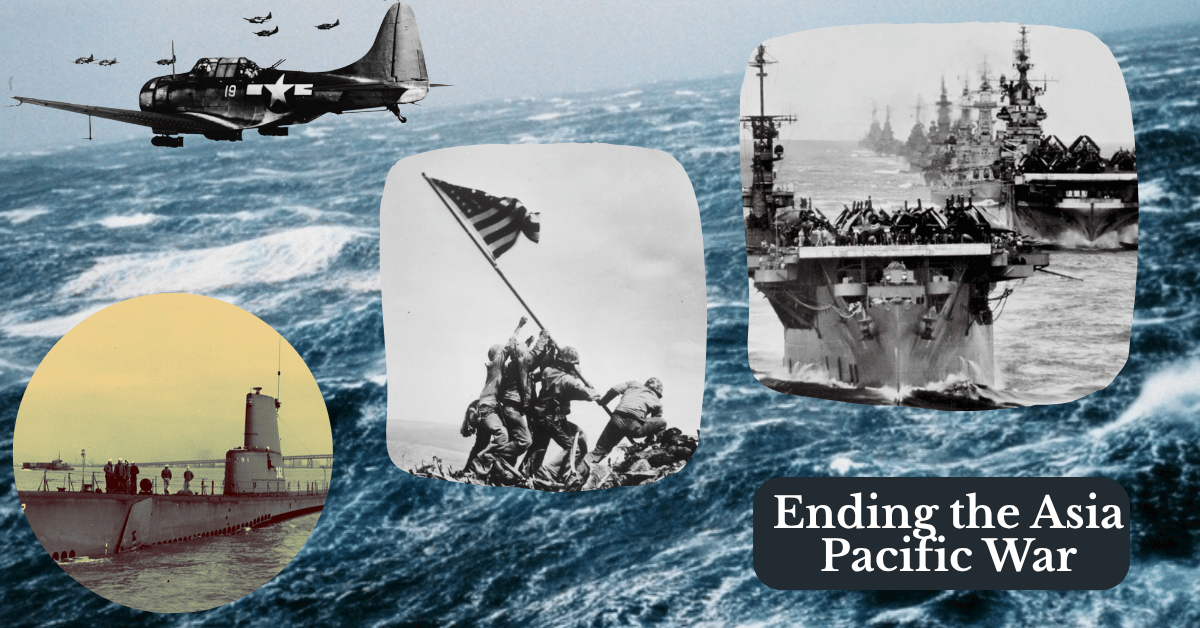
Image credit: various photographs from Naval Aviation Museum, National World War II Museum, and US Navy Archives.
This coming Sunday is the 3rd Sunday in Ordinary Time. In yesterday’s post we looked to the people called to accompany Jesus on his mission. Today we discuss some insights about fishing in the first century as well as being “caught” in our time.
Clearly Jesus is calling the disciples to a life with him. But every “calling to” is by default a “calling from” in some sense. Fishing was not as easy as getting a boat and having at it. Fishing was controlled by the “powers that be” in two ways. (1) Commercial fishermen worked for the royal family or wealthy landlords who contracted with them to provide a specific amount of fish at a certain time. They were paid either with cash or with fish. (2) Fishermen leased their fishing rights from persons called “toll collectors” in the NT for a percentage of the catch. The “tax” could be as much as 40% (see Malina & Rohrbach, Social-Science Commentary on the Synoptic Gospels, p. 44).
Thus, Jesus calling fishermen is more than just calling them away from their families. It also involves a break from the “powers that be” — the wealthy and or the government — and into a new power: the reign of heaven. Carter (Matthew and the Margins) comments about significance of Jesus calling fishermen:
The double call narrative in 4:18-22, then, utilizes a common form to present Jesus as God’s agent enacting his commission to manifest God’s saving presence, the empire of the heavens, and to legitimate the beginning of an alternative community of disciples called to live on the basis of this reign. The calls occur in the midst of the empire’s close control of fishing whereby licensing, quotas, and taxation secure Rome’s sovereignty over the water and its contents. Jesus’ call contests this dominant reality by asserting God’s sovereignty and offering an alternative way of life. [p. 120]
While the fishermen have some economic resources, their social ranking is very low. In Cicero’s ranking of occupations (De Off 1.150-51), owners of cultivated land appear first and fishermen last. Athenaeus indicates that fishermen and fishmongers are on a par with money lenders and are socially despised as greedy thieves (Deipnosophistai, 6.224b-28c). The two characters have a socially inferior and economically precarious existence under Roman control. It is among such vulnerable people that God’s empire is first manifested. [p. 121]
At one level the phrase does bring up an image of the unwilling being netted and dragged into the boat/the church. Perhaps it isn’t so bad for parents to “drag” their children to church. Maybe we should “drag” more people into church, whether or not they want to come. Put up roadblocks on the street and force the cars into our parking lots! Or maybe the “dragging” indicates that the coming of the Kingdom is out of our control. We are going to be “caught” in its coming whether we like it or not.
Generally we view being captured in such a way as a negative thing; but we also talk about being “captured by love”. The relationship of love is often something out of our control. It happens to us. When its power runs its full effect, it means a change in life — marriage is as much a dying to the old life as it is the beginning of a new life. That new life brings with it new relatives, whether we want them or not. Being captured by Jesus’ irresistible call meant an end to the old life and relations for the fishermen, so that they might start begin a new life together as followers of Jesus
Image credit:Detail of Domenico Ghirlandaio: Calling of the First Apostles | 1481–82 | Sistine Chapel, Vatican | PD-US
In its history the Church has known fear. The empire wide persecutions during the first 300 years. There have been persecutions in Japan, Mexico, France, China and more. In our history, the faithful have had reasons to fear. These are the obvious and loud dangers. But there are also quiet dangers in the life of faith: fear that keeps us from acting.
In the first reading, Israel’s army has been paralyzed for forty days. They are armed, trained, numerous, and yet they do nothing. Goliath’s size and strength dominate their imagination. Fear has convinced them that the situation is impossible.
David sees the same giant, but he sees him differently. David remembers something the others have forgotten: what God has already done for Israel throughout history and what God has done for David. He recalls how the Lord saved him from the lion and the bear. His confidence does not come from denying danger, but from trusting God’s faithfulness in the past and trusting that same faithfulness in the days to come.
David refuses Saul’s armor. Some suggest that it would restrict the throwing notion needed for use of the sling. But David knows that the armor represents a false security; protection without trust. David steps forward with only what he knows, a sling and five stones, and with a conviction: “The Lord who saved me… will save me again.” There is still risk. Goliath is a formidable opponent. Faith does not eliminate risk; it chooses trust over paralysis.
In the Gospel, we encounter a different kind of fear. The Pharisees watch Jesus closely. Israel and Jerusalem have a history of rallying behind one “messiah” after another. In the end the Roman armies quell the commotion, people die, and it is up to the religious leadership to calm things down and assure the Romans they have it under control. They also know the dangers of laxity and corruption of the worship demanded of Israel. They know the privileges and take comfort in control, authority and certainty.
The Pharisees are afraid of what might happen if Jesus acts. So instead of rejoicing in the possibility of healing, they remain silent.
Jesus brings the contrast into sharp focus with a simple question: “Is it lawful to do good on the sabbath or to do evil, to save life or to destroy it?” Their silence reveals how fear can disguise itself as caution, even as fidelity. Jesus chooses to act and heals the man with the withered hand, knowing it will provoke hostility. Faith, for Jesus, means trusting the Father enough to do good even when the consequences are costly.
Both readings confront us with the same choice.
Fear tells us to wait, to protect ourselves, to avoid risk. Faith tells us to remember who God is and to act accordingly. Fear focuses on what might go wrong; faith trusts that God will be present no matter the outcome.
In our own lives, fear often sounds reasonable. It urges delay, silence, and caution. But faith asks a different question: What does love require right now?
Trust in God does not mean being reckless. It means refusing to let fear have the final word. It means stepping forward sometimes with nothing more than what we already have and believing that God will do the rest.
Today’s readings invite us to examine where fear has frozen us and where God may be calling us to act. Not because we are strong, but because God is faithful.
Like David, we are asked to trust not in armor, but in the Lord. Like Jesus, we are asked to choose life, even when we are being watched.
Because faith that acts, even imperfectly, is far more powerful than fear that never moves.
It would not be accurate to describe the evolution of the Japanese military in the latter half of the 19th century. It was a radical revolution. After the Meiji Restoration (1868), Japan’s leaders concluded that national survival required a modern, Western-style military. They dismantled the Tokugawa samurai-based system and built a centralized national force modeled on European powers. This was made possible by Universal male conscription (1873) replacing hereditary samurai service, creating a national military loyal to the emperor rather than to domains or lords.
In order to accomplish this radical change, Japan looked to the nations it considered threats to Japan’s independence. This was accomplished by adopting foreign military models under the tutelage of foreign advisors. The army was modeled on Prussian doctrine that emphasized discipline, general staff organization, and state-controlled command. The navy was modeled on the British Royal Navy, adopting British ship designs, training methods, and naval strategy. At the same time, Japan imported modern rifles, artillery, and warships, then rapidly developed domestic arms industries, arsenals, and shipyards to ensure self-sufficiency.
Essential to the development of a modern military was formation and education. To this end, western-style military academies, staff colleges, and technical schools were established, professionalizing the officer corps and emphasizing science, engineering, and modern tactics. Western techniques were combined with emperor-centered loyalty, making the military both modern in form and uniquely Japanese in spirit. In addition, the spirit and lessons of the samurai were not lost. Japan did not simply preserve samurai tradition; it selectively reconstructed it.
Bushidō and the Meiji Military
Under Tokugawa Shogunate rule, “samurai spirit” referred to class-based ideals: loyalty to one’s lord, honor, discipline, and readiness to die. After 1868, the Meiji state detached these values from the samurai class and recast them as virtues for all citizens, especially soldiers. This recasting of the “samurai spirit” became known as Bushidō, and was a national moral code, not a code restricted to the military. But it did serve as a bridge between Japan’s past and its modern conscript army. No longer was there feudal loyalty to a daimyō; loyalty was now absolute and directed to the emperor. The Meiji Constitution made the emperor the “command-in-chief” of the army and navy. Bushidō preserved the form of samurai loyalty while transforming its object.
Formation and indoctrination of Bushidō was incorporated into every level of military training. While Japan adopted western drill, weapons, and organization, it paired them with ethical and spiritual instruction drawn from samurai ideals. Soldiers were taught: endurance, self-control, obedience, and acceptance of death as honorable if done in imperial service. These ideals were reinforced from the oath of service and in every course of education and training. Bushidō was simplified from is historical samurai basis and then standarized for modern instruction.
Bushidō was also incorporated in symbolic practices and rituals. Ceremonial language was ripe with honor and shame, casting failure as disloyalty to comrades and especially to the Emperor. Rituals reinforcing collective identity, willingness to endure hardship, and death as preferable to dishonor. The officer corp carried swords as symbols of moral authority and leadership. Clearly in modern warfare, the use of the sword was limited, but at the end of World War II photographs of kamikaze pilots before their final mission showed the officers with their swords which were carried in the cockpit on the one-way flight. All of this was an effort to link the modern military psychologically to the samurai past.
Key writers and thinkers such as Nitobe Inazō positioned bushidō as Japan’s equivalent to Western chivalry, and proof Japan possessed a moral civilization worthy of great-power status. This intellectualization helped justify both military discipline at home and imperial mission abroad.
The fusion of western military structure, samurai-derived moral absolutism, and emperor-centered ideology produced a military culture that valued spirit (seishin) over material limits, encouraged endurance and sacrifice, and discouraged surrender and compromise. These traits became especially pronounced in the early 20th century. It is noteworthy that during World War II, less than 3% of imperial Japanese soldiers surrendered – and most of these were extremely sick, starving or critically wounded. In many instances, there were no Japanese survivors.
The effects of bushidō formation was strikingly evident in 20th century combat behavior.
preference for death over surrender
emphasis on spirit over material reality – commanders often stressed seishin (spiritual strength) to compensate for shortages in equipment or supplies, encouraging frontal assaults and last-stand defenses even when strategically unsound.
fanatical defensive tactics where soldiers fought to the last man in Biak, Pelilui, Tarawa, Iwo Jima, and Okinawa reflecting the belief that total sacrifice was the highest form of loyalty.
Banzai charges and later kamikaze missions were framed as noble offerings to the emperor, transforming death into a sanctioned military tactic.
harsh treatment of prisoners and civilians since their surrender was and thus the prisoners were viewed with contempt, brutalized and executed in violation of the Law of War to which Japan was a signatory.
It also led to actions and campaigns that were strategically and tactically questionable supported by the guise that the bushidō spirit would compensate for all the evident shortcomings.
At the advent of the 20th century
By the late 19th century, Japan possessed a modern, disciplined, and industrialized military, capable of defeating China (1894–95) and Russia (1904–05), demonstrating that Japan had successfully adapted Western military systems to its own political and ideological framework.
When Japan adopted a Social Darwinist lens, East Asia ceased to be a shared moral world and became a competitive ecological system. Bushidō was the ideological element needed to form the military and the citizenry to not simply remain competitive but to become the apex nation in the Asia-Pacific sphere.
Image credit: various photographs from Naval Aviation Museum, National World War II Museum, and US Navy Archives.
This coming Sunday is the 3rd Sunday in Ordinary Time. In yesterday’s post we explored the meaning behind the Biblical land travelog that opens our gospel passage. Today we look to the people called to accompany Jesus on his mission.
17 From that time on, Jesus began to preach and say, “Repent, for the kingdom of heaven is at hand.” 18 As he was walking by the Sea of Galilee, he saw two brothers, Simon who is called Peter, and his brother Andrew, casting a net into the sea; they were fishermen. 19 He said to them, “Come after me, and I will make you fishers of men.” 20 At once they left their nets and followed him. 21 He walked along from there and saw two other brothers, James, the son of Zebedee, and his brother John. They were in a boat, with their father Zebedee, mending their nets. He called them, 22 and immediately they left their boat and their father and followed him. 23 He went around all of Galilee, teaching in their synagogues, proclaiming the gospel of the kingdom, and curing every disease and illness among the people.
Matthew includes the first of two important markers for the ministry of Jesus by telling us that “From that time on Jesus began to preach …” (4:17). The focus of the Gospel is no longer the identification of Jesus based upon the witness of others, but rather Jesus’ self-revelation in his words, deeds and signs. It is in these things he is revealed as the messenger of the Covenant, the King who declared that the kingdom of heaven was breaking into the experience of men and women.
The beginning of this record of Jesus’ ministry is marked by a note about those who followed him. Two sets of brothers are called by Jesus and become the first disciples. They are Simon Peter and Andrew, followed by James and John. The first call to discipleship is to fishermen, whose work is now to be ‘fishers of men’ – pointing to the later commissioning and mission to Israel and then to the ends of the earth. In addition to the special call of the disciples, the ministry of Jesus calls out to a wider audience. As he teaches throughout Galilee and heals the sick, “great crowds followed him” (4:25). But he does more than heal, Jesus is setting the stage to bridge to the “Sermon on the Mount.”
“From that time on, Jesus began to preach and say, “Repent, for the kingdom of heaven is at hand.” The very wording of the passage indicates a fresh start, a new phase of Jesus’ activity. At the heart of this new ministry is the proclamation of a message identical with that of John the Baptist (3:2), and later to be echoed by Jesus’ disciples (10:7). Jesus calls for a decisive response to a new situation, the arrival in his ministry of the kingdom of heaven.
The first to make that decisive response are the first disciples. The story of the call of Simon Peter and Andrew is very similar to the following story about the call of James and John. Both stories echo the story of Elijah’s call of Elisha (1 Kgs 19:19–21; and the prophets generally, cf Amos 7:15) – people divinely called, uprooted from ordinary existence. The calls similarly possess a four part structure: (1) the appearance of Jesus; (2) the comment on the work of the prospective disciples; (3) the call to discipleship; and (4) obedience to the call.
The first disciples encountered Jesus coming to them in their everyday occupation of fishing in the Sea of Galilee — then as now, an important and profitable business in Israel’s economy. It is easy to assume that Jesus has made an ad hoc metaphor. However, the image of a deity calling people to a new life – in both Judaism and local pagan cults – as “fishing” was common. The common theme of this metaphor was that the person was being called to participate in the divine work. Here God’s saving and judging mission to the world is represented by Jesus who calls disciples to participate in the divine mission to humanity. This scene anticipates the formal mission sending (9:36 ff) and the wider mission imperative to the whole world (28:19-20)
Without any preparation and with little or no deliberation, they leave behind their business and their families in order to follow Jesus. Discipleship is first and foremost being with Jesus, and the quick response of the first disciples (“at once” according to verses 20, 22) suggests how appealing the invitation to be with Jesus must have been. But discipleship also involves sharing in the mission of Jesus (“fishers of men” according to v.19), and that dimension too is stressed from the very beginning.
Boring (The Gospel of Matthew, 169) notes that “Despite its small size, this pericope represents a major subsection of Matthew’s structure…The call of the first disciples is the beginning of the messianic community: the church. Jesus’ baptism and temptation were not merely individualistic religious experiences of a ‘great man,’ but the recapitulation of the birth of Israel in the Red Sea and the wilderness testing; they lead to the formation of a new community, the Messiah’s people (1:21).”
It is here that we gain some insight into Matthew’s understanding of discipleship. A modern reader is tempted to refashion this biblical picture of discipleship into more manageable categories: accept Jesus’ principles for living, accept Jesus as a personal savior. Jesus “barges” into our midst and does not call us to admire him or accept his principles, but issues the divine imperative to follow him. The reasonable reply, “Where are you going?” is suborned to discovery along the way. Even without the language, the call of the disciples is a story of “belief,” “faith” and “trust.” Dietrich Bonhoeffer, in The Cost of Discipleship, notes that Jesus comes to men already leading useful lives.
Image credit: Detail of Domenico Ghirlandaio: Calling of the First Apostles | 1481–82 | Sistine Chapel, Vatican | PD-US
In the previous post we considered the late 19th-century events in Hawaii that led to the overthrow of the Hawaiian constitutional monarchy and eventually the annexation of Hawaii as a U.S. territory. The post ended with the Japanese reaction to these events. This post explores the lens through which the Hawaii events were seen and the rationale for the coming wars with China (1894-1895) and Russia (1904-1905). It also forms the basis on how the United States will be increasingly seen from Japan’s point of view.
If you ask most people who coined the phrase “survival of the fittest,” the most probable reply is Charles Darwin. But the correct answer is Herbert Spenser, a 19th century English philosopher. He is best known for his theory that, much to his chagrin, came to be known as Social Darwinism. Spenser’s work was based on the evolutionary theory of Lamarck, who posited that organs are developed or diminished by use or disuse and that the resulting changes may be transmitted to future generations. Spenser applied this view of evolution to society, proposing that societies, like organisms, evolve from simple to complex, and individuals/groups best adapted to competition thrive (“survival of the fittest”). He might be thought of as sociological “libertarian” as he advocated for minimal government interference (laissez-faire) to allow natural progress through specialization and adaptation, viewing society as an evolving organism. He argued for individual liberty and believed societal advancement comes from the “fittest” succeeding, leading to a more complex, efficient world.
When Spenser’s work reached late-19th-century Japan it reshaped elite thinking leading to a re-evaluation and view of China and East Asia after the Meiji Reforms. The core assumptions absorbed in Japan was that the nations compete like organisms in which there will always be a struggle for the resources that make life flourish and history will be governed by conflict in which weak states are absorbed or eliminated. Moral intention will not stave off extinction. For a nation that had long been invested in Confucian life where virtue and moral order are essential elements, the shift away from moral intentions to survival of the fittest, the natural pathway was imperialism and permanent competition for local, regional and global dominance.
It was a rapid shift away from traditional and classic ways of understanding the world order because they watched it unfold in the living laboratory called China. For Japanese elites and leaders social darwinism was evident in the Opium Wars, the Unequal Treaties, loss of economic control, and disintegration of internal cohesion. China became the empirical proof that moral civilization without power equals extinction.
Even before Spenser’s work reached Japan in 1870, Fukuzawa Yukichi published “Conditions in the West,” a meditation based on his observations in Europe and America. He introduced the concept that international relations operate by power, not morality and as a result weak nations are exploited regardless of virtue. He pointed out that China, while being morally refined, is politically helpless, no nation at all and is subjugated to the economic interest of the non-Asian world powers.
Among Japanese elites the dialogue asserted that Asia was collectively at risk, only strength and modernization could prevent subjugation, and equality would be granted only to those who could enforce it. Thus national survival required military parity, industrial capacity and territorial buffers
In 1882 Katō Hiroyuki published “A New Theory of Human Rights,” work in which Katō explicitly rejected natural rights, arguing that rights arise from power. He applied what was essentially evolutionary logic to politics: “The strong rule; the weak are destroyed—this is the law of nature.” Why this is significant is that his work marks the moment when evolutionary struggle became normative political theory. And then Spenser’ s work was translated by Katō and was propagated throughout academic journals tied to Tokyo Imperial University. Spencer’s philosophy opposed imperial aggression, but the Japanese elite emphasized struggle and survival.
In 1886, Tokutomi Sohō moved social darwinism to general readership with his work “The Future Japan.” In the popular work he combined social darwinism, national destiny, and historical inevitability. He argued that nations are competing organisms with only two outcomes: domination or eradication. He used China as the proof. This text popularized elite theory for mass readership, turning Darwinism into common sense.
In 1890 social darwinism was explicitly militarized as state strategy in the writings of Yamagata Aritomo. He was not translating western works, but synthesized western military theory to highlight key elements of national strategy: buffer zones and strategic depth. His famous idea was describing Korea as “a dagger pointed at the heart of Japan.” Yamagata asserted that since conflict was inevitable, preemptive expansion was critical and the first goal was Korea. If Japan did not dominate Korea, another power would.
The ideas of Yamagata pointed to zones of survival that were more than geography. Given Japan’s lack of many natural resources, Manchuria became seen as a repository of needed resources and a buffer against Imperial Russia. Zones of survival were never neutral. It was in this view that imperialism was not aggression but was defensive in nature. The implications are that the “empire” was inevitable and forced by global conditions. This allowed Japanese leaders to claim: “We do not seek conquest; we seek existence.” It is a logic that removes ethical restraint.
Another important work was “Leaving Asia (1985) by Fukuzawa Yukichi. It was an essay that argued that Japan must separate from backward Asia (pointedly referring to China and Korea). Strategically this transformed these two nations to “zones of survival” for their resources and to position to serve as a buffer against major powers.
The evolving integration of social darwinism into national polity and strategy began to transform Pan-Asianism. Early Pan-Asian thought was focused on solidarity among Asian nations in order to form a mutual defense in terms of culture, economy and border integrity. But under the concepts of social darwinism, Asia needed a leader. Japan’s view was that they were the only viable candidate. Solidarity was replaced by the architecture of hierarchy within Asia.
This thinking was not uniform across the range of Japanese elites. Some Pan-Asian thinkers opposed the imperialism embedded in the fusion of the two forms of strategy. At the same time, business leaders worried about economic stability and national budgets being redirected to military expansion. But military and bureaucratic elites set the national policy
What this means is that, depending on who governed, international relationships would be increasingly less reliant on the role of diplomacy as international relations became zero-sum, evolutionary and amoral. This logic carries will become evident in the First Sino-Japanese War (1894–95), the Russian-Japanese War (1904–05), the aftermath of the Mukdan Incident (1931) and the Second Sino-Japanese War (1937-1945; the opening action the the Asia-Pacific War) and in the attack on Pearl Harbor.
When Japan adopted a Social Darwinist lens, East Asia ceased to be a shared moral world and became a competitive ecological system. China was re-imagined not as a fallen elder brother but as an endangered species whose weakness threatened Japan’s own survival. Russia, Britain, France, Holland, Germany, and the United States were existential threats to Japan’s independence.
From this perspective, imperial expansion was a necessity for the very sake and survival of the nation.
Image credit: various photographs from Naval Aviation Museum, National World War II Museum, and US Navy Archives.
This coming Sunday is the 3rd Sunday in Ordinary Time. In yesterday’s post we placed our gospel reading in context of the unfolding of the events after Jesus’ time in the desert and before the calling of his disciples. In today’s post we explore the meaning behind the Biblical land travelog that opens our gospel passage.
12 When he heard that John had been arrested, he withdrew to Galilee. 13 He left Nazareth and went to live in Capernaum by the sea, in the region of Zebulun and Naphtali, 14 that what had been said through Isaiah the prophet might be fulfilled: 15 “Land of Zebulun and land of Naphtali, the way to the sea, beyond the Jordan, Galilee of the Gentiles, 16 the people who sit in darkness have seen a great light, on those dwelling in a land overshadowed by death light has arisen.” (Mt 4:12-16)
Jesus’ first stop in Galilee was Nazareth, the village where he grew up (2:23). Matthew does not dwell on Nazareth (cf. Luke 4:16–30), preferring to stress Capernaum because its location has prophetic significance. Capernaum is on the northwest shore of the Sea of Galilee, roughly two miles west of the Jordan River.
While Capernaum is mentioned in the other Gospels as a scene of Jesus’ ministry, only Matthew makes explicit that Jesus now made it his home or at least a ‘base’ to which Jesus and his disciples returned from time to time from their itinerant ministry. Matthew’s reason for mentioning this may be due to his own connection with the town where he served as a tax collector (Mt 9:9) or there may be a more theological motive in stressing the unique opportunity offered to this town which failed to believe (11:23–24). In any case, Capernaum, as a busy lakeside town, ensured a wider audience for Jesus’ teaching than Nazareth; leaving Nazareth may also reflect the rejection of Jesus by his own people recorded in Luke 4:16–30.
Because Capernaum is not mentioned in the OT, Matthew stressed its location in the territory of Zebulun and Naphtali (cf. Joshua 19:32–39); these two are mentioned in Isaiah 8:22-9:2. The territory of these two tribes was the first to be devastated (733-32 B.C.) at the time of the Assyrian invasion.
The expression “the way to the sea, beyond the Jordan” in Isaiah describes Galilee from the perspective of the Assyrian invader, as the land west of the river. “Galilee of the Gentiles” was now an even more appropriate description than in Isaiah’s day, as successive movements of population had given it a predominantly Gentile population until a deliberate Judaizing policy was adopted by the Hasmonaean rulers, resulting in a thoroughly mixed population in Jesus’ time.
Matthew finds that the area is the place of revelation of the Jewish Messiah in Isaiah’s prediction of new light dawning in Galilee after the devastation caused by the Assyrian invasion. After Isaiah’s prophecy to King Ahaz that the Lord’s sign to him was that a virgin would give birth (Is 7:14), Isaiah goes on to prophesize of a new salvation under a future Davidic King in which the lands lost to the Assyrian King Tiglath-pileser III in Ahaz’s time, would be restored to the rule of the throne of David. Isaiah describes those lands as “distress and darkness, oppressive gloom, murky, without light” (Is 8:22). It was true during the time under Assyrian rule, but even in Jesus’ time Galilee was often the underdog both in political fortunes and in the eyes of official Jewish religion. But in Jesus’ ministry in the region “the people who sit in darkness have seen a great light, on those dwelling in a land overshadowed by death light has arisen” (Mt 4:16)
Matthew connects the political darkness facing Israel in the days of Isaiah to the spiritual problem that caused it. Israel’s defection from the Mosaic covenant had led to her oppression by other kingdoms. Centuries later the linger effects point to the need for the redemption from sin that was now coming through Jesus the Messiah. In this way, Matthew highlights another fulfillment theme. Galilee was looked down upon by the Jerusalem establishment and those who supported it. Its population was a mixture of Jews and Gentiles. It was to this darkened place (cf. Ps 107:10; Luke 1:79) that Jesus brought the light of the Kingdom of God. His mission was not primarily geared toward the Gentiles during these early days of the Galilean ministry, but the beginnings of Jesus’ ministry in a remote, despised place, largely populated by Gentiles, foreshadows the expansion of mission to all the nations at the end of Jesus’ ministry (Mt 28:19).
Detail of Domenico Ghirlandaio: Calling of the First Apostles | 1481–82 | Sistine Chapel, Vatican | PD-US
Old garments and old wineskins represent the established religious practices, traditions, and structures of Judaism at the time, particularly those associated with the Pharisees and their legalistic interpretations of the Law. New cloth and new wine symbolize Jesus’ ministry, His teachings, and the Kingdom of God. This new way of life emphasized grace, faith, and a renewed covenant relationship with God rather than strict adherence to rituals and traditions.
Just as an unshrunk cloth will tear an old garment and new wine will burst old wineskins, the message and life Jesus brings require a transformation. Trying to merge the old and the new will lead to conflict and possibly destruction given the inherent nature of the old and new.
Jesus is inviting people into a renewed relationship with God that goes beyond the limitations of the old covenant. The “new wineskins” symbolize the need for hearts and lives to be transformed and made ready to receive the dynamic, expanding reality of God’s Kingdom.
What will the next three years bring with our president, Senate and Congress, mid-year elections, tariffs, armed conflict, wars, rumors of war… and the list goes on. Is this new wine trying to be poured into old wineskins? Old wine into new wineskins? Will things come apart at the seams? Who knows? Time will tell if the next four years are transformative.
On this day I wonder about the old and the new as I recall Dr. Martin Luther King’s Letter from the Birmingham Jail where he writes: “…. In the midst of a mighty struggle to rid our nation of racial and economic injustice, I have heard many ministers say: “Those are social issues, with which the gospel has no real concern.” And I have watched many churches commit themselves to a completely other worldly religion which makes a strange, un-Biblical distinction between body and soul, between the sacred and the secular.” These words were written 62 years ago. Are they “old” or “new” wine? Do they have transformative power?
Dr. King went on to wonder with deep disappointment at the laxity of the churches to respond to the injustices in the world. He wrote:
“There was a time when the church was very powerful – in the time when the early Christians rejoiced at being deemed worthy to suffer for what they believed. In those days the church was not merely a thermometer that recorded the ideas and principles of popular opinion; it was a thermostat that transformed the mores of society. Whenever the early Christians entered a town, the people in power became disturbed and immediately sought to convict the Christians for being “disturbers of the peace” and “outside agitators.”’ But the Christians pressed on, in the conviction that they were “a colony of heaven,” called to obey God rather than man. Small in number, they were big in commitment. They were too God-intoxicated to be “astronomically intimidated.” By their effort and example, they brought an end to such ancient evils as infanticide and gladiatorial contests. Things are different now. So often the contemporary church is a weak, ineffectual voice with an uncertain sound. So often it is an arch defender of the status quo. Far from being disturbed by the presence of the church, the power structure of the average community is consoled by the church’s silent–and often even vocal–sanction of things as they are.”
These are some who proclaim that as a nation we are at an intersection of rights, freedom, rule of law, and even the foundation of the Constitution. But you know….as Church and as believers we are always at that intersection, year in and year out. We are not called to be thermometers that simply reflect the temperature of civil society. We are always called to be the thermostat that transforms the mores of society to model the teaching of Jesus and the Kingdom of God. Democrats and Republicans come and go. Opinions rise and fall. Dr. King knew that even 2000 years later, the words of Jesus are ever “new wine” – everlasting words.
In the days, weeks, months and years to come lots of words will come from our civic leaders. Surely, they will be different words, but test these words against the Word of God lest we and the Church become thermometers that only reflect the ebb and flow of secular power.
The history of how Hawaii came to be part of the United States is not, in my opinion, a shining moment in our nation’s history. The Hawaiian archipelago consists of five major islands and a number of smaller islands – including Midway at the extreme northwest. The five major islands and several smaller ones in proximity were united under the great King Kamehameha in 1795. It was not a bloodless unification, but the Kamehameha dynasty was the reigning monarchy of the Hawaiian Kingdom. The Kingdom was formally recognized by the United States in 1846 and as a result of the recognition of Hawaiian independence, the Hawaiian Kingdom entered into treaties with the major nations of the world and established over ninety legations and consulates in multiple seaports and cities.
Europeans had first come across the islands in the late 1700s and by the 1790s was an active destination for American merchants. The arrival of outsiders brought new technologies, goods, diseases, and political dynamics, ultimately leading to Kamehameha’s unification of the islands. One of the key elements of Hawaiian that outsiders quickly encountered was that the land is a gift and not to be owned by individuals. It is a concept that the Hawaiians managed well enough in the normal matters of houses, villages, farms and the such. It was a concept unthinkable to merchants, missionaries, and members of the western business community.
Over the next 100 years more and more outsiders came to the islands. American merchant ships began stopping in Hawaii for supplies, and some sailors jumped ship to live among Hawaiians. The first wave of Americans were the New England missionaries who arrived in 1820. They were soon followed by business men, investors, and all manner of commerce. Plantation agriculture first appeared in Hawaii with the establishment of the first permanent sugar plantation in 1835, marking the start of large-scale commercial sugarcane production that would define the islands’ economy for over a century. It also led to immigration from China and Japan.
Immigration to Hawaii
Between 1852 and 1899, around 46,000 Chinese immigrated to Hawaii. Although many came as laborers for sugar plantations in Hawaii, they concentrated on getting education for their children. When their contracts expired, many decided to remain in Hawaii and opened businesses in areas such as downtown Honolulu’s Chinatown.
In 1868 the first documented group of Japanese immigrants arrived seeking work in Hawaii’s sugarcane and rice fields, though this initial wave was small. The major waves began in 1885 when the first large-scale, government-sponsored group of almost 1,000 Japanese laborers arrived, following King Kalākaua’s diplomatic efforts to secure workers from Japan for the plantations. Following this, many Japanese women arrived as “picture brides,” marrying men they’d only seen in photographs to join the growing immigrant community. In time, the Japanese community was well established in the islands.
All during this period land ownership was a constant source of friction between the native Hawaiians and the outsiders. In 1875, the U.S. considered Hawaii as critical to their national interest in the Pacific region and began discussions with the Hawaiian government about the use of Pearl River Lagoon as a naval base. We know the area as Pearl Harbor.
Imperialism from within
During the summer of 1887, while the Legislature was out of session, a group of Hawaiians (most also U.S. citizens) with land and business interests, essentially hijacked the nation. Under the threat of armed revolt and assasination, King Kalakaua signed what is known as the Bayonet Constitution. This resulted in disenfranchising two-thirds of the native Hawaiians as well as other ethnic groups who had previously held the right to vote but were no longer able to meet the new voting requirements. The new constitution was to the benefit of the white, foreign plantation owners. Of interest to this series is that Asian immigrants were completely shut out and were no longer able to acquire citizenship or vote at all.
The ruling elite almost immediately began to petition the U.S. to annex Hawaii. They sent a delegation to Washington in 1894 seeking annexation, but the new President, Grover Cleveland, opposed annexation and tried to restore the Queen. Spurred by the nationalism aroused by the Spanish-American War, the United States annexed Hawaii in 1898 at the urging of President William McKinley. Hawaii was made a territory in 1900.
Why annex Hawaii?
What were the considerations when the U.S. annexed Hawaii? Perhaps it can best be explained in three arenas: strategic considerations, economic motivations, and political rationale.
The strategic motivations can arguably be seen as an extension of “manifest destiny” extended into the Pacific for access to Asian markets. At the same time, acquiring territories like Florida and Louisiana was crucial to secure borders, control Gulf Coast ports, and prevent European powers from establishing footholds near U.S. territories. In the same light, security and economics merged by establishing Hawaii (Pearl Harbor) and the Philippines as vital naval bases and coaling stations, projecting American power into the Pacific and challenging European empires. This was also part of the political calculus
Economic motivations were basic: American industry needed raw materials and new consumers, making territories rich in resources or with potential trade routes in the Pacific highly valuable. This also gave added impetus to the development of west coast ports such as San Francisco, Los Angeles and Portland.
From a distance
By the 1880s Hawaii had become strategically and demographically important to Japan as Japanese laborers were the single largest ethnic group on the islands with many under state-supervised emigration contracts. Hawaii was also strategically important sitting astride Pacific sea lanes. Japanese naval planners viewed it as vital to Pacific security. Hawaii also had a symbolic importance to the Japanese. It was an independent non-Western monarchy, like Japan. Thus, its fate was watched closely as a test of whether non-Western states could survive. Thus Hawaii was both a practical concern (citizens, trade, security) and a symbolic mirror of Japan’s own vulnerability.
After the Hawaiian coup, Japan formally protested, viewing the coup as an illegal seizure of power and a threat to Japanese residents’ rights. The protests focused on unequal treatment of Japanese subjects as agreed to under international law. Japan dispatched the warship Naniwa to Honolulu (1887) to signal their protest in sign of deliberate restraint as there was no attempt to restore royal authority.
Despite outrage in some Japanese newspapers and among naval officers Japan feared diplomatic isolation and being labeled an “uncivilized” power – and mostly conflict with the United States and Britain. Many Japanese commentators concluded: “Even civilized, independent states can be destroyed if they lack power.” This sentiment was to come to a fuller fruition in the years to come.
When the U.S. annexed Hawaii, there were diplomatic objections similar to the ones a decade earlier, but there was also a pragmatic realism: Hawaii was firmly within the U.S. sphere. At the same time Japan was between wars in their own home region. The First Sino-Japanese War had just concluded and other war clouds were gathering for possible conflict with Russia. Japan protested symbolically but accepted the new reality.
Lesson learned
The events in Hawaii had a tremendous influence on the Japanese strategic mindset. The elites and military of Japan drew these lessons:
International law follows power
Legal sovereignty offers no protection without force.
Western powers will not tolerate non-Western autonomy in strategic zones
Emigration creates strategic vulnerability
Japan must secure its own buffers and so Korea and Manchuria became increasingly urgent.
Japan responded to the Hawaiian crisis with protest and symbolic force but no intervention, and it accepted U.S. annexation as unavoidable—drawing from Hawaiʻi the sobering lesson that even “civilized” non-Western states could not survive without overwhelming power, a conclusion that hardened Japan’s later imperial strategy.
Image credit: various photographs from Naval Aviation Museum, National World War II Museum, and US Navy Archives.

 friarmusings