This coming Sunday is the 3rd Sunday in Ordinary Time, Lectionary Cycle A when our primary gospel source is from St. Matthew. Our gospel passage is placed after the heavenly voice has identified Jesus as the Son of God in whom He is well pleased in the baptism account (3:13–17). It also follows the text where Jesus proves what kind of Son of God he is during the temptations in the desert (4:1–11). In our passage Jesus journeys from Judea to Galilee in order to begin his public ministry (4:12–17). In the course of this journey Jesus will call his core disciples (vv.18-22) and witness to his proclamation with powerful deeds (vv.23-25). His journey will cover the wilderness of Judea and the towns of Galilee. This begins with the barest of comments: “When he heard that John had been arrested, he withdrew to Galilee.” (v.12)
From the beginning of Matthew’s narrative up through the “temptation” in the desert (4:1-11) we have been introduced to Jesus of Nazareth, Israel’s Messiah and Son of God. A rich profusion of scriptural quotations and allusions has traced a variety of prophetic themes and connection, which as a whole, point to the coming of Jesus as the time of fulfillment of God’s desire and hopes for his people. Jesus has been marked as the one who will carry the work announced by John the Baptist into the era of judgment and salvation promised from of old by God. It is here in our gospel reading that the stage is now set for the public ministry of Jesus to begin in earnest.
Following the arrest of John the Baptist, Jesus began his own ministry in the territory of Zebulun and Naphtali, in the region of Capernaum (v.12). While the verse offers the “when” the simple verse does not explain the “why there?” Unlike Mark (Mark 1:14–15), Matthew feels obligated to explain in some detail why the Messiah should begin his public ministry in Galilee rather than in Jerusalem and Judea.
We know that, as Josephus tells us (Antiquities. 18:118), Herod Antipas saw the baptizing movement as a potential source of sedition. If Jesus had inherited that movement, then it is reasonable that Jesus would have been on Herod’s radar. But there is nothing to indicate that such succession was either real or planned. Would there be some risk in being associated with John the Baptist? Perhaps. What is clear is that Jesus “withdrew” from the south. “Withdrew” translates a word (anachōreō) used several times in Matthew and is associated with danger (see Mt 10:23; 12:15; 14:13; 15:21). There is something in Matthew’s use of “withdrew” that points to a “strategic” move. For example, seeing John’s ministry continuing in the South, Jesus focuses the kingdom message of repentance on the north of Israel closer to his home in Galilee.
Matthew uses geographical location to indicate not only change of scene, but also as an indicator of God’s will. As was the case when Matthew tells of the magi, Herod and the flight to Egypt, geography is explained in light of the Scriptures: Jesus’ Galilean ministry is in accord with the words of Isa 9:1–2, and thus in accord with God’s will.
12 When he heard that John had been arrested, he withdrew to Galilee. 13 He left Nazareth and went to live in Capernaum by the sea, in the region of Zebulun and Naphtali, 14 that what had been said through Isaiah the prophet might be fulfilled: 15 “Land of Zebulun and land of Naphtali, the way to the sea, beyond the Jordan, Galilee of the Gentiles, 16 the people who sit in darkness have seen a great light, on those dwelling in a land overshadowed by death light has arisen.” (Mt 4:12-16) We will explore the idea of geography/fulfillment in a later post.
Detail of Domenico Ghirlandaio: Calling of the First Apostles | 1481–82 | Sistine Chapel, Vatican | PD-US
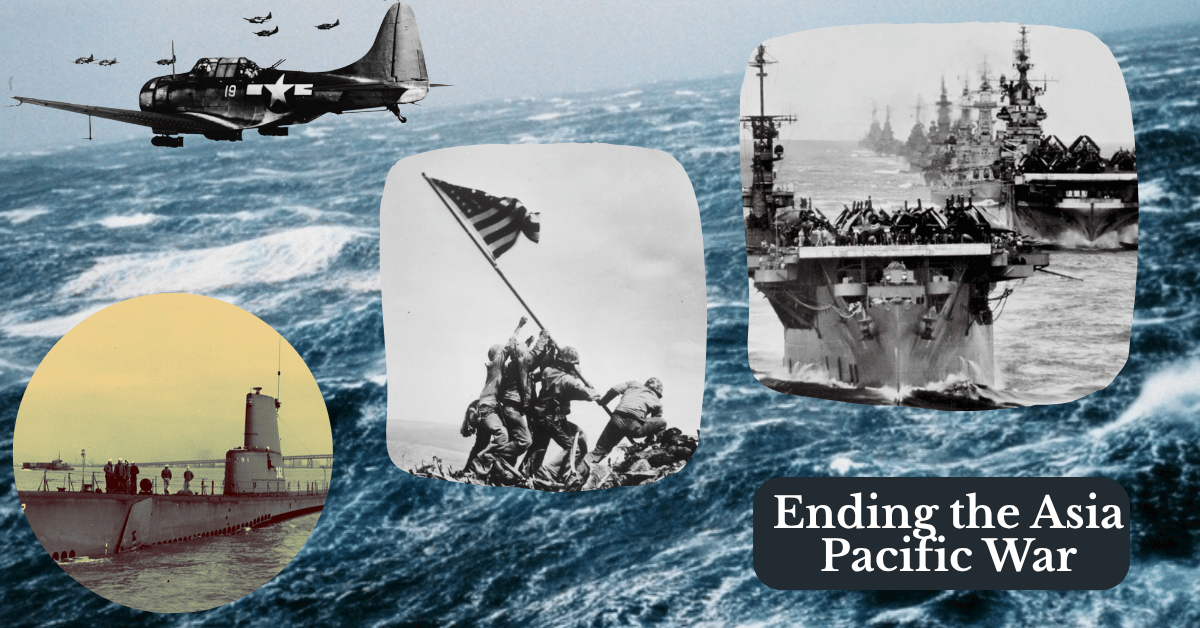
Thanks to all who have been reading the series. I wanted to let you know that I have divided the series “Ending the Asia Pacific War” into different categories as I ran into a technical limit on the blog for showing previous posts on their own page with an associated menu item.
The original series which ran from August to November 2025 can be found under the menu item: WW II
The new series which began in 2026 can be found under the menu item WW 2
Enjoy
Image credit: various photographs from Naval Aviation Museum, National World War II Museum, and US Navy Archives
Have you got some plans for the rest of the day? It’s playoff time for the NFL. Maybe you’re going to gather with friends and watch the game? Have plans for the week? A summer vacation? We all have plans of one sort or another. God has plans. He had them for you. Had them for John the Baptist and Isaiah, too. And the thing is that God’s plans turn out to be larger than anyone first imagined. That is true for Isaiah, for John the Baptist, for the Apostles, and if we are paying attention, even for us.
In the first reading, Isaiah, the servant, seems pretty clear about his sense of vocation. He knows he has been called by God, formed from the womb, named and claimed. And yet his initial understanding of what God is calling him to do, seems huge. “Isaiah, I need you to gather back all the people and restore Israel to be my Covenant People.” These are people that are scattered from Jerusalem to Baghdad and points East. This is no small task; noble and necessary, but huge. But that is not even the full scope of God’s plan. “It is too little… I will make you a light to the nations, that my salvation may reach to the ends of the earth.” Did you catch that: to the ends of the earth. What Isaiah thought was the whole mission turns out to be only the beginning. God’s plan is vastly larger.
We see the same pattern in the Gospel. John the Baptist is at the Jordan River, likely at the same spot where the people first entered the Holy Land after the wilderness years of the Exodus. It was a sign that they were a Covenant People as they accepted what God had promised Abraham, Issac, Jacob and Moses – a land of their own; the Promised Land. And now John the Baptist has his mission: call the people to repent and recommit themselves to be that Covenant People. John has no idea that he is at the start of something much longer. He knows his role, but not the full scope of what God is about to reveal.
And then he sees Jesus coming toward him and says something no one could have predicted: “Behold, the Lamb of God, who takes away the sin of the world.” Not the sin of a few. Not the sin of Israel alone. But the sin of the world. It is the parallel to Isaiah’s “ends of the earth.” It is becoming clear that Jesus’ mission will cross over national, religious, and cultural boundaries. The scope of God’s plan is way fuller than what we could imagine. But maybe now we can look into the “rear view mirror” and see the pattern.
With Adam and Eve, God began with a family. With Moses, God formed for Himself a clan. In Abraham and Sara, this grows to become a tribe. It becomes a confederation of tribes with Moses and then a nation under David and the kings of Israel and Judah. But now with Jesus Christ, it is all the people of the world. This is the full scope of God’s plan.
This is how God works. God’s call begins in something familiar: a people, a place, a responsibility and then widens. And this pattern does not end with Jesus. If we are paying attention, we who follow Christ are always being drawn beyond what feels comfortable or sufficient. The Church herself is born from a mission that is always bigger than expected. Bigger than one culture, one language, one generation.
Even in our personal lives, God’s work often begins with a simple yes, only to reveal later that he was asking for much more than we first realized and offering much more than we might imagine. 41 years ago I said, “Sure, I can help with the Youth Ministry.”
Realizing we are being asked for more can be unsettling. Such moments require deeper trust. They demand that we loosen our grip on control and allow God to expand our vision.
We are Isaiah in our own time and place. We are the countless known and unknown ancestors in the faith. We are baptized, we are chosen – not because we are perfect, but because God desires us and wants to reveal ourselves to ourself and to others. Slowly, sometimes awkwardly through prayer, experience, ministry, and the movement of the Spirit. We are sent. Go, the Mass has ended. We are sent on missions, not necessarily far away, but into the places where our lives already touch others.
The challenge is that each stage requires trust. Trust with a capital “T.” To trust the movement of the Spirit – even if it is only an inkling, a rumination, a passing thought. To trust that we are chosen even as we feel totally ordinary. To begin even when clarity is incomplete. To accept being sent when the mission feels larger than our ability.
And to trust that God always supplies grace for the mission. That was Isaiah’s experience. That was the experience of the Apostles. It has been the experience of the faith in the millenia since. When John the Baptist pointed to Jesus, he did not explain everything. He simply bore witness to what he had seen. And sometimes that is all faith asks of us: to stand where we are, to recognize what God is doing, and to allow ourselves to be drawn into a mission that is always bigger than we can imagine
This is the Way. It has always been the Way.
Here at the beginning of the year, at the start of Ordinary Time after the Christmas Season, in what way are you being called? Maybe it’s involved in ministry? Maybe being the one who animates family prayer? Perhaps you’ll start listening to the Bible-in-a-Year podcast during your commute to work. Volunteer to prepare meals for the homeless. It’s all there: pay attention to that inkling, rumination, or passing thought. Trust it is the movement of the Spirit. Don’t worry about the full scope. Take the next step.
It is the grace Nike moment of your walk in Christ. Just do it.
There is what scholars sometimes describe as a “lovely strangeness” in how the evangelists talk about John the Baptist. Each writer is announcing the same figure, but each tunes John’s ministry to a distinct theological key. Modern scholars tend to emphasize those distinct emphases; the Church Fathers, with their characteristic theological imagination, tend to harmonize them.
Mark leads with moral urgency. John appears in the wilderness: “proclaiming a baptism of repentance for the forgiveness of sins” (Mk 1:4). Repentance is the doorway into the story. John’s baptism cleans, prepares, and awakens Israel to the coming kingdom. Mark is writing for a community who needs to know that the gospel demands an immediate response. The Gospel of John gives a different angle. John the Baptist says: “I did not know him, but the reason why I came baptizing with water was that he might be made known to Israel.” (Jn 1:31) And the Baptist’s testimony climaxes in the Spirit descending and remaining: “I saw the Spirit come down like a dove from the sky and remain upon him.” (Jn 1:32). The Fourth Gospel is not denying repentance; it simply pivots to revelation. John is the hinge by which Israel sees the One upon whom the Spirit rests. The heart of John’s theology is revelation: Jesus is shown as the Lamb of God, the Spirit-bearer, the Son.
Modern scholars today tend to approach each gospel as its own literary and theological world. So they notice that Mark focuses on the ethical preparation of the people. John’s ministry cleans the heart so that one can welcome the stronger One who is coming, focusing on Christological revelation. The Baptist’s job is not primarily to purify Israel but to point out and identify Jesus as the one on whom the Spirit “remains” which will be a major Johannine theme. Modern critics don’t see these as contradictions but as distinct windows into the same historical event.
The Early Church writers in the 2nd through 4th centuries did not focus on the topics as modern scholars. The Father treated Scripture as a unified symphony, not a set of competing soloists. So they typically harmonize the accounts. They see the accounts as windows with complimentary views of the same historical event. Augustine, Chrysostom, and Hilary of Poitiers all say something like this: John’s baptism is first a baptism of repentance, preparing the people; it is also God’s chosen stage on which Jesus’ identity is revealed. John Chrysostom says that John called Israel to repentance so that they would be ready to see Christ when he appeared. Repentance clears the eyes; revelation fills them. Hilary notes that the Baptist is “the boundary between the covenants”—the last prophet of the old and the first herald of the new. His washing works as a sign, not as a sacrament; its value lies in its direction.
Either way, the outcome is the same: the Baptist’s ministry is a hinge between the old age and the new. The ministry calls Israel to turn back to God and pointing, unmistakably, to the One in whom the fullness of the Spirit dwells.
Image credit: Saint John the Baptist Preaching to the Masses in the Wilderness | Pieter Brueghel the Younger | Galerie de Jonckheere, Paris | Wikimedia Commons, PD-US
One of the enduring tensions in the life of faith is the tension between control and trust.
In the first reading, the elders of Israel come to Samuel with what sounds like a reasonable request: “Appoint a king for us to govern us, like all the nations to judge us.” They want stability, predictability, and protection. Their request is not irrational. Samuel himself is aging, and his sons have failed. The future is not looking so good. But God’s response reveals what lies beneath the request: “They have rejected me as their king.”
Israel is not simply asking for leadership; they are asking for control. I think that is something we can all relate to. We want something visible, centralized, and predictable. They want a system they can manage, even if it comes at a cost. Samuel patiently warns them of that cost: a king will take their sons, their daughters, their land, their labor. Control always demands payment. And still, the people insist.
Be careful what you wish for.
In the Gospel, we encounter a very different posture. The paralytic’s friends bring him to Jesus, but they cannot control the situation. The house is crowded. The path is blocked. There is no obvious solution. Yet instead of forcing outcomes, they trust. But notice it is not passively waiting in trust. They take some creative action as they continue to trust. They open the roof (Luke’s description is a little more vivid: they dig up the roof). With the passage cleared, they lower their friend into Jesus’ presence. At that point, they relinquish control, but not hope.
Jesus responds first not with a command to walk, but with words of forgiveness. This unsettles the scribes, who are deeply invested in controlling how forgiveness is mediated and who is authorized to offer it. Their objection sounds theological, but it is rooted in fear of losing control of their religious authority and status. Jesus exposes the contrast by asking: “Which is easier?” The real issue is do they trust that God is acting freely among them, or must everything remain contained within familiar structures?
The irony is striking. Israel asks for a king who will take from them, and God reluctantly allows it. A paralyzed man is brought to Jesus who gives everything: forgiveness, healing, restoration. Jesus asks nothing in return.
And what about us? These readings invite us to look honestly at our own lives. We, too, are tempted to trade trust for control. We want certainty before commitment, guarantees before obedience, clarity before faith. We prefer plans we can manage over dependence that leaves us vulnerable. It is a very human and natural inclination.
But the trust we are speaking about is very divine and supernatural. We know from our own experience that control offers only the illusion of safety and leaves us closed. The harder thing is trust but the upside is that trust opens us up to God’s grace.
The friends of the paralytic do not control the outcome. Heck they don’t even speak. But their trust speaks volumes and creates an opening where healing can happen. Israel, on the other hand, insists on control and receives exactly what they asked for, along with its burden.
The question these readings pose to us is simple and searching: where are we clinging to control when God is inviting us to trust?
God’s reign is never imposed through force or fear. It is proposed and received through faith. The kind of faith willing to open roofs, let go of certainty, and place what we cannot fix into God’s hands.
And when we do, we often discover that what God gives is far more freeing than anything we tried to control.
Jesus heals a paralytic | mosaic from Sant’Apollinare Nuovo – Ravenna | photo by José Luiz Bernardes Ribeiro | CC BY-SA 4.0
In the previous post we considered Japan’s 19th century transition from the Tokugawa Shogunate to the Meiji Restoration which transformed the nation of Japan to an outward facing nation, under the Imperial guidance of the divine Emperor, with a moral obligation to bring order and harmony to the Asian world in the face of western colonial power.
In this post, we need to “back up” and catch up with U.S. activities since the time of Admiral Perry’s 1853 visit to Tokyo Bay. In a previous post we noted that making the journey to China and maintaining the U.S. presence there also required a network of ports extending across the Pacific Ocean, and as such, the China trade soon drove the United States to expand its presence throughout the Pacific region. At its root, Perry’s primary mission was to establish a foothold that would strengthen the U.S. position for trade and diplomacy in the region. In other words, the United States opened relations with Japan in large part to enhance its status in China. On a smaller scale, as U.S. merchants began to stop at many of the Pacific Islands to replenish supplies and acquire goods to trade with Chinese merchants, the U.S. Government appointed consuls to several of these places. For example, consulates were established in Fiji in 1844, Samoa in 1856, and the Marshall Islands in 1881.
There was a lot going on in the period 1889-1900. I will mention some of the key events in order to keep them in context – and then go on to mention some later events with the United States – before returning the series to a more orderly arrangement.
The First Sino-Japanese War (1894-1895)
The U.S. annexation of Hawaii in 1898
The defeat of Spain in the the Spanish-American War of 1898
The China trade led to a growing U.S. presence in Hawaii that grew out of the need for a substantial base of maritime operations in the Pacific to support U.S. interests in China. Ultimately this need became so great, and the U.S. presence so large, that the United States annexed the islands in 1898. We will cover the annexation of Hawaii in its own post.
Following the defeat of Spain in the Spanish-American War of 1898, the United States acquired overseas colonies in the Caribbean and the Pacific. The two key Pacific acquisitions were the Philippines, Wake Island, and Guam in the Mariana Islands. Overnight the U.S. was solidly ensconced in the Central Pacific.
In one year the U.S. was in possession of locales that would be critical places in the Asia-Pacific War: Hawaii, Wake Island, Guam, and the Philippines. U.S. possession of Guam and the Philippines would be of principle concern for Japan.
In its new status as a global power, the United States pursued a series of policies designed to protect American territories and aggressively expand its international commercial interests. These policies included the promotion of the “Open Door” policy in China and the attachment of the Roosevelt Corollary to the Monroe Doctrine that formally announced the intention to use military force to defend the Western Hemisphere against European incursions. It was in this same period that President Theodore Roosevelt oversaw the construction of the Panama Canal, which would have profound economic implications for American trade and ease the movement of merchant and military shipping between Atlantic and Pacific regions. In just over a decade, the United States had redefined its national and international interests to include a large overseas military presence, overseas possessions, and direct engagement in setting priorities in international affairs.
It is noteworthy that from 1909 to 1913, President William Howard Taft and Secretary of State Knox followed a foreign policy characterized as “dollar diplomacy.” Taft shared the view held by Knox, a corporate lawyer who had founded the giant conglomerate U.S. Steel, that the goal of diplomacy was to create stability and order abroad that would best promote American commercial interests. Knox felt that not only was the goal of diplomacy to improve financial opportunities, but also to use private capital to further U.S. interests overseas. “Dollar diplomacy” was evident in extensive U.S. interventions in the Caribbean and Central America, especially in measures undertaken to safeguard American financial interests in the region. In China, Knox secured the entry of an American banking conglomerate, headed by J.P. Morgan, into a European-financed consortium financing the construction of a railway from Huguang to Canton. In spite of successes, “dollar diplomacy” failed to counteract economic instability and the tide of revolution in places like Mexico, the Dominican Republic, Nicaragua, and China. But the idea reflects the underlying principle: diplomacy, military capability, and business were at the root of America’s international interests.
Image credit: various photographs from Naval Aviation Museum, National World War II Museum, and US Navy Archives. Source credit: “Dollar Diplomacy, 1909–1913” | Office of the Historian, Department of State.
As noted above, this gospel lays out the story of a new creation that flows through the “next day” of our gospel reading and into the remainder of the first chapter. In that vein, Flannagan notes that a similar story is unfolding as witnesses to Jesus are gathered. It is the “new creation” of the people of God. No longer defined by ethnic association, but by belief in Jesus as the Son of God. Flannagan continues:
“There is another purpose that John, a man of rich creative genius, may have intended. His list of characters in this first act/period of seven days seems to typify the basic personal elements of the Christian community. In order there appear: (1) John the Baptist, precursor to the new creation, whose sole function is to witness; (2) the Savior; (3) disciples who hear, follow, look for, and stay; (4) Peter, the rock; (5) missionaries like Andrew arid Philip who spread the good news; (6) Nathaniel, the true Israelite in whom there is no guile, who, as some Jewish traditions expressed it, studied law under a fig tree and was rewarded. With this, the founding elements of the community are assembled.”
The Testimony. The Baptist makes clear that until seeing the descent of the Spirit upon Jesus, he did not know Him. This is not to say he had no idea about who Jesus was – after all they were cousins. Given that Jesus was brought up in Galilee and John in the Jerusalem area, perhaps they never met, or perhaps it had been since they were children and so Jesus was not recognizable. But by the time of this testimony, it is clear that the Baptist knows of Jesus and has a sense of his mission – even indicating “he existed before me…” We know the baptist is older than Jesus (cf. the Visitation story in Luke). Does the Baptist have an idea of the existence of Jesus before time itself? With all that is being revealed to the Baptist (by the Spirit?) it is no wonder that he remarks: “I did not know him” akin to “who is this guy, my cousin, I guess I really didn’t know him! But now I see…”
but the reason why I came baptizing with water was that he might be made known to Israel.” 32 John testified further, saying, “I saw the Spirit come down like a dove from the sky and remain upon him. 33 I did not know him, but the one who sent me to baptize with water told me, ‘On whomever you see the Spirit come down and remain, he is the one who will baptize with the holy Spirit.’ 34 Now I have seen and testified that he is the Son of God.”
Unlike the Lukan account, this gospel does not say whether the sign of the dove was included in the original revelation, or whether he simply recognized the dove for what it was when he saw it alight on Jesus. But what is clear is that he was given a divinely appointed sign, and that he knew Jesus by that sign. The Baptist is the one disciple who received true illumination about Jesus; every other disciple is dependent on another human witness.
John goes on to describe him as “the One who will baptize with the Holy Spirit.” The other three gospels make this point; Jesus came that people might be brought into contact with the divine Spirit who leads people into the infinite divine spiritual resources. This had not been possible previously, for there is a quality of life that Christ and none other makes available. Baptism with water in John’s time was a form of cleansing and an outward sign of repentance. Baptism with the Spirit portends a new thing. It is the bestowal of new life in God. In the Catholic understanding of Sacramental Baptism, both are accomplished. A person is cleansed of all sin and given the Spirit. It is an outward sign of an inward reality.
Image credit: Saint John the Baptist Preaching to the Masses in the Wilderness | Pieter Brueghel the Younger | Galerie de Jonckheere, Paris | Wikimedia Commons, PD-US
At this point in the series we have tried to give some sense and introduction to the currents of history that led the political, economic, and military stew that was the Asia-Pacific region in the mid-19th century. Some of the key elements include (and certainly not limited to):
The Opium Wars in China (1839 and 1857) and the fallout of these conflicts;
The U.S. fleet’s arrival in Tokyo Bay (1853) which led to the Treaty of Kanagawa which, not immediately, but eventually led to a more open posture of Japan to the world after 200 years of isolation; and
A self-view within Japan that in terms of culture, ethics, learning and more they were ready to be leaders in the Asian sphere
Via Dutch traders, Japan was aware of the Opium Wars in China, the unequal treaties that forced foreign trade upon China, and what the foreign powers were willing to do via military advantage. It became aware of how unprepared it was should these same foreign powers turn to Japan with the same intent. Concerned by Western incursions into Asia, particularly the Opium Wars’ impact on China and Commodore Perry’s forced opening of Japan, the Japanese sought firsthand intelligence on how China was handling the situation and the policies it adopted.
To that end, after two centuries of self-imposed isolation, in 1862, the Tokugawa Shogunate sent the sailing ship Senzai Maru to Shanghai as an unprecedented official mission by the shogunate to investigate trade and diplomatic conditions in China and learn from the Chinese experience with Western powers. The mission also hoped to open commercial and possibly diplomatic ties with China, which had been suspended for over 2 centuries.
The journey had a profound impact on Japan’s internal deliberations and future direction. The lessons learned in Shanghai, particularly witnessing the vulnerability of a closed-off nation to Western imperial powers, helped shift Japanese policy from isolationism to a reformist approach. This critical understanding contributed to the climate that enabled the eventual overthrow of the Tokugawa Shogunate
From Tokugawa to Meiji
The Tokugawa shogunate had established itself in the early 17th century. Under its rule, the shōgun governed Japan. About 180 lords, known as daimyōs, ruled autonomous realms under the shōgun. There was an Emperor, but the shōgun ruled. He set the tone and established a code of behavior for the nobility in 1605. Under the code, the emperor was required to devote his time to scholarship and the arts and was confined to the palace in Kyoto. Later, at the arrival of Western colonial powers as trading partners, a new power dynamic was introduced and with that an era of change. The western powers played the regional daimyōs against one another, who positioned themselves in regard to the Shogun (but not in ways always discernable for ill or for good). All the while the Emperor remained in Kyoto as something akin to a cultural icon of the ideals of Japan.
By the early 19th century the changing dynamic brought about within Japan led to a period of high inflation while at the same time samurai stipends were fixed. The same effects were felt among the feudal peasants but not among the ruling class and the merchants. All of this led to a crisis of authority. The Shogun, daimyōs, and their administrators (bakufu) appeared militarily weak, diplomatically incompetent, and unable or unwilling to defend Japan’s sovereignty against western manipulation. This triggered debate over who truly possessed legitimate authority to act in Japan’s name.
Some of the more powerful leading daimyōs invoked the Emperor as the source of ultimate legitimacy and as a rallying point against the controls and constraints of the bakufu. It was couched as a restoration of ancient practice but it was really a reinvention of imperial authority. As unrest spread a large number of young samurai, known as shishi or “men of high purpose”, began to meet and speak against the shogunate. The shishi revered the Emperor and rallied people to their side with the slogan “Revere the Emperor, Expel the Barbarians.” In January 1868, these shishi executed a coup d’état and seized the Imperial Palace in Kyoto, announced the abolishment of the Shogunate, and declared authority restored to the Emperor who adopted the reign name Meiji, meaning “enlightened rule”. There was a short civil war (Boshin War) that ended with the defeat of Tokugawa loyalists and the formal end of the Shogunate by 1869.
Long story, told short, these were the animating force that brought about the Meiji Reforms and ultimately the Meiji Constitution.
Japanese leaders realized they needed to modernize to avoid the humiliation suffered by China during the First and Second Opium Wars. After the old Tokugawa shogunate was overthrown during the Meiji Restoration, Japan initiated structural reforms resulting in rapid modernization, industrialization, militarization and imperialism modeled after the imperialistic Western powers.
The Meiji Restoration
It is important to understand that Meiji restoration was not, as claimed, a movement to restore ancient imperial rule. In reality it dismantled the existing means of governance, repurposed the bakufu, centralized power far beyond anything previously known in the history of Japan. The focal point of the restoration was the Meiji Emperor. He became the formal head of state and the symbolic center of loyalty and identity. But the real power lay with a small oligarchy of former samurai from the more powerful pre-Meiji domains: Satsuma, Chōshū, Tosa, and Hizen. The Tokugawa institutions were not completely discarded; many were adapted including the bureaucratic governance, legal codification, and the elites of the domains were incorporated into the positions wherein their expertise could be used, their ambitions controlled, and their wallets enhanced.
In the early Meiji period (1870s) the oligarchs and councils were the decision makers but the Emperor was cautiously used as the moral center of the coming changes. Some of the early and rapid reforms meant to consolidate power and control included the abolition of domains, end of samurai privileges, start of military conscription, national taxation, and education reforms.
Slowly the Emperor became the sacred focal point of the modern nation-state. This was enhanced even further when Shinto became the official “religion” of the nation. In 1889 the Meiji Constitution framed national sovereignty as emanating from the emperor – this was the notion of kokutai which held that national sovereignty and the emperor were identical.
The transition from Tokugawa to Meiji was not a popular uprising, nor a simple return to ancient rule, but a carefully managed elite revolution that used the emperor as a legitimating symbol to dismantle the old order and construct a modern state. A state that was preparing to face the challenge of western imperialism that had dismantled China.
Meiji and the Foundation of Expansionism
Under the Constitution, the emperor was no longer merely a symbol of unity. He was redefined not only as he kokutai, but as the moral center of the nation and the living embodiment of Japan’s historical destiny. This shift was crucial. Expansion could now be framed not as policy choice, but as moral obligation.
All of this was held to reside in the emperor by divine lineage. As such, the emperor possessed supreme command of the army and navy and authority over diplomacy and war. This structure had two consequences: military autonomy from civilian government and expansionist decisions could be justified as expressions of imperial will rather than partisan ambition. Once these actions were linked to the emperor’s sacred authority, opposition became disloyalty, not disagreement.
Sacred Nationalism
Long tradition held that the emperor was a descendant of Amaterasu, the Sun goddess. This belief was not part of Confucianism or Buddhism, but was grounded in Shinto, Japan’s indigenous religion that pre-dated history. Shinto is focused on reverence for nature, ancestors, and spirits called kami. Shinto emphasizes purity, harmony, gratitude, and sincere living rather than strict dogma or the teachings of a single founder. The Emperor was considered an embodied kami.
During the Meiji period Shinto was transformed into what is referred to as “State Shinto.” This was the government-promoted, nationalist ideology that fused Shinto traditions with state power, establishing the Emperor as a divine figure descended from the sun goddess, fostering national unity, and demanding loyalty through shrines and education, effectively making Shinto a quasi-official religion to support the goals of Imperial Japan. State Shinto transformed loyalty to the emperor into religious devotion. Under this veneer, expansion became a sacred mission and a fulfillment of Japan’s divine role in history. That divinely appointed role was the moral leadership to bring order and enlightenment to Asia under imperial benevolence.
Image credit: various photographs from Naval Aviation Museum, National World War II Museum, and US Navy Archives.Source Credit: “The Meiji Restoration and the rise of the Japanese Empire 1868–1931” | Office of the Historian, Department of State.
29 The next day he saw Jesus coming toward him and said, “Behold, the Lamb of God, who takes away the sin of the world. 30 He is the one of whom I said, ‘A man is coming after me who ranks ahead of me because he existed before me.’ 31 I did not know him, but the reason why I came baptizing with water was that he might be made known to Israel.” 32 John testified further, saying, “I saw the Spirit come down like a dove from the sky and remain upon him. 33 I did not know him, but the one who sent me to baptize with water told me, ‘On whomever you see the Spirit come down and remain, he is the one who will baptize with the holy Spirit.’ 34 Now I have seen and testified that he is the Son of God.” (John 1:29-34)
After John’s interrogation by priests, Levites and Pharisees, the evangelist proclaims Jesus as “the Lamb of God, who takes away the sin of the world!’ This is but the start of a short, compact testimony by the Baptist witnessing to the One he had just baptized.
“Behold the Lamb of God… (1:29)
who takes away the sin of the world.” (1:29)
The one who existed before John (1:30-31)
The one on whom the Spirit came from the sky and remain upon him (1:32-33)
“he is the Son of God.” (1:34)
The Fourth Gospel does not record, as the Synoptic Gospels do, the baptism of Jesus by John. However, the coming of Jesus mentioned in this verse was not his coming for baptism, because, as the reading implies, John had already witnessed the descent of the Spirit upon Jesus when he had baptized him. John already knew who Jesus was, and therefore said to those around, “Behold, the Lamb of God, who takes away the sin of the world”
The post title might cause you to wonder if there is a veiled reference to the 1998 movie, “There’s Something About Mary.” Nothing veiled about it. The basic plot of the movie is the infatuation of a host of suitors for a woman named Mary: Ted, Patrick, Dom, Norm (aka Tucker) and Brett. I would explain the plot but it is way too complicated – funny, but complicated. The basic plot of this post is that “China” is wooed and pursued by a host of suitors: Japan, Britain, France, Holland, Germany, Russia, and the United States. The plot is complicated but not by any means a comedy. But it is an element in the origins of the Asia-Pacific War.
Why was everyone interested in China? She is the mysterious woman whose charms and beauty were the speculation of Western Europe since the writings of Marco Polo. China and the Indies were the goal of the Spanish and Portuguese expeditions westward into the uncharted ocean regions where “beyond here, there be dragons.” The Americas got in the way, so they went the other way around Africa and in time reached India, Malaya, the Philippines, China and Japan. For the historical record let me add a completely unnecessary note: in 1291, 250 years before those expeditions, Pope Nicholas IV sent the Franciscan John of Montecorvino on mission to the Great Khan in response to a diplomatic inquiry from Great Khan Khubilai carried by the Nestorian monk Rabban Sauma. Traveling on the “silk road” through India Montecorvino reached Beijing (the new capital of the Mongol empire) in 1294; by then a new emperor had ascended—Termur or Emperor Chengzong. The first Portuguese traders arrived 200 years later.
Where was I? …Why was everyone interested in China? The great lure of China has not only been for its exotic exports but the possibilities of exports to China with their population in the millions. In the mid-19th century Britain had a massive trade deficit with China, as they imported huge amounts of tea, silk, and porcelain but China wanted little in return. An import/product was needed that would balance the trade relationship. Unfortunately the British East India company began the importation of opium from India. It became the commodity that reversed the cash flow, paying for Chinese goods but causing widespread addiction in China.
The Opium Wars
The Chinese Qing government, China’s last imperial dynasty, a centralized bureaucratic state ruled by the Manchu people, seeing the social and economic devastation, banned opium in 1839. They confiscated and destroyed over 20,000 chests of British opium in Guangzhou (Canton), the merchants demanded compensation, viewing it as an attack on property. Their demand was backed by the British government who further demanded “free trade” and an end to China’s restrictive Canton system which limited each foreign nation’s traders to one port and imposed strict rules for transactions. The conflict was fundamentally about sovereignty – China asserting its right to control its own internal affairs versus Britain’s assertion of international trade rights and extraterritoriality for its citizens.
The First Opium War between Great Britain and China was fought from 1839 to 1842. After defeating the Chinese in a series of naval conflicts, the British were in a position to make a large number of demands from the weaker Qing Government of China and obtained them in the Anglo-Chinese Treaty of Nanjing. Not to be outdone, U.S. negotiators sought to conclude a similar treaty with the Chinese, to guarantee the United States many of the favorable terms awarded the British. The Chinese readily agreed in an effort to keep all foreigners on the same footing.
The 1844 Treaty of Wangxia replicated many of the key terms of the Treaty of Nanjing. Most importantly, it established five treaty ports as open for Chinese-Western trade (Guangzhou, Xiamen, Fuzhou, Ningbo, and Shanghai). These treaty ports became key crossroads for Western and Chinese culture, as they were the first locations where foreigners and foreign trading operations could own land in China.
In the 1850s, the United States and the European powers grew increasingly dissatisfied with both the terms of their treaties with China, and the Qing Government’s failure to adhere to them. The British forced the issue by attacking the Chinese port cities of Guangzhou and Tianjin in the Second Opium War (1857–1858). Under the most-favored-nation clause, all of the foreign powers operating in China were permitted to seek the same concessions of China that Great Britain achieved by force. As a result, France, Russia, and the United States all signed treaties with China at Tianjin in quick succession in 1858.
The agreements reached between the Western powers and China following the Opium Wars came to be known as the “unequal treaties” because in practice they gave foreigners privileged status and extracted concessions from the Chinese. Ironically, the Qing Government had fully supported the clauses on extraterritoriality and most-favored nation status in the first treaties in order to keep the foreigners in line. This treaty system also marked a new direction for Chinese contact with the outside world. For years, the Chinese had conducted their foreign policy through the tribute system, in which foreign powers wishing to trade with China were required first to bring a tribute to the emperor, acknowledging the superiority of Chinese culture and the ultimate authority of the Chinese ruler. Unlike China’s neighbors, the European powers ultimately refused to make these acknowledgements in order to trade, and they demanded instead that China adhere to Western diplomatic practices, such as the creation of treaties. Although the unequal treaties and the use of the most-favored-nation clause were effective in creating and maintaining open trade with China, both were also important factors in building animosity and resentment toward Western imperialism.
The Open Door Policy
Secretary of State John Hay first articulated the concept of the “Open Door” in China in a series of notes in 1899–1900. These Open Door Notes aimed to secure international agreement to the U.S. policy of promoting equal opportunity for international trade and commerce in China, and respect for China’s administrative and territorial integrity. British and American policies toward China had long operated under similar principles, but once Hay put them into writing, the “Open Door” became the official U.S. policy towards the Far East in the first half of the 20th century.
The great powers that had an interest in China, included Great Britain, France, Russia, Germany, and Japan. These nations maintained significant physical and commercial presences in China, and were protective of their various spheres of influence and trading privileges there, and elsewhere in Asia.
Secretary Hay proposed a free, open market and equal trading opportunity for merchants of all nationalities operating in China, based in part on the most favored nation clauses already established in the Treaties of Wangxia and Tianjin. Hay argued that establishing equal access to commerce would benefit American traders and the U.S. economy, and hoped that the Open Door would also prevent disputes between the powers operating in China. For the United States, which held relatively little political clout and no territory in China, the principle of non-discrimination in commercial activity was particularly important. Hay called for each of the powers active in China to do away with economic advantages for their own citizens within their spheres of influence, and also suggested that the Chinese tariffs apply universally and be collected by the Chinese themselves. Although the other powers may not have agreed fully with these ideas, none openly opposed them.
In a relatively short “ballet” of negotiations, Hay was able to get all the interested nations to agree in principle. Together, the Open Door Notes served the important purpose of outlining U.S. policy toward China and expressing U.S. hopes for cooperation with the other foreign powers with a stake in the region. They were of lasting importance in U.S.-East Asian relations, and contributed to the idea of a Sino-American “special relationship.”
The articulation of the Open Door policy represented the growing American interest and involvement in East Asia at the turn of the century. Ironically, Hay articulated the Open Door policy at a time when the U.S. Government was doing everything in its power to close the door on Chinese immigration to the United States. This effectively stifled opportunities for Chinese merchants and workers in the United States.
Image credit: various photographs from Naval Aviation Museum, National World War II Museum, and US Navy Archives.Source Credit: “The Opening to China Part I: the First Opium War, the United States, and the Treaty of Wangxia, 1839–1844” and “Secretary of State John Hay and the Open Door in China, 1899–1900” | Office of the Historian, Department of State.

 friarmusings