Today’s readings place before us two parents, two children, and two very different outcomes of love.
In the first reading, we hear David’s cry — raw, unfiltered, and devastating: “O my son Absalom! My son, my son!” This is love stripped of dignity and defense. David’s grief is not only for a dead son, but for a relationship that was broken beyond repair when his son led a revolt against his father and king. Absalom’s life ends in violence and rebellion, and David is left with the agony of knowing that love alone could not save him.
This is the risk and tragedy of love; real, sincere, and yet powerless in the face of human freedom. David loved Absalom deeply, but Absalom chose a path that led to death. Scripture does not soften this moment. It allows grief to be heard in all its weight. It gives us pause to remember the risk and tragedy of the loves in our life, sometimes powerless before freedom.
The Gospel holds up another parent, another child, and another expression of love. Jairus comes to Jesus not as a ruler, but as a father who kneels. His day job is one punctuated by control and force, but his love leads him to surrender and trust. Even when he is told that his daughter has died, Jesus speaks words that change everything: “Do not be afraid; just have faith.”
The story of Jairus and his daughter is a love story that does not end in lament, but in life restored. Jesus takes the child by the hand and gives her back to her family. What King David could not do, bring his child back, Jesus does with the gentle authority of the Good Shepherd.
The contrast is not meant to judge David or glorify Jairus. It reveals something deeper: love alone is not enough unless it is entrusted to God. Love that clings, controls, or acts apart from God can break our hearts. Love that kneels, trusts, and places itself in God’s hands becomes a channel of life.
These readings speak honestly to our own experiences. We know both kinds of love. We have loved and lost, prayed and wept, trusted and waited. Sometimes, like David, we carry grief that will not be undone in this life. And Scripture does not rush us past that pain. But the Gospel insists on this hope: God’s final word is not tragedy, but life. Even when restoration does not come as we expect, Christ enters every loss, every death, and every broken relationship.
From tragic loss to restored life is the path Jesus walks. And he invites us to walk it too, loving deeply, trusting humbly, and believing that no love given to God is ever wasted. We are invited to place before the Lord both our laments and our hopes, trusting that the God who weeps with us is also the God of Life.
Image credit: The Daughter of Jairus (La fille de Zäire) | James Tissot, 1894 | Brooklyn Museum of Art | PD
In the previous post, it was noted that at the end of the First World War the Imperial Japanese Navy (IJN) had expectations but were realistic. They expected that their coalition work with the British in the Indian Ocean, Mediterranean, and taking on maritime security in the Pacific had earned them recognition, respect and parity with the western navies. They had just successfully operated as a “global navy.” They also recognized that maintenance and expansion of their fleet was directly tied to shipyard capacity, raw materials and industrial throughput. These were industrial limits impossible to ignore and were not limitations on either British or the Americans.
Japanese Naval Planning
The nation of Japan continued to struggle financially with the burden of Russo-Japanese war debt, expenditures on military replenishment, expenses on the build up and securing their footholds in Manchuria, Korea, and Liaodong. At the same time, like all nations post-WW1, there was a desire to return to a consumer economy after the deprivations of the war years.
The Navy’s planning division began to look ahead a decade to see what would be needed in the 1930s in order to support nascent plans for a Japanese-led Asia prosperity zone. The conclusion was that the Navy required two fleet groups, each consisting of 4 battleships and 4 heavy cruisers. Thus was born the 8-8 plan. The basis of the plan was the theory of sea power of Alfred Thayer Mahan which was the foundation of both Japanese and American naval strategy. One of the central theses of Mahanian thought was the “decisive battle” after which “control of the sea” would automatically default to the winner. The Japanese had to control the Western Pacific.
The problem was that in 1918-1919 Japan was experiencing a post-WW 1 economic depression making their 8-8 fleet plan financially impossible. Nishihara Hajime, Vice Minister of Finance noted to the Navy Minister Kato that not only would the capital budget for new construction consume 20-30% of the national budget, the outyear expenses for maintenance, operations, etc, for a fully operations 8-8 fleet would extend the budgetary consumption at similar percentage rates. It was not viable or sustainable. And the problem with that was the overall naval strategy was based on several premises:
The U.S. would not construct any fortifications/bases west of the Philippines or Guam.
So that in the event of a US-Japan conflict, the U.S. fleet would have to cross the Pacific for any hostile action against Japan.
Based on Mahan’s theory, the U.S. would lose 10% of its force effectiveness for every 1,000 miles of steaming – so after 3,000 miles of Pacific transit, the U.S. fleet would effectively be 70% of its original force structure.
Japan was in a position that it needed to understand what it could afford to build and maintain a 10:7 ratio of naval combatants. In other words, the two nations that had access to raw materials, finances, and shipyard capacity to outbuild Japan – they needed to be constrained to a limitation that fit within Japan’s strategic plan.
Forestalling an Arms Race
Meanwhile, there were growing tensions in East Asia over an unstable China, Japanese occupation of Shandong (former German territory), Manchuria, and more. Leaders in the international community sought to prevent the possibility of another war. Rising Japanese militarism and an international arms race heightened these concerns. Within the United States there were congressional calls for the U.S. to engage Britain and Japan in naval arms limitation negotiations.
In what must have seemed like a godsend to the Japanese in this era of growing tension, in 1921, U.S. Secretary of State Hughes invited nine nations to Washington, D.C. to discuss naval reductions and the situation in the Far East. This gathering is known as the Washington Naval Conference which produced three treaties: the Five-Power Treaty, the Four-Power Treaty, and the Nine-Power Treaty. Not terribly imaginative, but nonetheless descriptive.
The Five-Power Treaty, signed by the United States, the United Kingdom, Japan, France and Italy was the cornerstone of the naval disarmament program. It called for each of the countries involved to maintain a set ratio of warship tonnage which allowed the United States and the United Kingdom 500,000 tons, Japan 300,000 tons, and France and Italy each 175,000 tons. If you do the math the ratio between US/Britain and Japan was 5:3 (10:6 equivalent and not the 10:7 Japan desired)
In the Four-Power Treaty, the United States, France, the United Kingdom, and Japan agreed to consult with each other in the event of a future crisis in East Asia before taking action. This nullified the Anglo-Japanese Treaty of 1902, freeing Britain from coming to the aid of Japan in the event of war.
The Nine-Power Treaty, marked the internationalization of the U.S. Open Door Policy in China. The treaty promised that each of the signatories (the United States, the United Kingdom, Japan, France, Italy, Belgium, the Netherlands, Portugal, and China) would respect the territorial integrity of China. The treaty recognized Japanese dominance in Manchuria but otherwise affirmed the importance of equal opportunity for all nations doing business in China.
Japan and China also signed a bilateral agreement, the Shandong Treaty, which returned control of that province and its railroad to China. Japan had taken control of the area from the Germans during the First World War and maintained control of it over the years that followed. Combined with the Nine-Power Treaty the effect was meant to reassure China that its territory would not be further compromised by Japanese expansion. All of these treaties were set to expire in 1936.
The treaties of the Washington Naval Conference stabilized naval competition but ignored land-based conflicts. Rising Chinese nationalism with its own imperial privileges and Japanese ambitions. Manchuria remained unresolved as Soviet reemergence added strategic anxiety for Japan. Meanwhile, Western powers lacked capacity or will to enforce the system they had just created. East Asia was not at peace, it was balanced as long as there was restraint from all parties, but ready to topple once the first party was willing to move unrestrained.
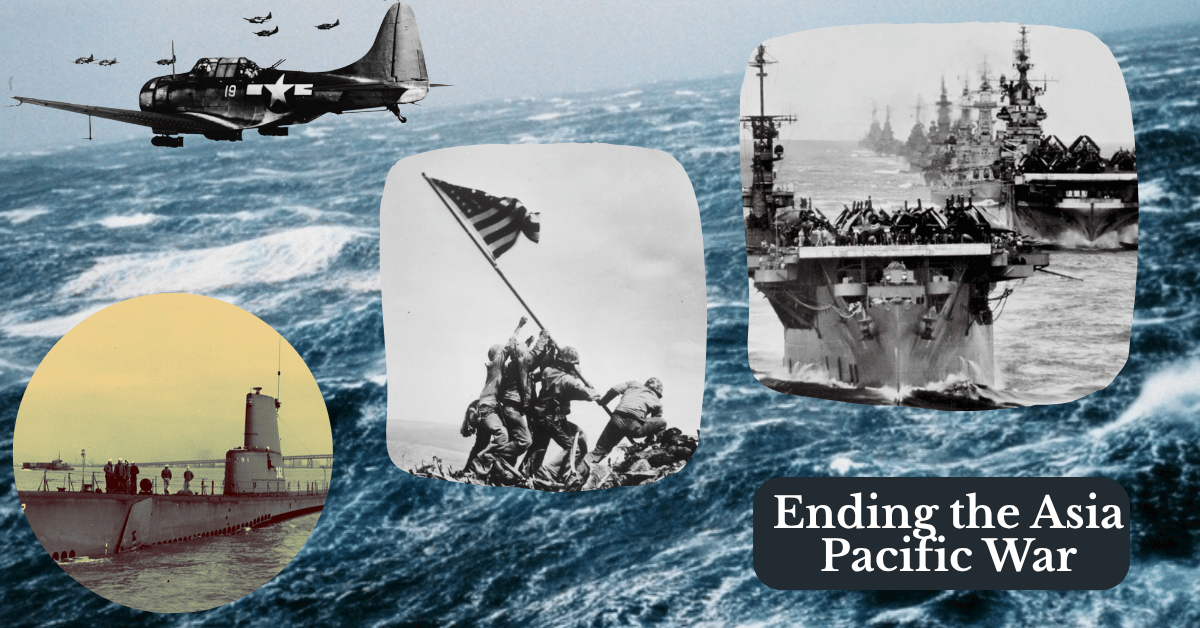
Image credit: various photographs from Naval Aviation Museum, National World War II Museum, and US Navy Archives.
This coming Sunday is the 5th Sunday of Ordinary Time, Year A. Our very short gospel passage (salt of the earth and light of the world) follows immediately after Matthew’s presentation of the Beatitudes. Verses 11-12 (not part of the Sunday gospel) are often called the 9th beatitude because of the opening phrase. But where vv.3-10 describes the good life, these verses bring it into contrast and begin to describe the cost (v.11) and remind the listener that you are simply joining a long tradition. The prophets who earlier proclaimed the kingdom and its demands were also persecuted.
Just as the prophets stood out and apart from “business as usual,” so too will the disciples who have committed themselves to Jesus. Here and in the next few verses the “you” that appears is always plural. The concern here is that the Christian community stand out, appear different, and become an alternative to the larger society. In Matthew’s account, the famous tune, “This Little Light of Mine” would read “This Little Light of Ours.” The community of disciples are called to be collective light and salt.
The salt/light metaphors (and possibly ‘city on the hill’) are only effective signs of the Kingdom to the extent with which the community is willing to use them, to bring them to bear. Salt, no matter how pure and tasty, if left in the cellar is not much use. A light locked away inside, will not illuminate anything in the world. In part, a goal of discipleship is to be noticed, to stand out, to be more than a curiosity, to be significant; in other words, to be distinctive and to be involved. The dangers of being a community too comfortable, too scared, or too closed off is seen in the Book of Revelation’s letter to the community of Laodicea: “To the angel of the church in Laodicea, write this: ‘The Amen, the faithful and true witness, the source of God’s creation, says this: “I know your works; I know that you are neither cold nor hot. I wish you were either cold or hot. So, because you are lukewarm, neither hot nor cold, I will spit you out of my mouth.”’” (Rev 3:14-16)
Image credit: Sermon on the Mount (1877) by Carl Heinrich Bloch | Museum of National History | Frederiksborg Castle, Public Domain

 friarmusings