
We have slowly been working our way through the early 20th century in Japan in search of key currents and views that were shaping Japan leading up to the 1937 start of the Asia-Pacific War. The 1860s movement from the Shogunate era to the Meiji Restoration was not a move to a constitutional republic that we know and accept in the United States. It is a complex topic best described by dedicated historians. To be clear, historians do not fully agree on the role Hirohito was playing and would play in the path to the Asia Pacific War. Nonetheless, some coverage is needed to understand how events have and will play out in 1930s Japan.
The Role of the Emperor
It is fair to say that a central goal of the Meiji Restoration was to reestablish the Emperor as a center of leadership, especially moral and symbolic leadership – but it needs to be said with qualifications.
One of the Restoration’s core aims was to overturn Tokugawa Shogunate rule, which governed in the Emperor’s name but marginalized him in practice. It was a critical aspect of the Restoration to reassert the Emperor as the legitimate source of authority for the state. This was essential for national unity during rapid modernization and would serve to legitimize institution and structural changes that would be needed for Japan to take its place in the world order. These changes included military conscription, taxation, education, state and foreign policy, and more. In this sense, the Emperor was intended as the moral and symbolic center of the new order.
But that was not to say the architects of the Restoration intended the Emperor to be involved in day-to-day operation of the State. Many of the Restoration leaders were themselves daimyō (regional rulers) in the Shogunate era. While they did not want a Shogun, neither did they intend the Emperor to govern directly. Influenced by Chinese and Western polity, they designed the ruling structures so that real power rested with the cabinet, bureaucracy, and the genrō – the elder statesmen of the era as it happens, themselves). The result was that the Emperor’s role was to sanction and embody decisions, not originate policy. This aligns with the idea of moral leadership rather than active governance.
Yet he served an important political function. The Emperor’s restored status provided continuity with Japan’s past, neutralized factionalism by placing authority above politics, and helped suppress dissent by framing opposition as disloyalty. The emperor-centered ideology was a means to an end, not an end in itself.
By elevating the Emperor as sacred, inviolable and the source of sovereignty, the Meiji system created structural ambiguity. Policies could be justified as “the Emperor’s will” while at the same time the Emperor was shielded from responsibility. While this is a broad statement, 1931 saw military leaders act in the Emperor’s name without his consent, control or authority. He is the Commander-in-Chief of the armed forces, yet his Kwantung Army in Manchuria felt free to do what it wanted, not expecting and not receiving punishment for their actions. Emperor Hirohito’s response to the events of 1931 was to “fire” the Prime Minister and form a new government, but did not take any action within Army ranks. Most historians believe it was a choice for national stability; control could come at a later time.
That did not seem to be the response of an absolute monarch yet neither was it a role of a powerless figurehead of State.
Prior to ascending the throne in 1926, Hirohito had taken a trip that included extended time in Britain. Among his interests was to understand the nuance and complexity of the King of England within the Constitutional Monarchy – which at the time seemed to be the closest configuration of what the Meiji founders had in mind. The historian Herbert Bix offers that King George of England shared with then Crown Prince Hirohito that the role of the monarch was also to influence the levers of power and on rare occasions to press with force. Hirohito never revealed his understanding of the role of emperor, not even after the end of the war in 1945 or later. It has left historians to research and draw their own conclusions. Historian Stephen Large offers an idea of “self-induced neutrality” – knowing he has the power but choosing not to act. Peter Wetzler believes that the Emperor knew how to put his thumb on the scale but at the same time did not believe himself to be responsible for the result. In the end his was only to approve policy, not to create it.
Whatever his actual views, his posture as Emperor from 1926 until 1937 fit into the Meiji system’s likely intent. By elevating the Emperor as divine, inviolable and the source of the nation’s sovereignty, the Meiji system created structural ambiguity wherein policies could be justified as “the Emperor’s will” and yet the Emperor was shielded from responsibility.
Sacred Duty
The education and formation ministries amplified this view of the Emperor with The Development of Sacred Duty. This was an essential idea that Japan needed to take its place among the powerful nations of the world, not only as an economic necessity but as a moral imperative rooted in its self-understanding through the eyes of Shinto religion. The argument was that if the emperor’s will was divine, then Japan’s policies (whether modernization, annexation, or war) could be framed as the fulfillment of a sacred mission. For example, in annexing Korea, Japanese officials and ideologues claimed they were “bringing civilization and order” under the emperor’s benevolent guidance.
This Shinto-based ideology taught that Japan was the land of the gods (shinkoku), uniquely pure and chosen. This translated into foreign policy as a belief that Japan had a moral right and duty to lead other Asian peoples (Korea, Taiwan, eventually China) — even if this meant dominating them. Unlike Western colonial powers, which often justified empire through Christianity or “civilizing missions,” Japan used State Shinto and emperor-centered nationalism to claim it was liberating Asia from Chinese decay or Western imperialism.
This view underpinned Japan’s expansion which was more than military force projection, it included economic and trade justifications – all connected to Japan’s need for markets, raw materials, labor, and trade routes. State Shinto teachings linked these economic aims to national survival and divine destiny. Securing resources in Korea, Taiwan, and later Manchuria wasn’t framed as “colonization,” but as fulfilling the emperor’s sacred mandate to protect and enrich his people. Thus, trade dominance and annexation were sacralized as part of a divine mission, not just pragmatic policy.
The cornerstone that held the structure together was the Emperor – or at least the idea of the Emperor.
This ideology formed the idea of The Eight Corners of the World in which the Emperor of Japan extended divine order first across East Asia then across the globe. In Korea, Manchuria and later in other conquered lands, Shinto shrines were built to enforce the symbolic inclusion of that country under Japan’s sacred imperial rule. This is the underlying foundation behind the Greater East Asia Co-Prosperity Sphere in which Asian countries should come together under Japan’s leadership to be free from Western colonial powers. On paper, it sounded like a partnership — “Asians helping Asians.” Japan said it would bring prosperity, unity, and independence to Asia. In reality, though, it mostly meant that Japan would dominate the region, control its economies, and use its resources for Japan’s benefit. So instead of being true cooperation, it was more akin to Japan empire building with kinder and gentler language and imagery.
In the Center
At the center of the puzzle is Showa Emperor Hirohito, the 124th descendant of the Sun Goddess, son of Emperor Taisho, the son raised from birth to take his father’s place on the throne. The one who inherited the root problem passed on by his father Emperor Taisho who had positioned the throne, for all practical purposes, as a Constitutional Monarch with no real powers – or at least Taisho did not exercise any power. Internal to Japan there were supporters of this dynamic as they desired for full democratic reforms. There were detractors that saw such reforming movements as an “infection” of western ideas. When Hirohito ascended the throne, he entered into an evolving system where the Cabinet and Diet establish policy and precedence internally and externally. Was this the intent of Meiji reforms? Was it an aberration? What was to be his role? Decision maker, Imperial “whisperer” whose position was only hinted at by the question asked, or, like his father, a symbol and endorser of already made decisions.
Historians generally describe Emperor Hirohito’s role between the Mukden Incident (1931) and the February 26 Incident (1936) as that of an engaged but constrained constitutional monarch whose authority was real yet structurally and politically limited and whose own choices increasingly favored management over confrontation. After this period, Hirohito became more engaged – how much more? But we know from this point forward Hirohito was not a passive figurehead. He received regular briefings from Army and Navy Chiefs of Staff, questioned military plans and timelines, and expressed concern about unauthorized actions, especially after Mukden. But Hirohito accepted the military’s assurances and fait accomplis rather than force a constitutional crisis. He was aware of this history of assassinations and divisions within the Army and strategically chose to avoid civil war or regicide. It was the latter in 1936 when Hirohito personally ordered the suppression of the coup. When the throne itself was directly threatened, he acted decisively. Hirohito could intervene, but usually chose not to unless imperial authority itself, not policy, was at stake.
1937 and Beyond
Perhaps getting ahead of ourselves, but continuing the thread, we continue to trace how Emperor Hirohito’s posture changed after 1937 when Japan’s actions initiated the Asia Pacific War with the outbreak of full-scale war against China that began with the Marco Polo Bridge Incident (July 1937)
Hirohito seems to accept the war as a reality to be managed. As Emperor he approved mobilization orders and war directives, accepting that conflict was now unavoidable. He shifted from questioning whether Japan should fight to how the war should be conducted as he focused on military feasibility, logistics, and timelines rather than political alternatives. Historians largely agree that Hirohito no longer saw the war as something he could stop without risking systemic collapse. Perhaps the one sentence description of how he viewed his role as Emperor would be: reluctant acceptance combined with managerial oversight.
As the war in China dragged on, Hirohito demanded more frequent briefings. During these briefings he often questioned generals on operational matters, including troop deployments and supply constraints. He continually expressed concern about two items. The first was overextension of the army. The IJA enjoyed continued success against Chinese forces, but that also meant longer logistic lines and a larger territory “behind the lines” for which they were now responsible. Second, there was no clear exit strategy or end-game that could be delineated. The Emperor made his presence increasingly known, but avoided direct confrontation.
And the war dragged on. Meanwhile on the home front, the Prime Minister who was a prime animating force for Japan’s continued aggression in China, Prince Konoe formed the Imperial Rule Assistance Association (IRAA). It was an attempt to unify Japan under a totalitarian, ultranationalist banner for total war, effectively dissolving all other political parties to eliminate factionalism and mobilize the nation for its expansionist goals in China, Mongolia and Siberia. While intended to consolidate power, it struggled with internal divisions and never fully achieved the monolithic control seen in Nazi Germany, facing resistance from established interests and failing to fully control the military.
In this period Hirohito voiced unease about war with the United States because of Japan’s industrial and naval limitations. At the same time he supported diplomatic efforts but seemed to keep them “on a short leash” so that they did not undermine imperial prestige. It was also in this period that he ultimately approved The Tripartite Pact with Italy and Germany. As well he approved the expansion to the southwest, occupying French Indochina. The Emperor seemed suspended between diplomacy and military momentum, wanting the former but unwilling to tamper down the latter.
In late 1941, despite misgivings, Hirohito approved the decision for detailed war planning against the United States and Britain and sanctioned pre-war operations while insisting that diplomacy continue until the last moment. But more on that in later posts.
After the Allies entered the Asia Pacific War and the tide soon turned, Hirohito asked increasingly pointed questions, privately expressed pessimism, but avoided direct intervention that might undermine military morale. He was informed, offered suggestions, but remained largely reactive but understood his was the final consent/approval of major actions and campaigns.
It was only in August 1945, when Japan was defeated but had not yet surrendered that Hirohito overrode military opposition to accept the Potsdam Declaration, intervened directly to solve a deadlocked cabinet, and ordered the end of the war. This moment starkly contrasted with his earlier restraint but he acted to preserve the nation and the Imperial House.
Historians often describe Hirohito’s post-1937 trajectory as moving from constitutional restraint to managerial involvement to reluctant authorization to a final decisive intervention. The paradox, the evolution if you will, is central to his legacy.
Earlier he possessed the authority to intervene but did not, seemingly out of fear of fracture, precedent, and the sacred status of the throne. He acted decisively only when national annihilation loomed
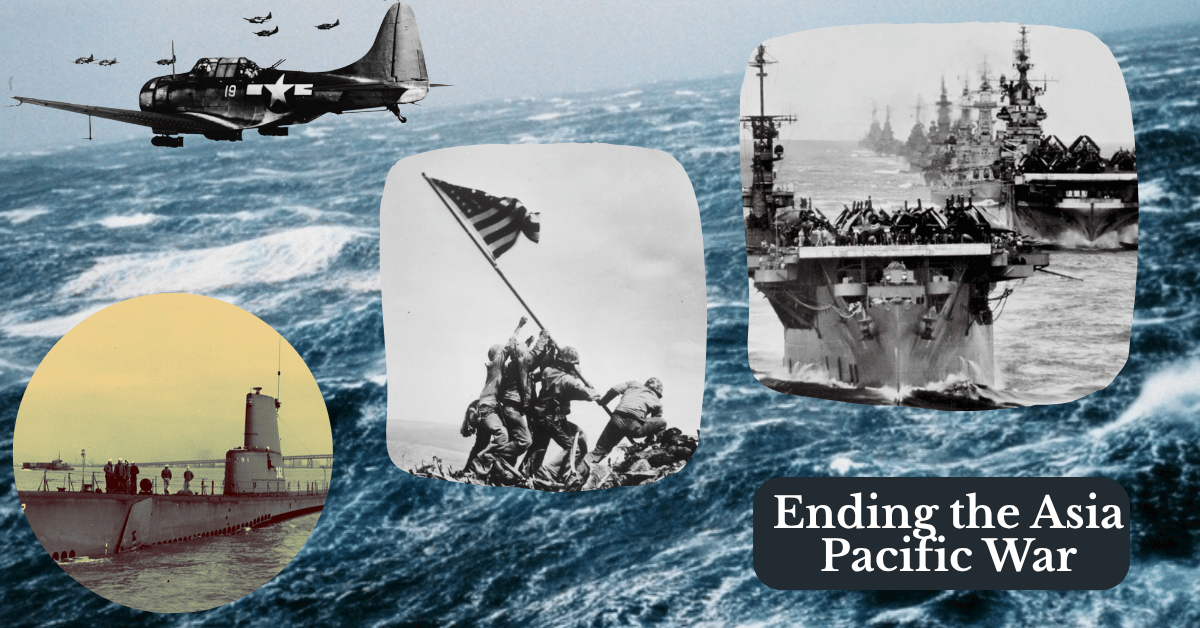
Image credit: various photographs from Naval Aviation Museum, National World War II Museum, and US Navy Archives
 friarmusings