Power and Life

Today’s first reading is one of my favorite chapters of the Old Testament: Isaiah 55. It always reminds me of the parable of the Sower and the Seed from the gospels with the Word of God being sent into the world on good and poor soil alike.

Starting in Isaiah 40, the prophet begins to describe the end of the Babylonian Exile period and the triumphant return of the People of God to Jerusalem. By the time the Prophet’s narrative arrives at Isaiah 55, Israel is invited to seek the Lord anew, forsaking the choices and ways that got them into Exile in the first place (Isaiah 55:6-7a). It is not the simple moral imperative, it is a reminder that echoes the beginning of Exodus 20: “I am the LORD your God, who brought you out of the land of Egypt, out of the house of slavery; you shall have no other gods before me” (Exodus 20:2-3). The Lord is now delivering them from Babylon with the same admonishment that the people received in Deuteronomy 34: choose life.

Isaiah has told them that they received what their choices deserved, but now they are encouraged to turn away from that which led them toward death and to turn again to the God of restoration and pardon.  It is an OT moment: “Repent and believe in God’s Word” that echo the words of Ash Wednesday: “Repent and believe in the Gospel.”  The people hearing Isaiah’s words are called to believe that God’s mercy and pardon triumph over God’s wrath. It is God’s mercy that gives life – and in today’s first reading Isaiah offers an illustration from the world around them.

Just as from the heavens the rain and snow come down and do not return there till they have watered the earth…

The heart of the image here is life. The earth is not that which gives life; it is the rain and snow, moisture from above, that causes the earth to proliferate, “making it fertile and fruitful, giving seed to the one who sows and bread to the one who eats.” Without the moisture, fertile and fruitful life shrivels-up. The power and the life is in the rain and snow.

The power and the life is in the Word of God: “So shall my word be that goes forth from my mouth; It shall not return to me void, but shall do my will, achieving the end for which I sent it.”  And what is that end? Repentance, faith, and salvation. We participate in this work of God. We don’t add to this work or validate it or accomplish it. This is God’s work done by way of God’s Word proclaimed.

And in Isaiah 55:12, the next verse just outside our reading Isaiah tells them that if the listen to the Word of God, take it as the compass of their journey in life, “Yes, in joy you shall go forth, in peace you shall be brought home; Mountains and hills shall break out in song before you, all trees of the field shall clap their hands.”  Even the very earth will give witness to the power and life in the Word of God.

The Word of God has come to you again and again in your lifetime. Have you allowed it to make your life fertile, fruitful, and cooperate in God’s work in this world? Yes? Then in joy may you go forth to let that Word work in you to accomplish its end.


Image credit: Detail of “Sower Went Out to Sow” | Irish Dominican Photography | Brasov, Romania | CC-BY
The Year Before Pearl Harbor

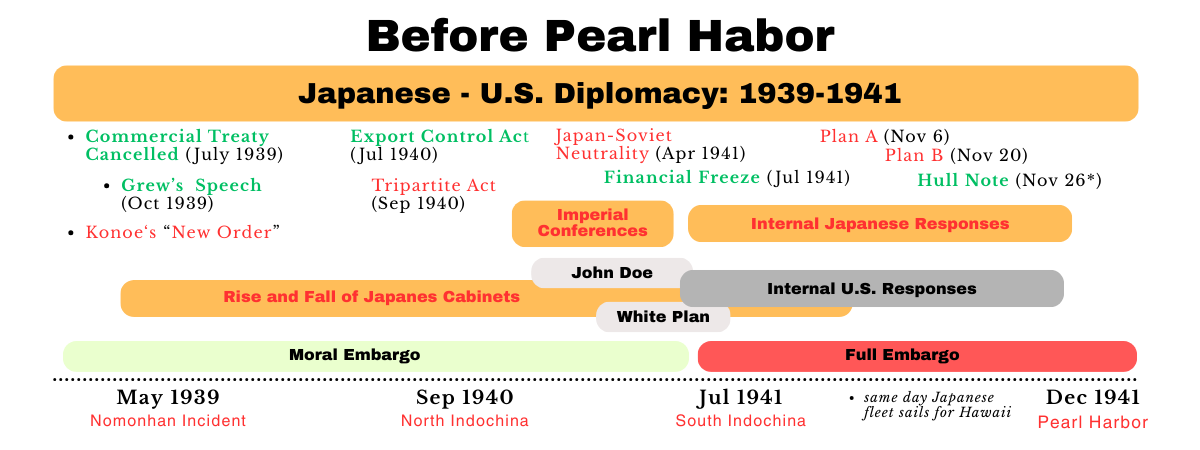
In previous posts, we have tried to trace the Japanese strategic commitment to the southern strategy focused on the resource rich Southeast Asia mainland and Pacific Islands. The movements into Indochina brought about increasingly more stringent export controls and licensing for Japanese concerns, ratcheted up and hardened positions inside and outside government – especially within Japan where when the “military coughed, the Japanese cabinet developed pneumonia and collapsed.” With each cycle, the military was increasingly dominant in Japanese policy and strategy. There was a lot going on…

The “roadmap” above is nowhere as complex as the underlying reality and labyrinth pathways. Over the next several posts, the conversation will advance along threads that move from January 1941 until Pearl Harbor on December 7, 1941. Those posts are meant to be part of the buildup of background to understand organizations, factions within organizations, government departments, key persons and personalities, and more – all to set the context as we move ahead.

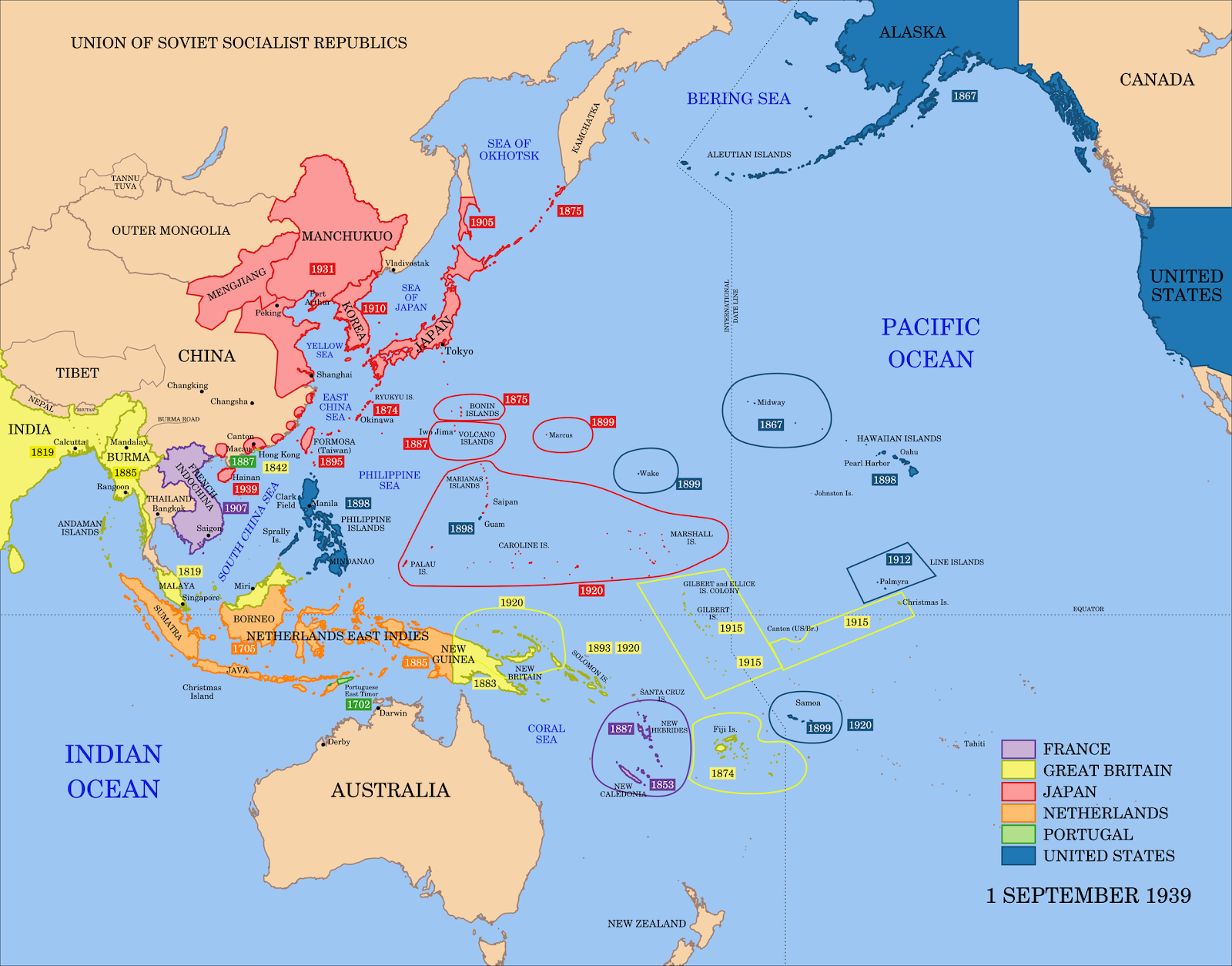
Back in one of the first posts, I asserted that the August 1941 “oil” (full) embargo did not start the war. The war in the Asia-Pacific region was already underway. One only needed to ask the Chinese, Vietnamese and Mongolians, as well as the Koreans. The full embargo of late July 1941 was a calculated political action by the U.S. in reaction to the Japanese occupation/invasion of French Indochina. It was a political action whose hope was to deter Japan from further expansion even further south to Hong Kong, Malay, Java, Borneo and the rest of the Dutch East Indies. Consider the map below (Sep 1939) and then add Indochina (Vietnam) and one can see Japan’s dagger is clearly aiming south.

To focus on only the oil embargo because Japan’s “economy” needed it, one has to remember it was a wartime economy that had already led to the deaths of 7 million Chinese by July 1941. Even if one chooses to only focus exclusively on the full embargo, one can ask: 

  • Was the embargo the decisive reason why Japan attacked Pearl Harbor or just more proximate than a collection of other reasons that was denying Japan unfettered access to war resources? 
  • The U.S. understood the goals for Japan southwest incursion, but did the U.S. truly understand the underlying motivations? I would suggest the U.S. perfectly understood Japan’s motivations and disagreed on moral and political grounds. Japan was fascism in the Asia-Pacific region – aligned to the fascist nations of Europe via the Tripartite Act.
  • Did the U.S. have a clear understanding of the internal Japanese dynamic that increasingly marginalized any peace/negotiation faction as the military grew in stature and power? This was the shift that was transforming a potential Asia-Pacific trading partner into a deadly rival fixated on status, honor, and establishing its equivalent of the Asia-Pacific Monroe Doctrine.
  • Was the embargo a virtual declaration of war hoping to draw Japan to military action so that the U.S. could enter the war in Europe? If so, then why was the U.S. so unprepared to fight any war, much less a two-ocean war?
  • Clearly the December 1941 and early 1942 “blitzkrieg” across Southeast Asia, the Southwest Pacific, and Central Pacific regions accomplished the mission of (a) capturing the resource rich nations and (b) setting a “line of defense” west of Hawaii. Was the attack on Pearl Harbor necessary for the plan to access the resource rich lands to the southwest of Japan? Couldn’t they just have moved south and left a “blocking force” against the Philippines and prevented U.S. resupply?
  • How did Japan so misjudge the U.S. public’s reaction to Pearl Harbor? Thanks to the movie “Tora!, Tora!, Tora!” we have Admiral Yamamoto, the architect of the Pearl Harbor attack, iconically uttering, “We have awoken the sleeping giant.” He never said that, but he should have because he clearly understood Japan could not win a protracted war.

Most, if not all, of the questions are not simply military moves and political reactions – but they form the milieu in which diplomatic dialogue swims. The external and internal dynamics make the path to diplomatic resolution akin to walking a moonless night in the wilderness with but only a lighted candle to show the way. There is light but its glow only reveals so much of the dark night. And as we will see in a later post, there are lots of things that “go bump in the night.”


Image credit: various photographs from Naval Aviation Museum, National World War II Museum, and US Navy Archive. | Mapworks | Original timeline by G. Corrigan

Teaching Disciples

This coming Sunday is the 2nd Sunday in Lent. In yesterday’s post we reviewed the theme of conflict which is a recurring theme throughout Matthew’s gospel – a conflict which is building heading toward the events of Holy Week, a week in which the faith of the disciples will be sorely tested. In today’s post we consider the event of the Transfiguration itself.

Matthew 17:1-13 is an instructional session for all the disciples – note that in v.10, Peter, James and John have joined the remainder of the group. Just as the preceding scene (16:13-28) juxtapositions the divine transcendence of Peter’s confession of Jesus as Son of God based on a revelation from heaven (16:17) with Jesus’ own teaching about the suffering Son of Man, so also in this scene the confession of the heavenly voice is juxtaposed with Jesus’ self-confession as suffering Son of Man.

The description of the Transfiguration is brief—just the first three verses of Matthew 17. But the incident becomes the context for two significant incidents for the disciples. 

  • In the first, Peter’s hasty response to the glory of the Lord (…make three tents) is corrected by the same heavenly voice heard at Jesus’ baptism (17:4–8; cf. 3:17). 
  • In the second, Jesus once again forbids the disciples to make him known (cf. 16:20), which leads to their question about the future coming of Elijah (17:9–13). 

Jesus answers their question cryptically in terms of a past coming of “Elijah,” and when he compares his own future suffering to what has happened to this “Elijah,” the disciples finally grasp that he is speaking of John the Baptist. Thus, the passage contains the transfiguration proper (17:1–3), a lesson on the fulfillment by Jesus of all that is promised in the Hebrew scriptures (17:4–8), and a lesson on the continuity of John the Baptist with Elijah of old and with Jesus himself (17:9–13).


Image credit: Sunrise, Simon Berger, Pexels, CC