
The previous post ended by comparing the current and flows of the events of 1941 as an “external and internal dynamics [that make] the path to diplomatic resolution akin to walking a moonless night in the wilderness with but only a lighted candle to show the way. There is light but its glow only reveals so much of the dark night. And as we will see in the next post, there are lots of things that “go bump in the night.” In the final months before Pearl Harbor we find one of those “bumps.”
In 1941 U.S.–Japanese diplomacy operated on two parallel planes. One was the formal, authorized negotiation between Japan’s Foreign Ministry and the U.S. State Department. The other was a private, unauthorized, and deeply fragile backchannel, involving two Maryknoll priests who sought out of moral urgency, without any official mandate, to open a path toward dialogue and de-escalation. The existence of this unofficial channel illuminates not only the desperation of late 1941, but also the fragmentation of authority, trust, and purpose within both governments. Examining the ebb and flow of this effort alongside the official negotiations reveals how diplomacy failed not for lack of contact, but because no shared political or moral common ground would be found. It either simply did not exist or was completely obfuscated by the many voices and channels working at cross purposes.
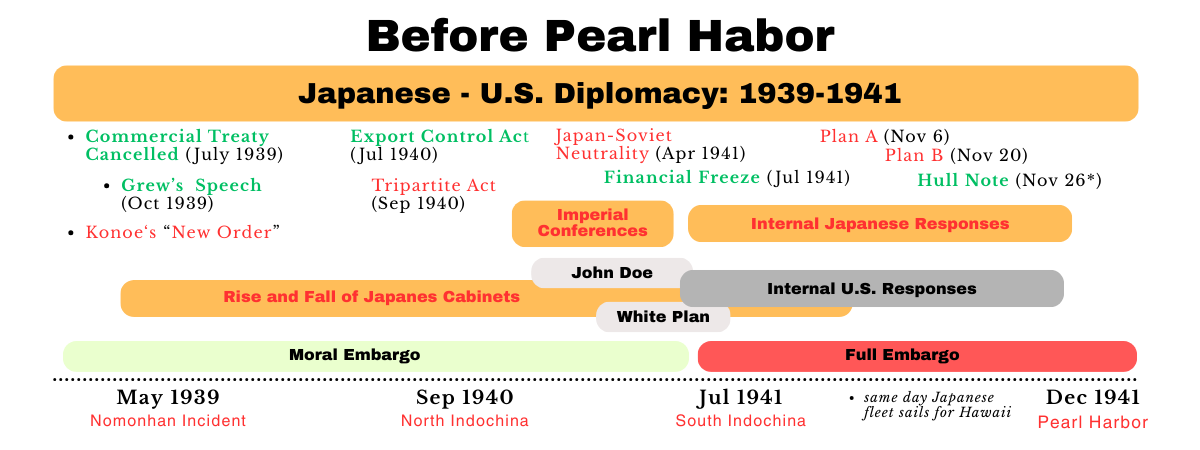
One way to describe the official diplomatic track is a system of increasing formalism and decreasing flexibility and imagination. By early 1941, official U.S.–Japanese diplomacy was already strained by mutual suspicion. Negotiations between Ambassador Kichisaburō Nomura (Ambassador to the U.S. and an acquaintance of President Roosevelt) and Secretary of State Cordell Hull were formal, cautious, and increasingly rigid. Nomura was not a diplomat; he was a retired admiral who had served as naval attache in Washington when Roosevelt was Assistant Secretary of the Navy in the 1920s. Hull was a career diplomat and a graduate of Yale and Havard Law who was connected in U.S. and international circles. While Japanese ambassadors came and went, Hull remained and consistently insisted on a principles-based approach—non-aggression, respect for sovereignty, and equality of trade—while Japanese negotiators often changed, were given differing instructions but often sought pragmatic accommodations that would preserve their position in China and Southeast Asia while asking immediate actions from the U.S. with delayed or vague actions on their part. Nomura arrives in Washington at the start of 1941 with no instructions at all.
As Japan moved into southern French Indochina in July 1941, the atmosphere hardened decisively. The U.S. freezing of Japanese assets and effective oil embargo transformed negotiations into a race against time, particularly for Tokyo. Within the U.S. government, confidence grew that Japan was negotiating in bad faith, using diplomacy to buy time for military preparations. Within Japan, civilian leaders feared economic collapse, while the military saw compromise as tantamount to surrender. This context is essential. By autumn 1941, official diplomacy would become procedural rather than exploratory. Notes were exchanged, positions clarified but over time imagination, trust, and risk-taking disappeared.
Maryknoll and John Doe
Against this bleak backdrop, two Maryknoll priests, Bishop James Walsh and Father James Drought became involved in a private initiative to foster dialogue. Maryknoll, as an American Catholic missionary order with deep experience in East Asia, occupied a unique moral and cultural position. Its members were neither diplomats nor intelligence officers, yet they were trusted by some Japanese interlocutors and respected within certain American circles, especially Irish Catholic Americans. The priests’ motivation was fundamentally pastoral and moral. They had already seen the devastation of combat in the Sino-Japanese war since 1937 in terms of 7 million Chinese deaths, devastation of major cities, and millions of millions of Chinese as refugees within their own country. They feared an expansion of the war if the U.S. were drawn into the war. They believed they could still find accommodation. Their effort was unauthorized, informal, and explicitly separate from official diplomatic channels, yet it unfolded in parallel with them, sometimes intersecting with individuals close to power.
As the Maryknoll effort developed in mid-winter and into the summer of 1941, it drew in a widening circle of intermediaries: Japanese civilians and former diplomats sympathetic to peace, American Catholic figures and lay intermediaries, and individuals connected indirectly to political leaders, including those who later were aware of Konoe’s last attempts to avoid war. All of these people shared a belief, already fading within governments, that personal trust and moral appeal might succeed where formal diplomacy had failed.
The Maryknoll contingent first proposed an outline of proposals to leaders in the Japanese government via Todao Ikawa, a senior banker and financier, thought to have a friendship with Prime Minister Konoe. In addition, the proposal was presented to Col. Hideo Iwakura, Chief of Military Affairs in the Ministry of the Army (War) said to be an important leader of the young officers and confidant of Army Minister Tojo. When the Maryknoll contingent left Japan in January 1941 they brought a concept of a Konoe-FDR summit, a clear message of Japan’s regional “Monroe Doctrine” aspirations, and a plan…that was not the same as they had presented in Japan (for reasons why, not clear).
Arriving in Washington DC, they bypassed the State Department and were able to secure a private meeting with FDR that lasted several hours. They assured the President that they had access to the moderates, the young conservative Army officers, and the Prime Minister. Soon after FDR pulled Ambassador Nomura into the conversation – but not Hull and the State Department.
Nomura found his naval attache, Capt. Yokoyoma, shared his perspective that a way to peace was necessary as Japan would ultimately lose in a war with the U.S. Nomura, Yokoyoma and two other staffers in the Washington DC embassy (unnamed and called “John Doe”) were then drawn into this parallel diplomacy effort.
The Maryknoll father’s Tokyo connections were in fact not that well connected, and did not represent either the moderates or the conservatives. But by March 1941, FDR had drawn Hull into the dialog. Long story short, in the end the stream of off-the-books diplomacy went nowhere. However it had three deleterious effects.
Nomura and Hull negotiated secretly. When the modified-Maryknoll proposal was presented to Tokyo and the Foreign Ministry, Nomura presented it as an American proposal without revealing the Maryknoll connection, sending inconsistent signals to Tokyo leading them to assume America’s resolve was weakening and that more concessions could be extracted.
In the end, Hull slowly morphed the draft to be the same as his four fundamental principles which asked for a permanent solution tied to concepts and lacking specificity. But it was understood that the U.S. wanted Japan to immediately withdraw from China – which was a not-starter for China.
It absorbed Secretary Hull’s time and energy from March to June when he realized this path was leading nowhere. In June he started an extended vacation and time away from Washington DC. Thus, he was not present in DC when Japan moved into Southern French Indochina (South Vietnam), the financial freeze was set, Dean Acheson slow-rolled the license approval in the FFCC, and the “oil embargo” began.
As we move into the summer of 1941 there are many dialogues and many distractions.
Image credit: various photographs from Naval Aviation Museum, National World War II Museum, and US Navy Archives. | Original timeline by G. Corrigan
 Did you know that nearly one quarter of McDonald’s Filet-of-Fish sandwich sales take place during Lent, when many fast-food customers are abstaining from meat? “That’s exactly what the McDonald’s operator who first put the cheese-topped sandwich on his menu had in mind back in 1962. When Cincinnati McDonald’s franchise owner Lou Groen noticed that his heavily Catholic clientele was avoiding his restaurant on Fridays, he suggested to McDonald’s owner Ray Kroc that they add introduce a fish sandwich. That led to a wager between Groen and McDonald’s chief Ray Kroc, who had his own meatless idea. “He called his sandwich the Hula Burger,” Groen said. “It was a cold bun and a slice of pineapple and that was it. Ray said to me, ‘Well, Lou, I’m going to put your fish sandwich on (a menu) for a Friday. But I’m going to put my special sandwich on, too. Whichever sells the most, that’s the one we’ll go with.’ Friday came and the word came out. I won hands down. I sold 350 fish sandwiches that day. Ray never did tell me how his sandwich did.”
 friarmusings