
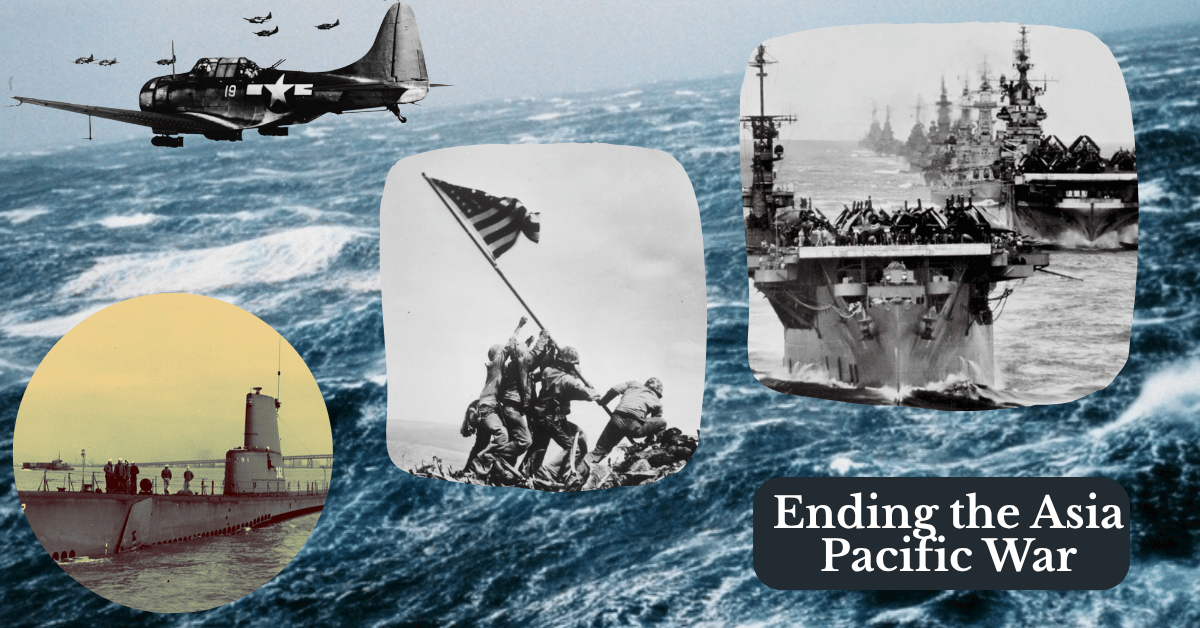
More than two months ago, we started a companion series to the 2025 series on the Asia- Pacific War. The focus of that series was less about how or why it started, but about its ending. You can read that series here. The focus of this 2026 series has been exploring how the currents of history brought the U.S. and Japan to the events of December 7, 1941 that was a final domino to fall and bring the United States into the firestorm that was the already on-going Asia-Pacific War.
In the previous post, Dialogue to War, described the departure of the Japanese fleet to attack Pearl Harbor while discussions were still underway, the final throes of diplomacy between Japan and the United States, and the result:
“A small fire at the Marco Polo Bridge in 1937 spread to Manchuria, northern China, key Chinese ports, and French Indochina. On December 7, 1941 by attacking the U.S. Pacific Fleet at Pearl Harbor, the growing fire became the full firestorm of the Asia-Pacific War that lasted until September, 1945 at the cost of more than 30 million Asian lives…Such was the path to the Asia Pacific War.”
Perhaps it was the inevitable consequence of Admiral Perry’s uninvited sail into Tokyo Bay in 1853 using “gunboat diplomacy” to force the isolated Japan during the Tokugawa Shogunate to open up for trade. Or was that simply incidental to the movements already underway that led to the fall of the Shogunate and the beginning of the Meiji Era centered on the Emperor. A coincidence of timing? Within the resource poor home islands, the population was already outstripping the ability of the nation to feed itself – a trend that continued into the 20th century. Were the internal pressures within Japan driving the nation to look for land and resources to sustain itself?
Perhaps it was the ascendancy of the military within the halls of power. Or the basic structure of the Meiji Constitution that provided virtually no civilian oversight to the military, leaving the only “firewall” as the Emperor who showed no inclination to involve himself in such affairs? All led to a military that seemed to have acquired all the bushido spirit of the samurai but no longer had the internal battles to seek glory and honor. It began a history of seeking such glory on the Asian mainland.
The military was not the only element of Japanese society that was looking outside the home islands. Contact with the West brought new observations and with them new insights and conclusions. The idea of “social darwinism” reshaped elite thinking leading to a re-evaluation of their views of China and East Asia after the Meiji Reforms. The core assumptions absorbed in Japan was that the nations compete like organisms in which there will always be a struggle for the resources that make life flourish and history will be governed by conflict in which weak states are absorbed or eliminated. Moral intention will not stave off extinction. For a nation that had long been invested in Confucian life where virtue and moral order are essential elements, the shift away from moral intentions to survival of the fittest, the natural pathway was imperialism and permanent competition for local, regional and global dominance.
It was a rapid shift away from traditional and classic ways of understanding the world order because they watched it unfold in the living laboratory called China. For Japanese elites and leaders, social darwinism was evident in the Opium Wars, the Unequal Treaties, loss of economic control, and disintegration of internal cohesion. China became the empirical proof that moral civilization without power equals extinction.
In 1870, Fukuzawa Yukichi published “Conditions in the West,” a meditation based on his observations in Europe and America. He introduced the concept that international relations operate by power, not morality and as a result weak nations are exploited regardless of virtue. He pointed out that China, while being morally refined, is politically helpless, no nation at all, and is subjugated to the economic interests of the non-Asian world powers. Among Japanese elites the dialogue asserted that Asia was collectively at risk, only strength and modernization could prevent subjugation, and equality would be granted only to those who could enforce it. Thus national survival required military parity, industrial capacity and territorial buffers
In 1882 Katō Hiroyuki published “A New Theory of Human Rights,” work in which Katō explicitly rejected natural rights, arguing that rights arise from power. He applied what was essentially evolutionary logic to politics: “The strong rule; the weak are destroyed—this is the law of nature.” His work marks the moment when evolutionary struggle became normative political theory within Japan. This movement in political thought was more fully described in the post Japan and Social Darwinism.
By the time Japan entered the post-WW1 era, it began to see itself as the only qualified leader of Asia for the modern world, a guardian of Asia against incursions by the West, and possessed of the destiny to assume it role of leadership a greater Asian prosperity sphere: an oriental Monroe Doctrine.
Jumping ahead to December 1941, Japan was bogged down in China fighting a war it started and, despite early successes, had very little chance of winning but every chance of experiencing the endless quagmire that had always been China. It is akin to the dog that chases the car, catching up to it, and clamping onto the bumper…now what? The fighting in China was already draining Japanese national reserves, was being fueled (literally) by oil and gasoline from the U.S., and was beginning to drastically reduce the standard of living among the Japanese people on the home islands. Why would Japan start a conflict with the U.S.?
It was a battle that the leaders of Japan knew they could not win. A war the Japanese government’s Total War Research Institute reported there was no chance of winning. Their actions were not rational; made no sense to the Western mind. Even the best minds in Japan argued against the possibility of success. But as Prime Minister Tōjō once remarked: “Occasionally, one must conjure up enough courage, close one’s eyes and leap off the veranda of the Kiyomizu Temple.”
It wasn’t rational by any standards of Western thinking steeped as in the biblical admonition of caution and wisdom: “Or what king marching into battle would not first sit down and decide whether with ten thousand troops he can successfully oppose another king advancing upon him with twenty thousand troops?” (Luke 14:31). The combined power of the western allies would bring to bear far more than a 2:1 advantage. Surely, Japan would “count the cost.”
It wasn’t rational. But what was it? As I try to “wind down” this series, that question will be the path of inquiry. Previous posts have laid a foundation in terms of prior U.S.-Japanese contact, economic issues, financial and market pressures, political and diplomatic conflict, and a range of core issues. Future posts will draw on that foundation (and include links to those posts rather than repeat their argument in whole) with a goal of answering the question of “why would Japan force the United State into the Asia-Pacific War?” It is a question of history but also an opportunity for “lessons learned” for application to future conflicts.
Image credit: various photographs from Naval Aviation Museum, National World War II Museum, and US Navy Archive. |
Discover more from friarmusings
Subscribe to get the latest posts sent to your email.
 friarmusings
Dear Fr. George,
These past two series have been an incredible learning experience far beyond by wildest expectations’.
Thanks .
Richard
You are too kind – and besides it was been a lot of fun for me. All the best – FrG