Both readings today speak with a sharpness that may unsettle us but it is the sharpness of a physician’s scalpel, not a weapon. God is not condemning for the sake of condemning. He is calling His people back to integrity, back to a faith that is lived and not merely displayed.
Through the prophet Isaiah, God addresses leaders who are very religious on the surface. They offer sacrifices. They observe rituals. They show up for worship. And yet God says something shocking: “I cannot endure solemn assemblies with iniquity.” In other words, religious activity has become disconnected from moral conversion.
So God does not ask for more prayer, more offerings, or more public devotion. Instead, He says: “Wash yourselves clean. Put away your misdeeds. Learn to do good. Make justice your aim.” God is not rejecting worship. He is rejecting worship that does not change how people live.
Jesus makes the same point in the Gospel from Matthew, though He directs it squarely at religious leaders. The scribes and Pharisees know the law. They teach correctly. But Jesus says they “do not practice what they teach.” Faith has become something they perform rather than embody.
Jesus’ concern is not with leadership itself, but with leadership that seeks recognition instead of responsibility. Titles, honors, places of importance—these become substitutes for humility. And when faith becomes about being seen, it quietly stops being about being faithful.
At the heart of both readings is a single question God asks every generation: Does your worship shape your life or does it simply decorate it?
God desires a people whose prayer leads to justice, whose knowledge of the law leads to mercy, and whose closeness to God leads to humility. That is why Jesus ends with a simple but demanding truth: “Whoever humbles himself will be exalted.”
Humility, in Scripture, is not thinking less of ourselves it is living honestly before God, allowing Him to align our words, our worship, and our actions. It is choosing consistency over appearance, conversion over comfort, obedience over applause.
Today’s readings invite us to examine not how religious we appear, but how deeply our faith is shaping our daily choices: how we speak, how we forgive, how we treat the vulnerable, and how we seek God when no one is watching.
If we are willing to listen, God still speaks the same promise Isaiah proclaimed: “If you are willing, and obey, you shall eat the good things of the land.”
Not because we performed well but because we allowed our hearts to be changed.
Image credit: CANVA, “a sailboat adrift” AI generated, downloaded Mar-1-2026
The previous posts focused on the internal dialogue within the United States government during the period January into June, 1941. The focus was limited to the Departments of State, Treasury, Army (War) and Navy; the office of the President of the United States; and even included independent non-governmental agents helping/confusing depending on one’s perspective. The positions and approaches on how to best engage the Japanese government were varied, sometimes inconsistent, and largely reactive to Japanese actions. The State Department under the leadership of Cordell Hull consistently advanced Hull’s “Four Principles” which were end-states of diplomacy without interim checkpoints and thus lacking in measured concrete progress. Within the Far East Division of State there were proponents of assertive action and response as well as those who wanted to always engage Japan diplomatically. The Treasury Department was largely “let’s use the financial tools available” and bring Japan’s aggression to heal. But, from that same department, the White Proposal took an approach which addressed material and non-materials concerns of Japan in measured and concrete ways. And then there was the President, Franklin D. Roosevelt, who preferred one-on-one meetings between leaders to make decisions.
That was a high-level view of the milieu in the U.S. What about in Japan?
Japan’s Internal Debates on the United States
In the first half of 1941 the idea of war between Japan and the U.S. was not considered inevitable or even desirable. It was a period of strategic uncertainty, factional rivalry, economic anxiety, and diplomatic improvisation within Tokyo. Although Japan had already been at war in China for nearly four years, its leadership remained divided on how to consider the United States. Should they should be deterred, negotiated with, or ultimately confronted. Between January and June 1941, the Japanese government under Prime Minister Fumimaro Konoe wrestled with three interlocking questions:
Could the China War be ended on terms acceptable to Japan?
Should Japan align more deeply with Germany?
Could conflict with the United States be avoided without abandoning imperial gains on mainland Asia? During the first half of 1941 this meant Manchuria, parts of Northern China, every major sea port in China, Taiwan (Formosa), Korea, and Northern French Indochina (North Vietnam)
The answers varied depending on whether one looked at political leaders, diplomats, or the armed services.
Political Circles: Konoe and the Problem of Survival
Prime Minister Konoe presided over a fragile civilian government increasingly overshadowed by military influence. In part by Meiji Constitution and in part by practice, the military occupied a minimum of four cabinet positions (Army, Navy, Army Minister, Navy Minister). If any one of them objected to a government policy or proposal, they simply resigned. This meant the Prime Minister had to form a new government and, as often was the case, the military refused to assign a new cabinet member until it received assurances that decisions would be in their favor. The Prime Minister had to navigate these waters.
Politically, three broad positions existed within the political arena: the pragmatists, the hardliners, and the diplomats. Prime Minister Konoe, cabinet members outside the military, leaders of key industries and others formed the “Pragmatists” view. They recognized Japan’s strategic weakness relative to the United States, especially in industrial capacity and oil supply. They favored:
Continued negotiations with Washington
A possible summit between Konoe and Roosevelt
Limited concessions (e.g., partial withdrawal from China under conditions)
Avoiding a two-front confrontation while Germany was at war with Britain
This group did not advocate abandoning imperial gains, but rather modulating expansion to avoid provoking U.S. intervention. However, Konoe’s weakness was structural. The military retained constitutional autonomy, and he lacked the authority to compel strategic compromise on their part, and sometimes to even control the military.
Right-wing politicians and ideological nationalists formed the group of “Hardliners” and by-in-large had the support of key elements within the military. The hardliners framed U.S. pressure and especially its support for China, as hostile interference in Japan’s rightful sphere. While not yet uniformly calling for immediate war, they increasingly depicted confrontation as inevitable. They argued that:
The United States’ goal was to strategically control Japan economically, tightening or loosing controls as needed until Japan complied with U.S. demands.
The Sino-Japanese War must be seen through to a political reordering of East Asia in which Japan established its own version of the Monroe Document. As the U.S. did in Central America and the Caribbean to eliminate despots and bandits, so too was China doing in China where war lords and the Chinese communists were disrupting peace and Japanese interests.
Any retreat from already achieved mainland Asia gains would undermine imperial prestige and internal cohesion and ultimately lead to losing it all.
The Diplomatic Circles were mostly associated with the Japanese Foreign Ministry. Unlike the U.S. where Cordell Hull had been in charge of the nation’s diplomacy, from 1930 until the end of 1941 Japan had ten different Foreign Ministers serving in 13 different cabinets. The high turnover reflected the instability of Japanese politics, the growing influence of the military, and the intensifying internal divisions over diplomacy toward China, the Tripartite Pact, and negotiations with the United States. Within the Foreign Ministry, debate was intense and more nuanced than often assumed and was not always clear to U.S. leaders who depended on Ambassador Joseph Grew whose connections were with the moderate wing of the government and was not always able to discern the shifting alliances and currents within the Japanese government.
Within Tokyo some diplomats favored a modus vivendi, a temporary freeze on expansion into other Asian countries in exchange for economic relief. Others believed U.S. policy was fundamentally hostile and would not accept Japan’s position in China under any conditions other than full withdrawal. An intrinsic problem was always China because Japan’s government was always reacting to independent decisions being made in China by the Imperial Japanese Army (IJA). Japan never had a policy or “end game” for China. As a result, diplomats lacking concrete instructions were often negotiating without authority or substance regarding the central issue: China.
When Admiral Nomura was sent to Washington DC, he was sent without instructions regarding any aspect of U.S.-Japanese relations and trouble spots – and yet was expected to steer the relationship away from confrontation with the U.S. Nomura, who had spent extensive time in the U.S. believed that war with the U.S. would be catastrophic. As a result his default position was incremental compromise to stabilize relationships and renormalize trade. This likely created the environment where Nomura was drawn into the Maryknoll/John Doe dialogue and then later private negotiations with Secretary Hull. The effect was 6 months passed and U.S.-Japanese relations were as they had been since the beginning of 1941.
Debate within the Imperial Army and Navy
The most consequential debates occurred within the armed forces, particularly between the Imperial Japanese Army (IJA) and the Imperial Japanese Navy (IJN). The Army remained focused primarily on securing victory in China and guarding against Soviet Union incursion into Manchuria (the northern strategy). However, after Germany invaded the Soviet Union in June 1941, Army factions renewed the debate about striking north into Siberia while the Soviets were occupied on the eastern front.
Even before June, many Army leaders believed economic strangulation by the U.S. would force Japan’s hands to launch offensive military action to the resource-rich Southwest Pacific. That said, in early 1941 the Army had not yet finalized a decision for war with the United States but knew that the southern expansion would increase the likelihood of war with the Americans.
The Navy’s position was paradoxical and was increasingly the more important voice from military circles. Senior naval leaders recognized U.S. industrial superiority., understood a long war would likely end in Japanese defeat, and yet believed that if war came, it must begin with a decisive blow to take the U.S. out of the conflict for a period while Japan consolidated gains in the south and created a defensive zone to the east against the U.S. fleet. In early 1941, many in the Navy preferred avoiding war if possible but in any case to have more time for adequate preparation.
But there was a contingent of naval officers that understood the U.S. was in the midst of building a two-ocean navy with the 1940 signing of the Naval Expansion Act. The act authorized the U.S. Navy to build 18 aircraft carriers, 7 battleships, 33 cruisers, 115 destroyers, 43 submarines, 15,000 aircraft, and 100,000 tons of auxiliaries. It was thought that a surprise attack was necessary, but the policy was not settled.
Economic Realities and Strategic Anxiety
Among all the groups, a central driver of debate was oil. Japan imported roughly 80% of its oil from the United States. By early 1941 U.S. export controls were tightening, Japanese reserves were finite and economic planners warned of severe vulnerability as the military operations continued to draw down oil reserves. The strategic dilemma became increasingly stark:
Concede in China to preserve economic survival?
Or seize resource-rich Southeast Asia (Dutch East Indies) and risk U.S. war?
This tension simmered throughout the first half of 1941 but did not fully crystallize until after July.
By June 1941, Japan had not yet decided on war with the United States. Japan’s internal debate was characterized by:
Political fragility within Konoe’s government
Diplomatic efforts lacking decisive authority
Military contingency planning without full consensus
Growing anxiety over economic vulnerability
The period was one of conditional escalation rather than inevitability. War became likely only when the internal debates (oil, China, and southern expansion) collapsed into a consensus after the summer crisis of 1941: the invasion of Southern French Indochina and the subsequent U.S. economic freeze and oil embargo. Any settlement that required major withdrawal was politically impossible at home in Japan.
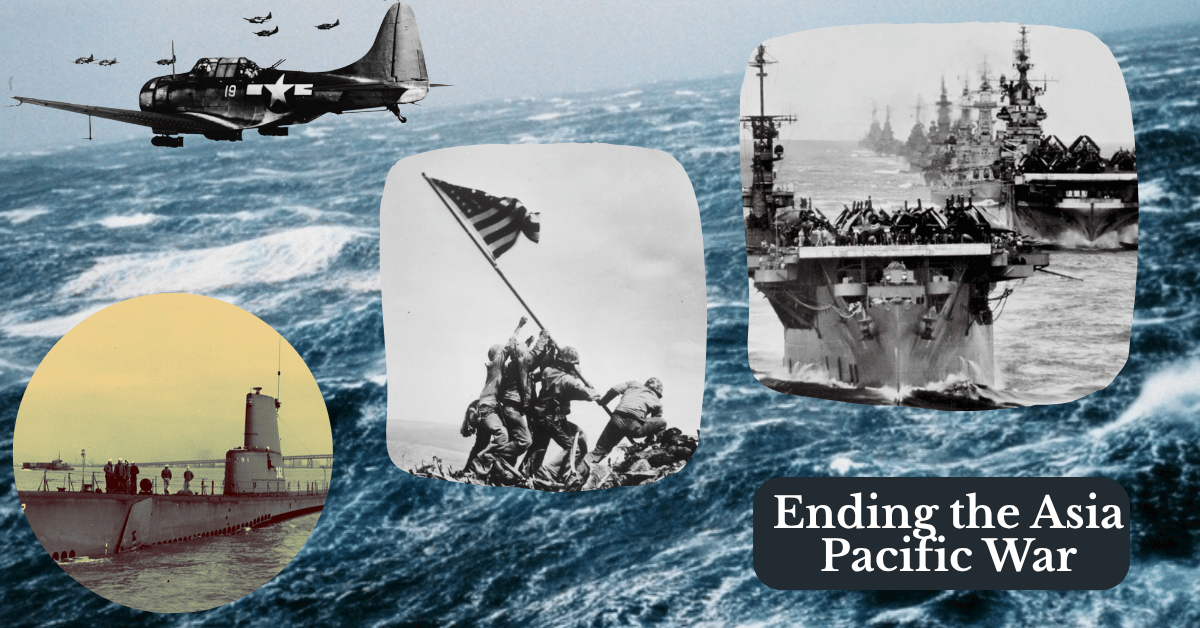
Image credit: various photographs from Naval Aviation Museum, National World War II Museum, and US Navy Archive. |
This coming weekend is the 3rd Sunday of Lent. In the previous post we delved into all might be implied in the simple opening which tells us where and when. We raised the question of whether it was simple geographical information or was St. John providing theological clues and breadcrumbs. Now we begin to consider the dialogue that ensues. The dialogue between Jesus and the Samaritan woman consists of thirteen exchanges, one of the longest dialogues in the Gospel. It is divided into two sections, each section introduced by a request/command by Jesus: (I ) vv.7-15 (“Give me a drink”); (2) vv.16-26 (“Go, call your husband”).
Verse 7 is filled with OT images that figure prominently in the rest of the narrative: “A woman of Samaria came to draw water. Jesus said to her, “Give me a drink.” First, Jesus’ request for water recalls the story of Elijah and the widow of Sidon (1 Kgs 17:10-11). In both stories a man interrupts a woman engaged in household work to request a gesture of hospitality. The parallels between Elijah and Jesus suggest the image of Jesus as prophet, a theme that will occupy a pivotal place in Jesus’ conversation with the woman (4:19).
Second, the scene of a man and a woman at a well recalls the betrothal stories of Isaac (Gen 24:10-61), Jacob (Gen 29:1-20), and Moses (Ex 2:15b 21). John 4:4-42 evokes these betrothal stories in order to rework their imagery, however. The story of the wedding feast (2:1-11) and John the Baptist’s parable (3:29) have already introduced wedding imagery into the Fourth Gospel as images of eschatological joy and fulfillment. It is in that context that the messianic/bridal symbolism has credence. Unlike the OT well scenes, Jesus does not come to the well looking for a woman to be his bride, but for a witness who will recognize the Messiah and bring the marginalized and despised people to faith in Him. In the fact that a Samaritan woman becomes that witness (vv.28-30, 39-42).
The Samaritan woman responds to Jesus’ request with amazement because it violates two societal conventions. First, a Jewish mandid not initiate conversation with an unknown woman. Moreover, a Jewish teacher did not engage in public conversation with a woman (“Hence the sages have said: He that talks much with womankind brings evil upon himself and neglects the study of the law and at the last will inherit Gehenna.” p.’Abot 1:5) Second, Jews did not invite contact with Samaritans. The Fourth Evangelist’s aside in v.9 underscores the seriousness of the breach between Jews and Samaritans. A fear of ritual contamination developed into a prohibition of all social interaction.
Instead of answering the woman’s question directly, Jesus invites her to answer her question herself (“If you knew…”). If the woman could recognize the identity of the person with whom she speaks, a dramatic role reversal will take place. The woman would be the one who requests water. “Living water” (hydor zon). As with ańothen from the encounter with Nicodmus, hydor zon has two possible meanings. It can mean fresh, running water (spring water as opposed to water from a cistern), or it can mean living/life-giving water. Once again, Jesus intentionally uses a word with a double meaning..
The Samaritan woman hears only the meaning “running water” in Jesus’ words and so responds to his offer of living water with protests of logical and material impossibility (cf. Nicodemus, 3:4). It is not credible to her that a man who has just asked her for water because he was unable to acquire any for himself should now offer her fresh running water (v.11 a). Her protest leads to a question, “Where then can you get that hydor zon?” (v.11b). This question, like other questions about the origins of Jesus’ gifts (1:29; 2:9; 3:8; 6:5), is ironically charged. The question operates on two levels simultaneously—it makes sense to ask a man with no bucket where he will get water, but the question can also be asked of Jesus’ gift of living water. The irony arises because the reader knows the appropriateness of the question on both levels, but the woman is wary – still clinging to the practical (bucket/deep), but perhaps possessing a sense of the greater things in play (living water).
The woman’s question in v.12 (Are you greater than our father Jacob) is a universally recognized instance of Johannine irony. The immediate source of its irony is clear: for the Fourth Evangelist and most of his readers, Jesus is greater than Jacob, while the woman seems to assume the opposite. (The question is introduced by the interrogative mē in the Greek text, a construction that anticipates a negative reply: “You are not greater than Jacob, are you?” (cf. 8:53)). Since Jesus has no visible means with which to draw water, the woman’s question seems to imply that only a miracle similar to the one tradition attributed to Jacob at Haran could produce the water. The woman’s response to Jesus is a challenge to match the gift of one of the great forebears of the faith.
Jesus responds to the woman’s challenge by focusing on the permanent effect of the two waters on thirst. Jacob’s gift may have been miraculous and its abundance legendary, but it could not assuage thirst permanently (v.13). Jesus’ gift of living water will, however, do just that (v.14): but whoever drinks the water I shall give will never thirst; the water I shall give will become in him a spring of water welling up to eternal life.
The contrast between the two waters recalls Isa 55:1-2 (“everyone who thirsts,/ come to the waters”). Jesus’ description of his gift of water in v.14 clarifies the meaning of the expression “living water”: Jesus offers water that gives life. Those who drink from Jesus’ water “will never thirst” (lit., “will not be thirsty forever”), because his water will become “in them a spring of water gushing up to eternal life” (v.14). In John 7:37-39 Jesus’ gift of living water is associated with the gift of the Spirit, and it is possible to see that connection in v.14 as well.
The Samaritan woman responds enthusiastically to Jesus’ words (v.15a), but her enthusiasm misses the point. The motivation for her request—that she would no longer have to come back to the well (v.15b)—shows that she has not yet grasped the radical nature of Jesus’ gifts. She continues to see Jesus through her categories of physical thirst and miraculous springs, and so she does not understand the meaning of his “living water.” Her request is ironic to the reader, because it is the right request for the wrong reasons (cf. 6:34).
On the one hand, then, v.15 sounds a note of failure. Although by her request for water the Samaritan woman is seemingly doing what Jesus had earlier said she should do (v.10) – yet she does not know for what she is asking or of whom she is asking it. She thinks that Jesus is a miracle worker who can provide her with extraordinary water. Her misperception is the source of the irony of her response for the reader, because the conversation has led the reader to see that something more is at stake in these verses.
On the other hand, v.15 sounds a note of hope, however embryonic: The woman said to him, “Sir, give me this water, so that I may not be thirsty or have to keep coming here to draw water.” The woman has gained considerable ground in this conversation. She has moved from seeing Jesus as a thirsty Jew who knowingly violates social convention to seeing him as someone whose gifts she needs. At the beginning of the conversation, Jesus’ words about living water seemed preposterous to her, empty boasts by a man without a bucket (v.11), but in v.15, she believes that Jesus can give water that will assuage her thirst. The woman’s openness to Jesus and her willingness to engage him in conversation stand in marked contrast to Nicodemus, who only greeted Jesus with amazement and resistance (3:4, 9). The Samaritan woman recognizes neither Jesus’ true identity nor the fullness of his gifts, but in v.15, she is willing to receive what she thinks he is offering and hence to acknowledge her need of him.
Christ and the Woman of Samaria | Pierre Mignard, 1681 | The North Carolina Museum of Art, Raleigh | PD