The gospel for today comes from Matthew’s Sermon on the Mount. The verses following the Beatitudes and the longer portion of the Sermon in which Jesus will explain the deeper meaning of the Commandments of God. (“You have heard it said, but I say to you…). The between verses are subject to much debate as to the correct understanding:
“Jesus said to his disciples: ‘Do not think that I have come to abolish the law or the prophets. I have come not to abolish but to fulfill. Amen, I say to you, until heaven and earth pass away, not the smallest letter or the smallest part of a letter will pass from the law, until all things have taken place.’”
The problems are centered on the use of the word “until.” Long story short, there is one view that essentially says, “Well…. Jesus perfectly fulfilled the Law and the promises of the Prophets… hence the Law and Prophets – a way to say the entire Old Testament – all of it can be ignored now.”
Then again, “Until heaven and earth pass away” is the equivalent of our modern “until hell freezes over” – a none too subtle “never” (also used in Jeremiah, Job and the Psalms). The conclusion is all the OT laws still apply and so we should keep the Sabbath (Friday sunset to Saturday sunset) and move away from Sundays.
The scholar RT France offers a great understanding: The law, down to its smallest details, is as permanent as heaven and earth, and will never lose its significance; on the contrary, all that it points forward to will in fact become a reality. The new reality is present in Jesus, but not fully present as the kingdom of heaven. Still the law (smallest detail and all) have to be seen in a new light, but they still cannot be discarded. Matthew will make that clear in the Sermon on the Mount.
Image credit: Cosimo Rosselli Sermone della Montagna, 1481, Sistine Chapel, Public Domain
On November 26, Hull presented what became known as the Hull Note, demanding full Japanese withdrawal from China and Indochina and adherence to multilateral principles. Within Japan, the note was discussed in emergency meetings and ultimately rejected as unacceptable. Hull delivered what was seen within Japan as an ultimatum. It required Japan to:
withdraw all military forces from China and Indochina.
end support for any puppet regimes (i.e., dissolve Manchukuo).
recognize the Nationalist government (Chiang Kai-shek) as legitimate in China.
abandon the Tripartite Pact commitments.
agree to non-aggression pacts and equal commercial opportunity in the Pacific.
and in return, the U.S. would resume normal trade, including oil.
For leaders who had already committed themselves to war preparation, it confirmed that diplomacy could not secure Japan’s objectives.
Japan’s leaders viewed this ultimatum as humiliating and as requiring them to give up everything they had fought for since 1931. Yet, Japan’s oil reserves were running out. The Navy warned that by late 1942 or early 1943, Japan would be unable to support its armed forces anywhere in the Pacific.
Historians have asked if Hull’s note was a rogue act and the historical record is clear that it was not. Negotiations were dragging on and MAGIC intelligence (diplomatic not military) pointed to Japanese troop movements toward Southeast Asia along with repositioning of naval assets in that general direction. Roosevelt and his Cabinet were increasingly suspicious of Japanese intentions, seeing the protracted delays in responses as “stalling” to complete their war footing.
Going to War
The Second Imperial Conference was held November 5, 1941 after weeks of Army–Navy–Cabinet debates. It was decided that Japan would give negotiations until early December. If no settlement was reached, Japan would launch war against the U.S., Britain, and the Netherlands. The military finalized operational plans — the Navy would strike Pearl Harbor while also moving into Malaya and the Dutch East Indies.
There was a final Imperial Conference on December 1, 1941. The cabinet reported to Hirohito that negotiations had failed. The Army and Navy both argued that war was now unavoidable. Hirohito approved the resolution that war with the United States, Britain, and the Netherlands would begin in early December. Diaries record Hirohito as somber, but he gave no objection. His silence ratified the decision. Hirohito performed the ritual reading of the imperial rescript that authorized hostilities. The debate was closed.
In his post-war memoirs, Lord Privy Seal Kido wrote that Hirohito considered the Hull Note a “humiliation” Japan could not accept. There are layers of reasons why, but from Japan’s perspective the U.S. was treating Japan like a defeated power before a shot was fired. Kido recorded that Hirohito was deeply offended that the U.S. would presume to dictate terms so sweeping without acknowledging Japan’s own status as a great power. Prime Minister and Foreign Minister Tōgō wrote that it was “tantamount to a demand for unconditional surrender” for a war that had not begun.
Japan had spent a decade building the “New Order in East Asia” and the Greater East Asia Co-Prosperity Sphere. The Hull Note demanded Japan dismantle these achievements entirely — which would have been politically impossible for the Army, and a blow to Hirohito’s prestige as the figurehead of expansion.
In Japanese political culture, especially at that time, “losing face” before domestic and international audiences was nearly as bad as military defeat. If Hirohito had accepted the Hull Note, he would have been remembered as the Emperor who surrendered Japan’s destiny without a fight. Even though he disliked war, he considered acceptance dishonorable and humiliating — worse than risking war with the U.S.
On the same day the Hull Note was received, November 26th, the Japanese First Air Fleet (Kido Butai) — the carrier strike force that attacked Pearl Harbor — sailed. It consisted of 6 aircraft carriers, 2 battleships, 3 cruisers, 9 destroyers, 8 oilers. At dawn on December 7 it launched its first wave of aircraft.
The Asia-Pacific War in the Pacific expanded to include the United States, Great Britain, the Netherlands, Australia, New Zealand, and in time a host of other nations.
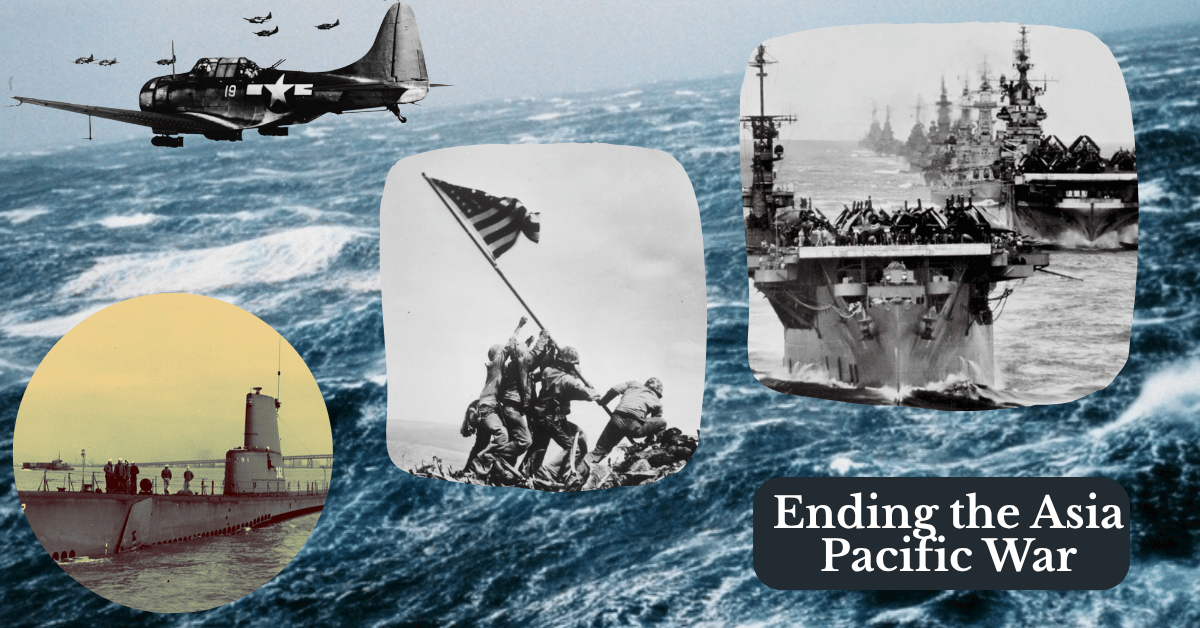
A small fire at the Marco Polo Bridge in 1937 spread to Manchuria, northern China, key Chinese ports, and French Indochina. On December 7, 1941 by attacking the U.S. Pacific Fleet at Pearl Harbor, the growing fire became the full firestorm of the Asia-Pacific War that lasted until September, 1945 at the cost of more than 30 million Asian lives.
It was a battle that the leaders of Japan knew they could not win. A war the Japanese government’s Total War Research Institute reported there was no chance of winning. Their actions were not rational; made no sense to the Western mind. Even the best minds in Japan argued against the possibility of success. But as Prime Minister Tōjō once remarked: “Occasionally, one must conjure up enough courage, close one’s eyes and leap off the veranda of the Kiyomizu Temple.”
Such was the path to the Asia Pacific War.
Image credit: various photographs from Naval Aviation Museum, National World War II Museum, and US Navy Archive.
This weekend we celebrate the 4th Sunday in Lent . In yesterday’s post we considered St. John’s treatment of “sin.” Today we move into the text itself.
If you wanted a one sentence summary of this account – here it is: “I came into this world for judgment, so that those who do not see might see, and those who do see might become blind”(v.39). Or: as a sign that he is the light, Jesus gives sight to a man born blind. But there is a richness to be gained in a detailed look at the text and narrative. The Johannine scholar, Fr. Raymond Brown suggests the following outline: Continue reading →