
The previous posts focused on the internal dialogue within the United States government during the period January into June, 1941. The focus was limited to the Departments of State, Treasury, Army (War) and Navy; the office of the President of the United States; and even included independent non-governmental agents helping/confusing depending on one’s perspective. The positions and approaches on how to best engage the Japanese government were varied, sometimes inconsistent, and largely reactive to Japanese actions. The State Department under the leadership of Cordell Hull consistently advanced Hull’s “Four Principles” which were end-states of diplomacy without interim checkpoints and thus lacking in measured concrete progress. Within the Far East Division of State there were proponents of assertive action and response as well as those who wanted to always engage Japan diplomatically. The Treasury Department was largely “let’s use the financial tools available” and bring Japan’s aggression to heal. But, from that same department, the White Proposal took an approach which addressed material and non-materials concerns of Japan in measured and concrete ways. And then there was the President, Franklin D. Roosevelt, who preferred one-on-one meetings between leaders to make decisions.
That was a high-level view of the milieu in the U.S. What about in Japan?
Japan’s Internal Debates on the United States
In the first half of 1941 the idea of war between Japan and the U.S. was not considered inevitable or even desirable. It was a period of strategic uncertainty, factional rivalry, economic anxiety, and diplomatic improvisation within Tokyo. Although Japan had already been at war in China for nearly four years, its leadership remained divided on how to consider the United States. Should they should be deterred, negotiated with, or ultimately confronted. Between January and June 1941, the Japanese government under Prime Minister Fumimaro Konoe wrestled with three interlocking questions:
- Could the China War be ended on terms acceptable to Japan?
- Should Japan align more deeply with Germany?
- Could conflict with the United States be avoided without abandoning imperial gains on mainland Asia? During the first half of 1941 this meant Manchuria, parts of Northern China, every major sea port in China, Taiwan (Formosa), Korea, and Northern French Indochina (North Vietnam)
The answers varied depending on whether one looked at political leaders, diplomats, or the armed services.
Political Circles: Konoe and the Problem of Survival
Prime Minister Konoe presided over a fragile civilian government increasingly overshadowed by military influence. In part by Meiji Constitution and in part by practice, the military occupied a minimum of four cabinet positions (Army, Navy, Army Minister, Navy Minister). If any one of them objected to a government policy or proposal, they simply resigned. This meant the Prime Minister had to form a new government and, as often was the case, the military refused to assign a new cabinet member until it received assurances that decisions would be in their favor. The Prime Minister had to navigate these waters.
Politically, three broad positions existed within the political arena: the pragmatists, the hardliners, and the diplomats. Prime Minister Konoe, cabinet members outside the military, leaders of key industries and others formed the “Pragmatists” view. They recognized Japan’s strategic weakness relative to the United States, especially in industrial capacity and oil supply. They favored:
- Continued negotiations with Washington
- A possible summit between Konoe and Roosevelt
- Limited concessions (e.g., partial withdrawal from China under conditions)
- Avoiding a two-front confrontation while Germany was at war with Britain
This group did not advocate abandoning imperial gains, but rather modulating expansion to avoid provoking U.S. intervention. However, Konoe’s weakness was structural. The military retained constitutional autonomy, and he lacked the authority to compel strategic compromise on their part, and sometimes to even control the military.
Right-wing politicians and ideological nationalists formed the group of “Hardliners” and by-in-large had the support of key elements within the military. The hardliners framed U.S. pressure and especially its support for China, as hostile interference in Japan’s rightful sphere. While not yet uniformly calling for immediate war, they increasingly depicted confrontation as inevitable. They argued that:
- The United States’ goal was to strategically control Japan economically, tightening or loosing controls as needed until Japan complied with U.S. demands.
- The Sino-Japanese War must be seen through to a political reordering of East Asia in which Japan established its own version of the Monroe Document. As the U.S. did in Central America and the Caribbean to eliminate despots and bandits, so too was China doing in China where war lords and the Chinese communists were disrupting peace and Japanese interests.
- Any retreat from already achieved mainland Asia gains would undermine imperial prestige and internal cohesion and ultimately lead to losing it all.
The Diplomatic Circles were mostly associated with the Japanese Foreign Ministry. Unlike the U.S. where Cordell Hull had been in charge of the nation’s diplomacy, from 1930 until the end of 1941 Japan had ten different Foreign Ministers serving in 13 different cabinets. The high turnover reflected the instability of Japanese politics, the growing influence of the military, and the intensifying internal divisions over diplomacy toward China, the Tripartite Pact, and negotiations with the United States. Within the Foreign Ministry, debate was intense and more nuanced than often assumed and was not always clear to U.S. leaders who depended on Ambassador Joseph Grew whose connections were with the moderate wing of the government and was not always able to discern the shifting alliances and currents within the Japanese government.
Within Tokyo some diplomats favored a modus vivendi, a temporary freeze on expansion into other Asian countries in exchange for economic relief. Others believed U.S. policy was fundamentally hostile and would not accept Japan’s position in China under any conditions other than full withdrawal. An intrinsic problem was always China because Japan’s government was always reacting to independent decisions being made in China by the Imperial Japanese Army (IJA). Japan never had a policy or “end game” for China. As a result, diplomats lacking concrete instructions were often negotiating without authority or substance regarding the central issue: China.
When Admiral Nomura was sent to Washington DC, he was sent without instructions regarding any aspect of U.S.-Japanese relations and trouble spots – and yet was expected to steer the relationship away from confrontation with the U.S. Nomura, who had spent extensive time in the U.S. believed that war with the U.S. would be catastrophic. As a result his default position was incremental compromise to stabilize relationships and renormalize trade. This likely created the environment where Nomura was drawn into the Maryknoll/John Doe dialogue and then later private negotiations with Secretary Hull. The effect was 6 months passed and U.S.-Japanese relations were as they had been since the beginning of 1941.
Debate within the Imperial Army and Navy
The most consequential debates occurred within the armed forces, particularly between the Imperial Japanese Army (IJA) and the Imperial Japanese Navy (IJN). The Army remained focused primarily on securing victory in China and guarding against Soviet Union incursion into Manchuria (the northern strategy). However, after Germany invaded the Soviet Union in June 1941, Army factions renewed the debate about striking north into Siberia while the Soviets were occupied on the eastern front.
Even before June, many Army leaders believed economic strangulation by the U.S. would force Japan’s hands to launch offensive military action to the resource-rich Southwest Pacific. That said, in early 1941 the Army had not yet finalized a decision for war with the United States but knew that the southern expansion would increase the likelihood of war with the Americans.
The Navy’s position was paradoxical and was increasingly the more important voice from military circles. Senior naval leaders recognized U.S. industrial superiority., understood a long war would likely end in Japanese defeat, and yet believed that if war came, it must begin with a decisive blow to take the U.S. out of the conflict for a period while Japan consolidated gains in the south and created a defensive zone to the east against the U.S. fleet. In early 1941, many in the Navy preferred avoiding war if possible but in any case to have more time for adequate preparation.
But there was a contingent of naval officers that understood the U.S. was in the midst of building a two-ocean navy with the 1940 signing of the Naval Expansion Act. The act authorized the U.S. Navy to build 18 aircraft carriers, 7 battleships, 33 cruisers, 115 destroyers, 43 submarines, 15,000 aircraft, and 100,000 tons of auxiliaries. It was thought that a surprise attack was necessary, but the policy was not settled.
Economic Realities and Strategic Anxiety
Among all the groups, a central driver of debate was oil. Japan imported roughly 80% of its oil from the United States. By early 1941 U.S. export controls were tightening, Japanese reserves were finite and economic planners warned of severe vulnerability as the military operations continued to draw down oil reserves. The strategic dilemma became increasingly stark:
- Concede in China to preserve economic survival?
- Or seize resource-rich Southeast Asia (Dutch East Indies) and risk U.S. war?
This tension simmered throughout the first half of 1941 but did not fully crystallize until after July.
By June 1941, Japan had not yet decided on war with the United States. Japan’s internal debate was characterized by:
- Political fragility within Konoe’s government
- Diplomatic efforts lacking decisive authority
- Military contingency planning without full consensus
- Growing anxiety over economic vulnerability
The period was one of conditional escalation rather than inevitability. War became likely only when the internal debates (oil, China, and southern expansion) collapsed into a consensus after the summer crisis of 1941: the invasion of Southern French Indochina and the subsequent U.S. economic freeze and oil embargo. Any settlement that required major withdrawal was politically impossible at home in Japan.
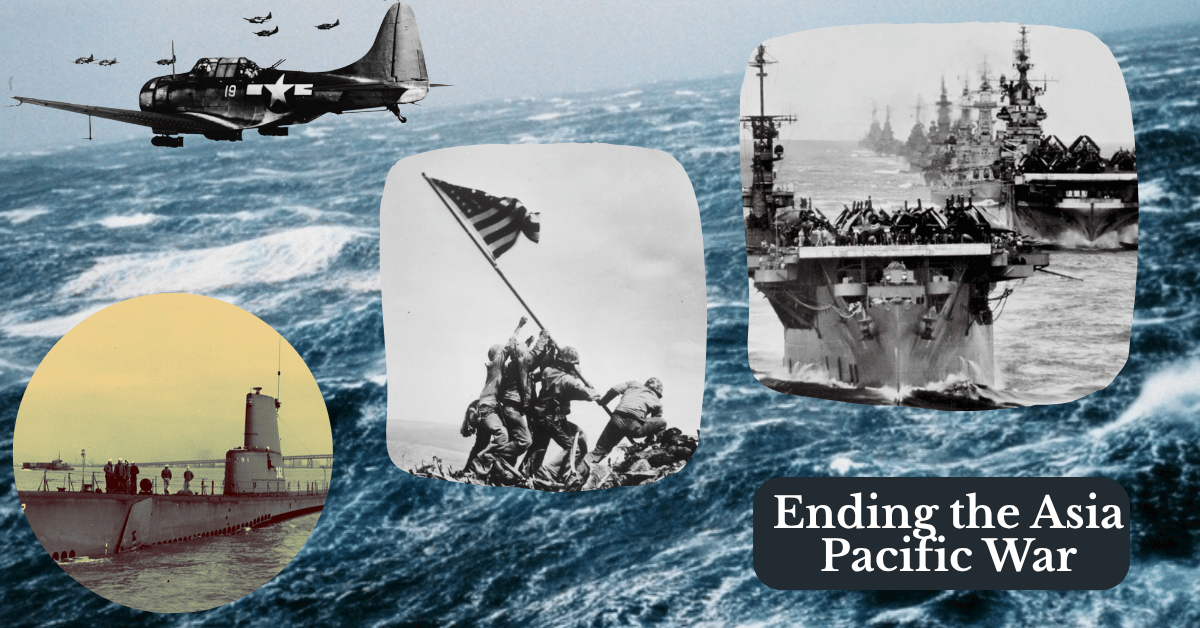
Image credit: various photographs from Naval Aviation Museum, National World War II Museum, and US Navy Archive. |
Discover more from friarmusings
Subscribe to get the latest posts sent to your email.

