
While the Imperial Japanese Army (IJA) lurched into escalation through a series of “incidents” in China and suffered defeat at Nomanhan at the hands of the Soviets, the Imperial Japanese Navy (IJN) followed a very different strategic logic. It was one that was more calculated and globally oriented, though ultimately no less expansionist.
Both Japan and the U.S. were adherents of the theories of Alfred Thayer Mahan (1890) who posited that national greatness is inextricably linked to sea power, defined as the ability to control vital maritime trade routes and project naval force. Mahan argued that a large, concentrated, offensive, steam-driven navy (as opposed to sail) supported by merchant shipping and overseas colonies, is essential for securing economic wealth and international influence.
By the early 1930s, the IJN had concluded that Japan’s survival depended on maritime access to resources. As such, it was clear that the decisive threat was the United States, not China or the Soviets (IJA’s concerns). IJN leaders, many of whom had served or studied in the United States, knew war, if it came, would be long, decided by naval forces, and dependent on control of the seas. This contrasted sharply with the Army’s fixation on continental expansion, border clashes and the ideological fixation against communism.
Decisive Battle Doctrine
The Navy’s planning revolved around kantai kessen (decisive fleet battle) which is described in a previous post: War Plan Orange. In short, the operational concept was to allow the U.S. Pacific Fleet to steam west 3,000 miles to the Western Pacific (Mahan’s theory was that for every 1,000 miles of ocean transit a fleet would lose 10% of its combatant strength). But along the way to attrit the U.S. Fleet with submarines and air attacks. The now weakened U.S. Fleet would be destroyed in a decisive surface battle in Japanese waters.
This doctrine was at the root of naval construction efforts: battleships, cruisers, destroyers, and aircraft carriers. The IJN was at the forefront of aviation, not only for deployment on carriers, but also for island-based airfields across Micronesia (Truk, Saipan, Palau and others). Such installations were sited on expected lines of advance of the US Fleet and served as “unsinkable aircraft carriers.” In this same vein, Japan emphasized long-range naval aviation, knowing that would be a key to success in the open waters of the Pacific. The Japanese also greatly expanded their submarine fleet.
The IJN and China
When the Army expanded the Sino-Japanese war after the Marco Polo Bridge Incident, the Navy viewed it as a dangerous distraction from the larger strategic threat. Nonetheless, the Navy took on the natural role of blockading the Chinese coast, seizing key ports (Shanghai, Canton), and protecting maritime supply lines for Army forces. At the same time, the IJN took the opportunity to develop experience in long-range bombing by extensive naval air bombing of Chinese cities. The Navy hoped the whole “China affair” would quickly move to a political settlement so that resources and attention would focus on the coming naval battles
Internal Navy Debate: Treaty Faction vs. Fleet Faction
The Washington Naval Treaties of 1922 divided the IJN for the next 20 years. The resulting factions still mattered right up to 1941. In short, the Treaty Faction favored naval arms limitation, feared war with the U.S. and preferred diplomacy and gradual expansion. The Fleet Faction rejected treaty limits as shameful and dishonorable, sSought parity through qualitative superiority, and held that war with the U.S. was inevitable. By the late 1930s, the Fleet Faction dominated, especially after Japan withdrew from naval treaties in 1934 and began to build new combatants exceeding the limitation of the treaty. A key concept of the Fleet Faction was parity with the United States. While they knew the U.S. could outbuild Japan, they also knew that the U.S. was required to be a two-ocean navy. The Fleet Faction did not have many officers who were familiar with the U.S. industrial capacity or resources. Their basic assumption of parity in the Pacific was seriously wrong, and in addition, the focus on combatants severely diminished the production of merchant shipping and especially fleet oil tankers. In 1939, despite having a large merchant marine, Japan still relied on foreign-flagged vessels for nearly 30% to 40% of its shipping needs to sustain its economy, particularly for raw materials and oil. This persisted even into 1941. Japan’s military and industrial goals meant that it had to import 94% of requirements for oil, aviation fuel, gasoline, lubricants, and general purpose oil-based products.
Japan’s reliance on pre-war, Allied-flagged tankers, which ceased upon war declaration, left them with a massive logistical gap. Japan did not possess enough specialized oil tankers to adequately transport oil from Southeast Asia (the “Southern Resource Area”) to Japan after Pearl Harbor. In 1941 Japan required 32 million barrels of oil annually. This equated to 5 million (dead-weight) tons of shipping. Japan’s tanker fleet was inadequate, with only 49 merchant tankers (approx. 587,000 tons) available at the start of the war – only 10 percent of their needs. The lack of tankers was a critical failure in planning, as Japan failed to prioritize building enough tankers to secure their oil lifeline. While they quickly conquered oil fields, allied submarines and aircraft sank tankers faster than they could be replaced, severely crippling the oil supply line.
IJN Operational Planning
The Army’s 1939 defeat by the Soviets at Nomonhan had an impactful, yet indirect effect on naval policy. The IJN concluded that continental expansion (China, Siberia, Mongolia, etc) was a strategic dead end. As such Japan must look south, not north. This reinforced the Navy’s preferred Southern Advance (Nanshin-ron) to Southeast Asia, the Dutch East Indies, and British Malaya
From the autumn of 1939 forward, naval war plans increasingly assumed U.S. embargoes and thus the need for preemptive action. Even then IJN leaders repeatedly warned the Diet and the Emperor about U.S. industrial superiority, repeatedly stressing that a long war with the United States could not be won. Oil reserves sufficient for roughly 18–24 months; after that, the fleet would be immobilized and any war fought later would be unwinnable.
No one expressed this more bluntly than Admiral Yamamoto, the architect of the Pearl Harbor attack, who warned that Japan could: “Run wild for six months… but I have no confidence after that.” It was sober professional judgment shared widely in naval circles.
The IJN lived with a deep internal contradiction. It understood with remarkable clarity that Japan could not win a long war against the United States, yet it simultaneously embraced plans that assumed a short, decisive victory would somehow occur. This was not simple irrationality. It was a coexistence of strategic realism and catastrophic optimism, reinforced by culture, doctrine, and institutional pressure.
Knowing a long war was unwinnable, it was clear that realism led not to peace, but to a compressed decision space. Diplomacy required abandoning China which was politically impossible. Waiting meant fuel exhaustion which was strategically fatal. Therefore, war now was preferable to war later. This logic did not say Japan could win a long war. It said Japan must force a short one.
The planning for the Attack on Pearl Harbor captures the paradox perfectly. The plan was realistic: neutralize the U.S. Pacific Fleet early. buy time to seize oil-rich territories, and establish a defensive perimeter too costly to break. The plan was catastrophically optimistic because it hoped the Americans would lose the will to fight, the U.S. would seek to negotiate after early setbacks, and so Japan could dictate terms before U.S. industrial power fully mobilized. Naval planners did not believe Japan could outbuild the U.S. They believed it could outshock it.
War Games
In the years before 1941, the IJN prided itself on war gaming as a mark of scientific modernity. They were conducted at the Naval War College; using detailed maps, counters, and probability tables; and overseen by highly trained staff officers. These war games were treated as tools for refining doctrine, proof of intellectual seriousness, and reinforcement of professional military identity. But they were not neutral experiments. They were embedded in the doctrine of decisive battle thinking.
Nearly all IJN war games began with non-negotiable assumptions: war would be decided by a single climactic encounter, the U.S. forces would advance methodically across the Pacific, and Japan would attrit the enemy and then strike decisively. Because these assumptions were never questioned, war games tested how to win the decisive battle not whether the strategy itself made sense. This meant strategic failure was excluded by design, including one of the most important assumptions: attrition.
To give you an idea, IJN war games consistently assumed elite pilots survived at implausible rates, ignored replacement shortfalls, underplayed maintenance and fatigue and treated fuel and logistics as abstract variables. Attrition was systematically minimized. Why? Because acknowledging attrition meant acknowledging time and time favored the United States. Thus, war games preserved optimism by compressing time out of the model.
The War Games always modeled the success of the decisive battle. It never modeled the war of attrition in which they were engaged.
The Fatal Flaw
What realism failed to penetrate was American political culture. While IJN leaders understood U.S. industry. They underestimated the U.S. public reaction of rage, the resulting unity, and capacity to “turn on a dime” to a war economy. Japan achieved the shock it sought but not the reaction. Instead of weakened resolve, Pearl Harbor produced total mobilization, political unity, and a war effort that erased Japan’s initial advantages within a year. By December 1942, a year after Pearl Harbor, the U.S. was on the offensive having achieved a decisive result at the Battle of Midway, was close to driving the IJA from Guadalcanal, and was turning back the Japanese in New Guinea. Meanwhile, the shipyards and factories were producing ships, planes and pilots at rates that would soon overwhelm the Japanese. At the same time the Japanese merchant fleet was being methodically reduced by unrestricted submarine warfare.
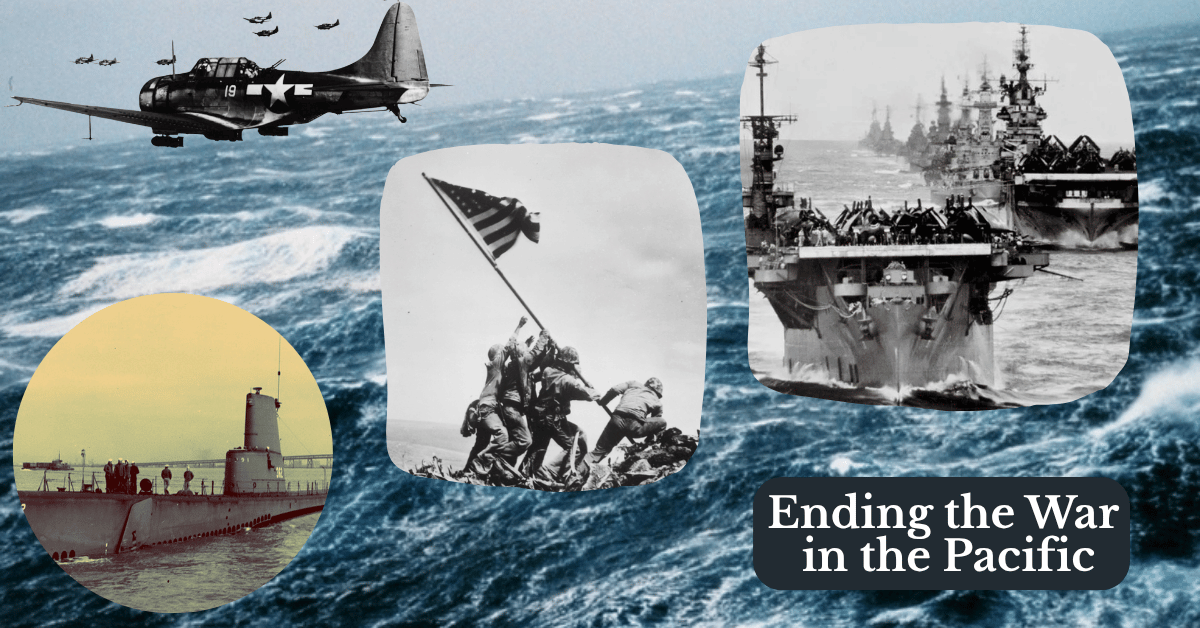
Image credit: various photographs from Naval Aviation Museum, National World War II Museum, and US Navy Archive.
Discover more from friarmusings
Subscribe to get the latest posts sent to your email.
 friarmusings
Imagine the attrition if the US only had decent torpedoes.