
Pearl Harbor was just the beginning of a remarkable series of rapid military victories across the Central and Southwest Pacific and Southeast Asia. From the 1939 occupation of Northern French Indochina, the aim of Japan had always been focused on the oil fields of the Dutch East Indies. The July 1941 occupation of Southern French Indochina was a preparatory move towards Thailand, Burma, the Malay Peninsular, and the city of Singapore. These were preliminary moves to the invasion of the Dutch East Indies.
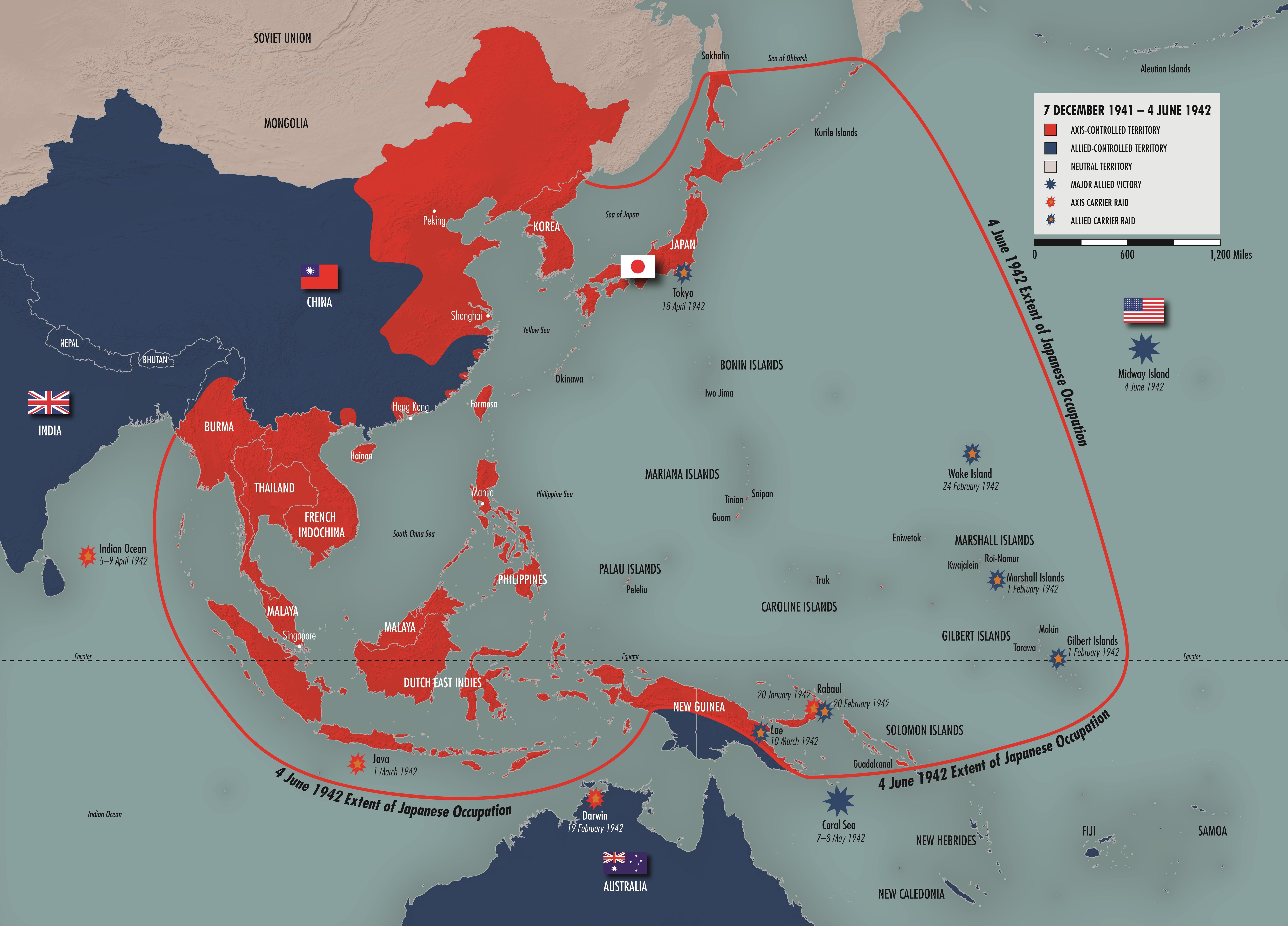
The Path to the Dutch East Indies
December 8
- Invasion of Hong Kong. This important British colony and supply route for the Chinese Army was fully captured by Christmas Day.
- The first wave of IJN bombers attack Wake Island. The Marine Defense Force on the island with its limited air support repulses multiple attacks but finally falls on December 23rd.
- Bombing and amphibious landings occur in the Philippines (Luzon). Manila is declared an open city and occupied by the Japanese on January 2nd. The allied forces on the Bataan Peninsula surrendered April 9th, with the last stronghold, Corregidor, falling on May 6th.
- Japanese forces landed in northern Malay with concurrent landings in southern Thailand. The Malay peninsula was under Japanese control by January 18th leaving the Japanese army at the “gates” of Singapore.
December 10:
- The U.S. territory of Guam in the Marianas Islands was captured in a single day operation.
- The main British naval deterrent in the Southwest Pacific, HMS Prince of Wales and HMS Repulse, are sunk by IJN torpedo planes.
December 22:
- Japanese forces cross into Burma
- By March 7, Rangoon was controlled by the IJA
- By April 26, all of Burma was under Japanese control
February 15: British forces surrendered Singapore, the largest British military defeat in history.
Conquering the Dutch East Indies and their Oil Fields
- December 16: Japanese troops invade Borneo with the ultimate target of the oil fields of Balikpapan. Borneo was under Japanese control by February 1
- February 14: Sumatra was invaded with the ultimate target of the oil fields of Palembang. By March 28 the island was under Japanese control
- February 28: Java was invaded and under Japanese control by March 14.
Strategic Situation
By late May 1942 Japan had achieved nearly all of its initial war aims:
- Securing oil and resource regions
- Eliminating Allied naval forces in Southeast Asia
- Establishing a broad defensive perimeter stretching from Southeast Asia, to the Southwest Pacific, to the central Pacific, occupying all locales of significance.
However, the rapid expansion also stretched Japanese logistics and resources. Within days of the end of May 1942 Japan would face a turning point of the Pacific War at the Battle of Midway, where this string of victories would abruptly end.
Image credit: various photographs from Naval Aviation Museum, National World War II Museum, and US Navy Archive. Map from John Parshalls.
Discover more from friarmusings
Subscribe to get the latest posts sent to your email.
 friarmusings
My mother told us stories of Japanese invasion in PI during her time.