
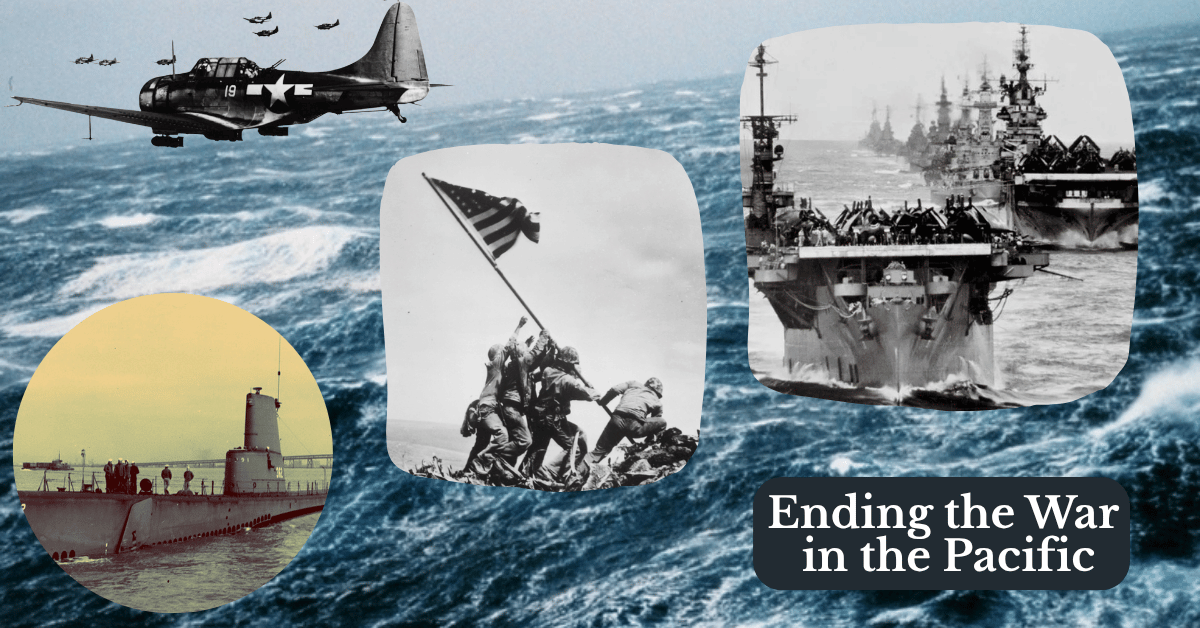
Two nations expanding outward, each for their own reasons, collided in the waters, islands, and nations of the Western Pacific. Before the 19th century, in certain ways, each nation was a stranger to what would become the battle ground of the 20th century Asia-Pacific War. While Japan had “history” in the region, it had self-isolated during much of the 17th and 18th centuries. But then there was always China. Japan had a long off-and-on again relationship with China.
The United States was “introduced” to China when the U.S. merchant “Empress of China” arrived in 1784 to begin the long legacy of US-China trade. New England whalers rounded Cape Horn just before 1800. While first focused on the South Pacific, they reached Japanese waters by 1820. Early American forays into the region were discussed in China Trade and US Expansion and There’s Something About China.
By the mid-to-late 19th century we had two countries with visions of expansion, swimming in the same waters. The visions were not compatible as they would eventually discover. Even more, neither country ever really understood the other. One was a homogeneous, cohesive society beholding to an Emperor looking at the other which was a melting pot of immigrants beholding to no man – people with a long history of “moving west.” Or so it seemed to the Japanese. From the other view, it was a nation of adventurous plain-spoken explorers encountering inscrutable people who spoke meaning within meaning and wrapped themselves in plots and counter plots.
Where perhaps the natural inclination of Japan was to “stay home” in the land that had never been successfully invaded, and when others had tried, the divine winds (kamikazi) had driven the invaders away. The home islands were spectacular, blessed by the gods, but limited in land to provide food for its burgeoning population – and limited in the natural resources to take its place in the world order as peer to the great western powers. Japan asked itself, “Had we not defeated them in the Russo-Japanese War of 1904-05? Had we not stood with the Allies in the “Great War” ended in 1919? Surely, they would recognize our sphere of influence and leadership in the Asia-Pacific region.”
The natural inclination of America was not to stay home, but explore, moving ever west and a mere obstacle like the Pacific Ocean was only one more “river” to cross. We would build a canal across Panama to get there even quicker. There were new lands to find and business to be done because America had resources and land galore, industry to create things and needed new markets for our products. We were the new power taking over the world order. Hadn’t we just rescued the so-called “leading nations” from the quagmire of the “Great War.” Heck, our founding began by defeating the great British Empire and wresting our independence from the “world order.”
What is often overlooked is that both Japan and the United States “broke out” onto the world stage at approximately the same time in history. Japan defeated China in the First Sino-Soviet War and greatly profited in terms of land and war reparations. The defeat of Russia was waiting in the wings.
After demolishing the Spanish Empire, the US took possession of the Philippines. Elated by success at sea, the US increased its naval power but kept its standing army small. However, the imperialist experiment in the Philippines failed. After a short and violent rebellion, the US displayed a kind of benign neglect toward its only major colony. Investment and trade were insignificant, and administrative costs were high. In less than a generation, the US gave the Philippines home rule and promised independence. More typical of American-style power politics was the Open Door policy that called for international respect of Chinese territorial integrity and free access to markets and resources. In one form or another, the Open Door was American policy until Pearl Harbor.
One nation was focused on building an Empire. An empire it needed for its population that had “outgrown” the home islands. An empire for the resources needed to become the recognized leader of the Asia-Pacific sphere – and that meant the old colonial system needed to go. Asia for Asians under Japan’s leadership and benevolence.
The other nation was focused on establishing and maintaining a position as the preeminent business and trade partner in the Asia-Pacific market. There was enough to go around…as long as we had what we needed for export of our industrial products.
By the 1930s we had two countries that were now sharks circling each other in the same waters. Different kinds of sharks, but sharks nonetheless.
One shark brought the power of its military to bear to dominate the Asia-Pacific region. One brought the power of its financial and industrial resources to temper and tame the other. But as I have tried to outline in the posts since this past January, there were too many voices, too many hands, all leading to steps, missteps, misunderstandings, reactions and overreactions.
The government of Japan might share a vision with its Imperial Army leadership, but not a timetable to achieve that vision with the junior officer corp: Mudken, Marco Polo Bridge, and Nomonhan. Japan’s culture, constitution, government, popular press, and more created the military behemoth it could not control. And so it followed. In for a penny, in for a pound. They did not lack ambition, technology, or commitment. They lacked finances, natural resources, and any understanding of American reaction to a “sneak attack.” The 1937 USS Panay incident should have been their early warning. As I have described elsewhere, by 1937 Japan was like a car with marginal brakes. Fine for the flat roads, but now they were accelerating downhill, blowing through one stop sign after another.
Like Nazi Germany, Japan was a serial aggressor that took on far more than it could handle. Tokyo strategically and tactically backed itself into a corner thinking it could wage war with the United States, willing allies in the Pacific, and the Soviet Union in addition to an exhausting 4-year war in China that it did not know how to win? Japan invited its own downfall and backed into a war it was never going to win. Their imperial ambitions were not matched to their ability to achieve them. The first six months following Pearl Harbor were heady days, reinforced by all the misplaced assumptions, blinding them to the long term consequences.
But the United States was burdened by its own poor assumptions, the most damaging of which was believing that our enormous leverage over their economy was sufficient to temper Japan’s behavior. The U.S. demanded that Japan withdraw its forces from both Indochina and China. In effect they required that Japan renounce its empire in exchange for a restoration of trade with the United States and acceptance of American principles of international behavior. For Japan, a major reason for establishing an empire in East Asia was to free itself from the humiliating economic dependency on the United States. What was to stop the Americans from coercing further territorial concessions from the Japanese, including withdrawal from Manchuria and even Korea? What the U.S. thought was a defensive deterrent – the economic sanctions – was tantamount to a declaration of war.
By late November 1941 there was “blood in the water” fueled by an increasing sense that war was inevitable. Too easily “inevitable” becomes a self-fulfilling prophecy. As H. P. Willmott points out, Japan was, “a nation with no experience of defeat and, more importantly, a nation created by gods, and ruled by a god. This religious dimension provided the basis for the belief in the superiority of the Japanese martial commitment . . . that was the guarantee against national defeat.” Even in 1944 and 1945 it was clear that while the U.S. had suffered losses in difficult and bloody battles in the Central Pacific, there was no way for Japan to win. The Japanese had no way to reinforce, no way to resupply, no way to evacuate, no way to equal the firepower of the U.S. Navy, and frequently no air power. The Japanese recognized their fate but their objective became to inflict as many casualties as possible on Allied forces with the real target being the homefront. They believed they could destroy the will of the American people back home who would demand an armistice. It was a fatal belief that took Japan to the edge of starvation.
Japan’s drive for power, honor, and reputation led to Japan’s complete destruction and subsequent occupation by the United States. Their ambition and foreign policy led the people into a war against an undefeatable enemy. It was a policy of suicide before dishonor. As the late 20th century demonstrated, good relations with the United States would always be a condition for a secure Japan.
Blood in the water
The earlier analogy of 1941 being the body of water, two sharks, and already blood in the water has its limits. It is a myth that such guarantees a violent frenzy among the sharks. Blood in the water is just one of many sensory inputs that a shark processes. The other inputs were too much. Two nations started a war that was always going to end the same way. It was only a matter of time. By September 1945 the frenzy was over and the water was thick with blood.
Epilogue
A final post. Probably not, but another overarching series … I don’t think so. The two series (created from Aug 2025 until March 2026) comprise almost 400 pages of writing, lots of reading and research, and was fun. I hope you enjoyed it too.
There are lots of singular topics of interest which might lead to other smaller efforts. So from time to time….
Image credit: various photographs from Naval Aviation Museum, National World War II Museum, and US Navy Archive | the Hart quote found in Tohmatsu and Willmott, A Gathering Darkness: The Coming of War to the Far East and the Pacific
Discover more from friarmusings
Subscribe to get the latest posts sent to your email.
 friarmusings