

The previous posts attempted to lead the reader through the labyrinth of thoughts and attitudes that formed the currents of Japanese-U.S. relationship from the beginning of 1941 until June 1941. Within the U.S. government, the key figures were already in place and would remain so for the remainder of 1941 as would their views and recommendations. Within the Japanese government the same could not be said. There were changes in the Foreign Ministry, Navy Ministry, and in the office of the Prime Minister. These changes are a reflection of the changing and narrowing of Japanese options.
In May of 1941, after months of private negotiations, Ambassador Nomura delivered Hull’s 4 principles to Tokyo. They were sent without context. Nomura never indicated that these were at the core of Secretary Hull’s agenda. Foreign Minister Matsuoka rejected them in substance and issued a counter-position that sharply redefined the terms of any agreement. Hull’s Four Principles (sovereignty and territorial integrity; non-interference; equality of commercial opportunity; peaceful change) were, in Matsuoka’s view, abstract and one-sided. His counter proposal stressed five key elements:
- Any settlement had to recognize Japan’s leadership role and security needs on the Asian mainland. This meant the U.S. had to recognize Japan’s “special position” in East Asia, especially in China, which the Four Principles implicitly denied.
- Non-abrogation of the Tripartite Pact: Japan would not renounce or dilute its alliance with Germany and Italy as a precondition for talks.
- Reciprocal non-interference, meaning the U.S. should cease material and moral support for China, notably aid to Chiang Kai-shek, if Japan were to consider moderation of its China policy.
- Stability through spheres of responsibility, not universal rules. Japan argued that regional order required acknowledging existing facts created by force.
- Economic normalization first, particularly restoration of trade (notably oil), before political or military concessions.
In effect, Matsuoka transformed Hull’s universal principles into a regional, power-based framework that preserved Japan’s gains in China and its axis-powers alliance commitments. This response hardened American skepticism about Japan’s sincerity and widened the gap that later negotiators, after Matsuoka’s removal in July 1941, would struggle unsuccessfully to bridge.
At this point, Japanese–American relations were already severely strained. Four years of war in China, Japan’s alignment with Germany and Italy, and growing American economic pressure had narrowed the space for compromise. Yet neither side regarded war as inevitable in June 1941. Diplomacy continued, but increasingly as a race against time, shaped by internal political constraints and strategic calculations.
In Tokyo, the central question was whether Japan could secure its objectives, especially access to vital resources, without provoking war with the United States. The Japanese made efforts to secure long term oil delivery contracts through the Dutch East Indies. However it was not purely a commercial proposal, the request while offering preferred trading status to the Dutch East Indies also required recognition of Japan’s territorial gains and regional leadership. The Dutch rejected any agreement that implied political concessions or recognition of Japanese expansion in China or Southeast Asia. They coordinated closely with the United States and Britain, aligning Dutch policy with the broader Allied strategy of economic pressure. After Japan’s move into southern Indochina, the Dutch joined the asset freezes and export controls, effectively ending meaningful oil sales to Japan.
For Japanese leaders, the Dutch refusal was decisive. It confirmed that no major Western power would break ranks to supply oil. It reinforced the military argument that Japan must seize the oil fields rather than negotiate for access. By late summer 1941, Japanese planning explicitly assumed that oil would be taken by force if diplomacy failed.
In Washington, the question was whether Japan could be deterred from further expansion without concessions that would undermine U.S. commitments to its alliance partners: China, Britain, and the Netherlands.
Outline of National Priorities
The decisive turning point on the Japanese side came at the Liaison Conference of June 27–30, 1941, attended by civilian leaders, Army and Navy chiefs, and senior bureaucrats. This body coordinated policy between the government and the military and effectively set the framework for subsequent diplomacy. The conference produced the document titled “Outline of National Priorities in View of the Changing Situation.” When is this in time? It is before the Japanese move into Southern Indochina and the subsequent financial freeze and de facto oil embargo.
The significance of the document lay not in operational details but in its strategic logic. The core assumption of the “Outline of National Priorities” were:
- The European war favored Japan in the short term, as Britain was stretched and Germany appeared dominant.
- The United States was the primary long-term threat, due to its industrial capacity and naval power.
- Japan must secure the resources of Southeast Asia, especially oil, to sustain both the China war and national defense.
- Diplomacy should be pursued—but without sacrificing core objectives, especially Japan’s position in China.
The document endorsed a dual-track policy: (1) continue negotiations with the United States and (2) preparations for military expansion southward if diplomacy failed. Importantly, the conference concluded that waiting passively risked strangulation through economic pressure. This logic framed all subsequent diplomatic negotiations.
The “Outline” was handled as a confidential document that was never transmitted via diplomatic cables and so the U.S. was unable to intercept and decode. While the U.S. decision makers never saw the “Outline”, through other MAGIC intercepts of Tokyo–Washington diplomatic instructions, U.S. officials inferred Japan’s strategic direction, deadlines, and bargaining posture. Messages revealed that Japan was operating under time pressure, that negotiations had implicit deadlines, and that military preparations were proceeding in parallel with diplomacy. These intercepts conveyed the effects of the Outline: rigidity on China, insistence on economic relief, willingness to risk war. but not its formal articulation or internal debates.
June was also an important month in that Germany invaded the Soviet Union on June 22, 1941 requiring Japanese leaders to reassess their strategic options. With the Soviet threat temporarily reduced as they turned to the West to face the German advance, Japanese attention shifted decisively south. In early July, another Liaison Conference approved the occupation of southern French Indochina, a move that went far beyond earlier deployments in northern Indochina.
The decision of the Liaison Conference to advance into southern French Indochina was formally presented to, and approved by, the Emperor at an Imperial Conference on July 2, 1941. At that Imperial Conference, the government and military placed before Emperor Hirohito the policy resolution that authorized the southern advance into Indochina, continued diplomacy with the United States and Britain, and simultaneous preparation for possible war should diplomacy fail. The Emperor gave his assent, making the move into southern Indochina official state policy. Although well after the fact and Japan’s move into Southern Indochina, on August 8th MAGIC intercepted a message detailing the decision of the July 2nd Imperial Conference.
Although presented diplomatically as a stabilizing measure, it was widely understood by Tokyo and Washington alike as a direct threat to British Malaya and the Dutch East Indies. The American response was swift and severe: Japanese assets in the U.S. were frozen and oil exports effectively ceased. For Japanese leaders, this was a shock. While economic pressure had been anticipated, the scale and immediacy of the oil cutoff transformed diplomacy from a matter of advantage into one of national survival. The oil cutoff intensified internal divisions:
- The Army argued that Japan had little choice but to prepare for war. Prolonged negotiation would only weaken Japan’s position.
- The Navy warned that war with the United States was unwinnable in the long term but concluded that if war was unavoidable, it should be fought sooner rather than later.
- Prime Minister Konoe Fumimaro sought a diplomatic breakthrough, including a personal summit with President Roosevelt, but lacked the authority to compel military compromise.
Throughout July and August, Liaison Conferences repeatedly reaffirmed the need to continue negotiations while accelerating military preparations, an inherently unstable posture.
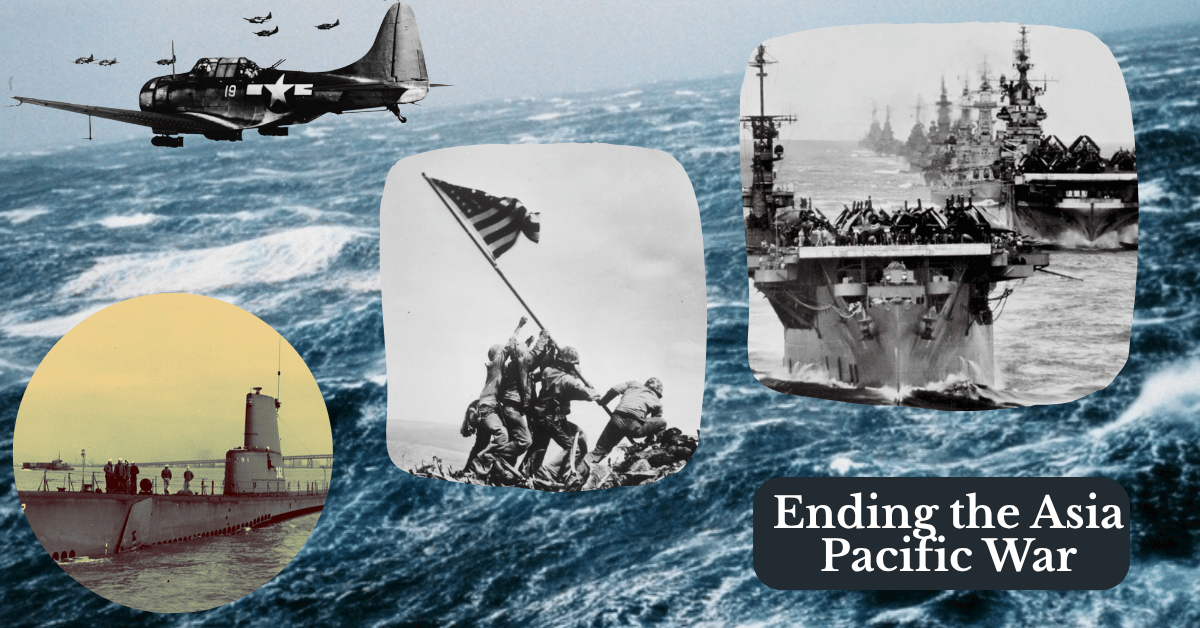
Image credit: various photographs from Naval Aviation Museum, National World War II Museum, and US Navy Archive.
 friarmusings