Unknown's avatar

About Friar Musings

Franciscan friar and Catholic priest at St. Francis of Assisi in Triangle, VA

Are we there yet?

The familiar complaint and plea from the backseat of a long road trip – or what seems long to the one voicing the inquiry. And the longer the destination looms in an unclear and uncertain future, the more mischief blossoms in the back seat. “He’s touching me” / “she on my side, make her move over / “they won’t let me sit by the window.”  It is not the jealousy, envy, malicious slander, and defamation that James has been admonishing the community about, but it bubbles up from the same source. Continue reading

The Foundation

This coming Sunday is the 8th Sunday in Lectionary Cycle C. Again we are considering the “Sermon on the Plains” from the Gospel of Luke. In yesterday’s post we noted that the consistency of heart and action, when pointed to Jesus, will bear the fruit of the Kingdom. As John Nolan remarked:  “Whether one likes it or not, what one produces is finally a product of what one is.” Continue reading

James – an epistle of straw?

The Protestant reformer Martin Luther called the Letter of James an “epistle of straw.” While some claim he wanted to remove it completely from the Canon of New Testament scripture, that likely claims too much.  What is clear is that he held less importance than other NT books. He relegated James, as well as Hebrews, Jude, and Revelation to a second tier status. Why? Luther wrote: “Though this epistle of St. James was rejected by the ancients, I praise it and consider it a good book, because it sets up no doctrines of men but vigorously promulgates the law of God.” Luther never offers substantive proof of his rejection claim and in any case relies on two “ancients” (Origen and Eusebius) who don’t actually reject James but think of them as of lesser importance. A thought not shared among the whole of the patristic saints. Continue reading

Living into the unknown

Today’s first reading continues to work its way through the Letter of James.

13 Come now, you who say, “Today or tomorrow we shall go into such and such a town, spend a year there doing business, and make a profit”— 14 you have no idea what your life will be like tomorrow. You are a puff of smoke that appears briefly and then disappears. 15 Instead you should say, “If the Lord wills it, we shall live to do this or that.” 16 But now you are boasting in your arrogance. All such boasting is evil. 17 So for one who knows the right thing to do and does not do it, it is a sin. (James 4:13-17)

Continue reading

Splinters and Logs

This coming Sunday is the 8th Sunday in Lectionary Cycle C. Again we are considering the “Sermon on the Plains” from the Gospel of Luke. In yesterday’s post we noted that Jesus is preparing his disciples to “be like the teacher” in that they truly begin to see the kingdom and are no longer blind. The first part of the sermon has offered a new understanding of the values of heart and action called for by God. Even if the listener decides to choose Jesus as the teacher, to what degree will they follow? Will they act on this new understanding? Will they persevere to become “fully trained” and become like their teacher? Continue reading

Leadership

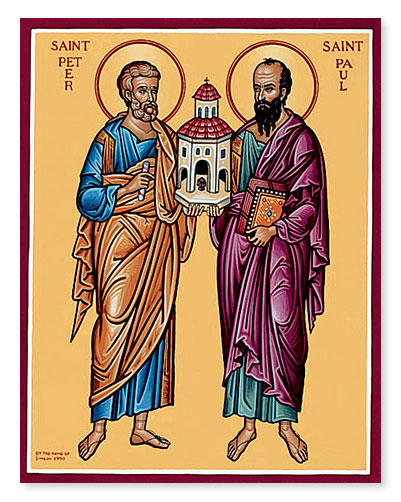
The gospel for today is often a central part of any discussion about the role of Peter as appointed leader of the early church leading into the successors of Peter as the Pope of the modern Catholic Church. A modern evangelical scholar, nominally part of a religious perspective that would deny any particular role assigned to Peter, offers that his peers have to twist Scripture out of shape to reach that conclusion. Their arguments are molded to fit their predetermined end. This scholar holds that clearly Peter was assigned leadership. However, he would argue that there is nothing in these verses to point beyond Peter’s leadership of that group of Apostles. He argues that Catholic apologists argue to their own predetermined ends. Continue reading

Blindness

This coming Sunday is the 8th Sunday in Lectionary Cycle C. Again we are considering the “Sermon on the Plains” from the Gospel of Luke. In yesterday’s post we held that this point in the gospel marks a change in which appears a principal call of Luke-Acts: the practical demand of the gospel with emphasis on behavior – not a sole emphasis – but highlighted nonetheless. The issue is one of character and commitments becoming action in the life of the believer. Continue reading

Next-level and the Red Pill

In normal times and seasons, air travel is a routine thing – at least in my time. My dad was born in 1912. That year, a trip between Tampa and St. Petersburg, two cities sitting on opposite sides of Tampa Bay, took two hours by steamship, at least 4 hours by rail. Traveling by automobile around the bay took as much as 20 hours. On Jan. 1, 1914, the world’s first scheduled passenger airline service took off, operating between St. Petersburg and Tampa in a Thomas Benoist-designed flying boat. The 21-mile flight took 23 minutes. The St. Petersburg-Tampa Airboat Line was a short-lived endeavor — only four months — but it was a profound technological shift in the way we lived and perceived our present and future. Some refer to such things as “shock level” events – events that impress, frighten, and make us wonder about tomorrow in new ways. Continue reading