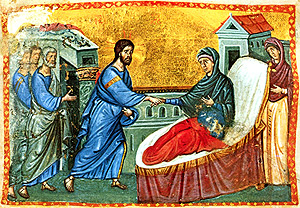
 29 On leaving the synagogue he entered the house of Simon and Andrew with James and John. 30 Simon’s mother-in-law lay sick with a fever. They immediately told him about her. 31 He approached, grasped her hand, and helped her up. Then the fever left her and she waited on them. 32 When it was evening, after sunset, they brought to him all who were ill or possessed by demons. 33 The whole town was gathered at the door. 34 He cured many who were sick with various diseases, and he drove out many demons, not permitting them to speak because they knew him. 35 Rising very early before dawn, he left and went off to a deserted place, where he prayed. 36 Simon and those who were with him pursued him 37 and on finding him said, “Everyone is looking for you.” 38 He told them, “Let us go on to the nearby villages that I may preach there also. For this purpose have I come.” 39 So he went into their synagogues, preaching and driving out demons throughout the whole of Galilee.
The narrative move quite quickly in the Gospel according to Mark. The narrative’s pace and immediacy is one of the most notable attributes of the writing. Lest one think that Mark is simply concatenating stories without a larger vision in mind, it is always good to “step back” and see the larger framework in which the Gospel account exists. Continue reading →


 29 On leaving the synagogue he entered the house of Simon and Andrew with James and John. 30 Simon’s mother-in-law lay sick with a fever. They immediately told him about her. 31 He approached, grasped her hand, and helped her up. Then the fever left her and she waited on them. Continue reading
  The Franciscan friars of Holy Name Province have served at Sacred Heart in Tampa since 2005. The friars assumed pastoral leadership from the Jesuits of the Southern Province who had well served the people since 1882. The Jesuits and their tradition continue for the citizenry of Tampa through their ministry at Jesuit High School. The Jesuits have left their mark in downtown by the amazing edifice that is our church. Their legacy also is appropriately displayed in their motto, Ad Majorem Dei Gloriam, “to the greater glory of God,” which adorns the arch over the transept/sanctuary.
 Last week’s gospel was, like this week’s gospel, a scene in which Jesus begins to call people to the ministry. When people were curious, Jesus responded. “Come and you will see…”
 friarmusings