Even after a fruitless night of fishing, tired and ready to “call it a night”, the disciples dutifully cast the nets again. On their own they had caught nothing, but in response to Jesus’ command, there is a fantastic catch of fish (cf. 4:50, 53; 5:8; 11:43). The mention of precisely 153 fish (v. 11) has led to symbolic interpretations of all kinds. And indeed, there must be symbolism involved (unless one assumes that the disciples took time out to make a count).
 Saint Jerome believed that the zoology of his time taught that there were 153 different kinds of fish; and the number, as a result, reflected universality. Jerome was probably incorrect about the zoologists of his own day, but his idea about universal symbolism was probably correct. Augustine of Hippo argued that the significance lay in the fact that 153 is the sum of the first 17 integers with 17 representing the combination of divine grace (the 7 gifts of the Spirit) and law (the Ten Commandments). Augustine goes farther and notes that “153” is the “triangular number.” He arrives at this conclusion noting that 153=1!+2!+3!+4!+5! (math refresher: factorials). When the factorials are arranged (see diagram), one sees an image of the Trinity. (Sorry: I was an undergraduate math major , and just had to include this…!)
Over time there have been a host of theories, but the scholar D. A. Carson discusses this and other interpretations and concludes “If the Evangelist has some symbolism in mind connected with the number 153, he has hidden it well.” Perhaps we can let Carson have the last word.

 Today’s first reading is about the conversion of St. Paul. It is an event in history that we note in reference to the place it transpired – the Road to Damascus. It is an event that inspired the great Italian artist, Caravaggio to create his masterpiece, The Conversion on the Way to Damascus. The artwork is located in the Cerasi Chapel of the church of Santa Maria del Popolo, in Rome. Across the chapel is a second Caravaggio depicting the Crucifixion of Saint Peter. On the altar between the two is the Assumption of the Virgin Mary by Annibale Carracci. It is quite the chapel.
 One of the most famous and insightful sentences in Christian history comes from the first page of Saint Augustine’s Confessions. As the book unfolds, Augustine describes his extensive experiences with unfulfilled desire. And so as if to give his conclusion beforehand, in the very first paragraph of the book he writes, “Thou has made us for Thyself, and our hearts are restless until they find their rest in Thee.” An insatiable craving, a psychic abyss, unsatisfied desire and desires, and the deep longing for a faraway land — all these point to and find fulfillment in God alone, despite our many failed experiments with all sorts of substitutes.
 Risk is one of those things we don’t think about, are adverse to in different measures. It is unavoidable. We would rather not have any, and yet are surrounded by it, and sometimes we are so focused on it that we can think of little else. It has always been one of the things I wonder about. Its one of the things financial advisors try to discern about your investment posture: risk avoidance or acceptance. It’s something people wonder about submariners. Its one of the things economists specialize in. It is part of life and is unavoidable – so sometimes it is easier to ignore. But I like to read about it from time to time.
 “So now I tell you, have nothing to do with these men, and let them go. For if this endeavor or this activity is of human origin, it will destroy itself. But if it comes from God, you will not be able to destroy them; you may even find yourselves fighting against God” (Acts 5:38-39)
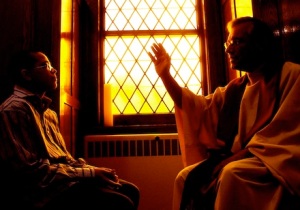 On a rather regular basis, I am asked via email about the Sacrament of Reconciliation (Confession) and forgiveness of sins. The questions that I am thinking of are mostly from folks who are firmly entrenched in their Christian faith in the Protestant or Reformed tradition. But increasingly these days, inquiries also come from Catholics. Sometimes they are not really questions at all. They are invitations for me to debate them as they wish to free me from the errors of my Catholic beliefs or free the Catholic from the need to go to the Sacrament of Reconciliation. The question is always some variation of “how can priests forgive sins” when – and here are the variations in their logic – (a) there is no such thing as priest, there is only Jesus as High Priest, (b) only God can forgive sins, (c) people only have one mediator, jesus Christ, and therefore one need only ask Jesus for forgiveness, (d) Scripture never talks about confessing sins to a priest, ….and I think that covers the common debate topics.
 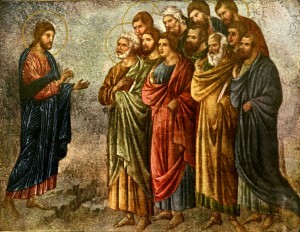 The gospel for the
  Fair warning, this is not my usual fare for posting. As it happens I am in my office waiting for a parishioner when I came across this article. Here is the setup. Do you remember the chewing gum
  Life can be breathless. Sometimes we need to take a breath and see how far we have come; to ponder our successes, our failings, all the hurdles we jumped, disasters we dodged, and things that we accomplished. As strange as it might seem, the Easter Season can be a time to think about Lent. At the beginning of Lent the classic refrain is “What are you giving up?” One parishioner who loves chocolate gave it up entirely for Lent. I asked, “Did that bring you closer to God?” The response was, “Not really. I just end up being cranky and miserable for all of Lent.” I am pretty sure that was not the hoped-for result. Within the tradition of prayer, alms giving, and fasting, there needs to be a path that makes room in your life for our God who is ever close to us.
  friarmusings