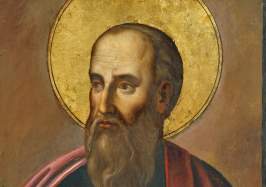
 One of our Bible study folks asked about the reference in The Letter to the Galatians to St. Paul’s time in Arabia. I had always wanted to post something on the topic – and now I have an immediate request to do so. The problem is that we don’t really know a lot of biographical information about St. Paul – at least not in the sense of modern biographies.
In any biography the author, by necessity, leaves out many events. Even a lengthy work like the 16-volume, 10 million-word biography of Winston Churchill by Randolph Churchill and Martin Gilbert, which is said to be the longest biography of modern times, will still leave out much more than it records. So, when we read the New Testament, which is relatively short, we do well to remember that the human authors have been highly selective, mentioning only a very few events in the lives of the characters. St. Paul’s time in Arabia is one such event that receives only a couple of brief mentions, without which we would know nothing of it at all. We can only speculate on the “why,” “when,” and “how long” of Paul’s time in Arabia based on the information we have – which is not a lot. Continue reading →

 In today’s gospel, St. John tells us the importance of witness, or as he writes: ““When the Advocate comes whom I will send you from the Father, the Spirit of truth who proceeds from the Father, he will testify to me. And you also testify, because you have been with me from the beginning.” (John 15:26-27). The entirety of the the Gospel of John is structured around testifying, around giving witness. Continue reading
  In the course of my MBA studies, professional career, life as a priest, and all the points in between, I have witnessed and participated in conversations gone wrong. “What we have here is a failure to communicate” (Captain, in Cool Hand Luke). I have studied instantiated and uninstantiated communications, message and meta message theory, and a whole host of topics whose names have been lost in the course of time. It seems as though communications is a mathematical stew of thousands of variables and a limited number of equations… translated: there is no one solution. At best you can hope to reach an optimal answer given a particular starting point – it won’t be perfect, but it will hopefully work.
  The name “Hester Ford” probably does not ring a bell. She died mid-April (2021) in Charlotte, NC. Theodore Roosevelt was President of the United States when she was born in 1906 (might have been 1905; the records are unclear). The covid-19 pandemic was not her first. She lived through the 1918 influenza pandemic. She lived through two world wars, saw aviation go from marvel to the everyday, witnessed the age of radio then television and then the internet. She witnessed lynchings and Jim Crow. As a black women she knew prejudice and intolerance, but saw the Civil Rights movement begin to make some inroads. She lived long enough to see 21 Presidents – she marveled and was joyous when a Black man was elected President of the United States – something she never expected.
 Clayton Schenkelberg
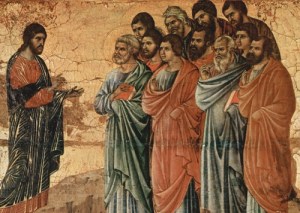 Sometimes, another just says it succinctly and to the point. Bishop Robert Barron does that so well commenting on
  Today’s
 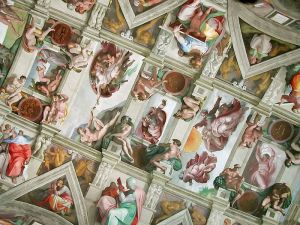 If you have been a visitor to Rome and to the Vatican – no doubt you have been present in the Sistine Chapel. Originally known as the Cappella Magna (‘Great Chapel’), the chapel takes its name from Pope Sixtus IV, who restored it between 1473 and 1481. Since that time, the chapel has served as a place of both religious and functionary papal activity. Today, it is the site of the papal conclave, the process by which a new pope is selected. The fame of the Sistine Chapel lies mainly in the frescos that decorate the interior, most particularly the Sistine Chapel ceiling and The Last Judgment, both by Michelangelo.
 It’s a late December day in Jerusalem. Jesus is walking in the Temple area, and as usual, he’s drawing a crowd during the Feast of the Dedication (better known to us as Hanukkah). The people have come with a question. Perhaps they’ve heard one of Jesus’s enigmatic parables, or witnessed one of his miracles. Or maybe they just want to trap him into saying something they consider blasphemous. Whatever the motive, they ask: “How long will you keep us in suspense? If you are the Christ, tell us plainly.”
 friarmusings