I will begin posting again…. well, when I get back, answer 2 gazillion emails, VMs, and talk to all manner of folk that have been waiting to chat. Could be a while.
God bless.

I will begin posting again…. well, when I get back, answer 2 gazillion emails, VMs, and talk to all manner of folk that have been waiting to chat. Could be a while.
God bless.
 When the English historian Christopher Dawson decided to become a Roman Catholic, his aristocratic mother was distraught, not because of Catholic teaching, but because now her son would, in her words, have to “worship with the help.” His background would no longer set him apart from others or above anyone. At church he would be just an equal among equals because the Eucharist would strip him of his higher social status. It was this very thing that first drew Dorothy Day to Christianity. During the Eucharist, she noticed the rich and the poor knelt side by side; all humbled before the great gift of Christ. Around the Eucharistic table what Mary prophesized in her Magnificat came to be, that, in Jesus, the mighty would be brought down and that lowly would be raised up. Continue reading
 Monday night I was called out to Tampa General for an emergency anointing for a patient preparing to pass into God’s bright glory. When I arrived at the room, a very familiar sight greeted me. Kumbe! There was a pair of religious sisters I recognized as Benedictine Sisters from Tanzania. I attended to the immediate family, greeting them and offering some words of comfort. When I came to the Sisters, it was their chance to be surprised when I greeted them in Kiswahili. Their eyes grew wide, surprised that another person in this small room shared some of the sounds and words of their home a half a world away. We all let the surprise pass and gave way to the woman for whom I had been called. Continue reading

On Mother’s Day, I would like to share with you the Sunday Pastor Column guest-written by Mrs. Pamela Ferron, our Director of Parish Life and Communications
“WHERE IS MY WHITE TANK TOP?”
“Why would I know?”
“BECAUSE I LET YOU BORROW IT!” Continue reading
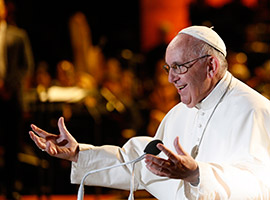 Several weeks ago I wrote “Not yet…” an article that acknowledged Pope Francis’ new apostolic exhortation, the Joy of Love – and noted that I was glad people were asking me about it, but I needed time to read it, re-read it, and think about it. I can report that I have now read it, have re-read parts of it, and am still thinking about. What I can offer at this point is some thoughts from here and there – and offer them cautiously at that. Continue reading
This weekend I am preaching for the Annual Pastor Appeal – so I thought I would post a homily from several years ago that I gave on this same weekend.
 As I have loved you, so you also should love one another (John 13:34)
In his book Surprised By Joy, CS Lewis describes being at a very proper English tea, standing there with an overly filled cup, when, quite by accident someone bumped into him, causing the jostled cup to spill some of its content out. Later, when reflecting on that most ordinary of things, he noted isn’t that a lot like life. If we want to know that with which we have filled our life, we only need to be jostled by life to see what spills out. Continue reading
 It is said that you can tell a lot about a person by their hands. The common wisdom is that a person’s self-image is revealed in the manner in which they shake hands. One of the oft-told stories in my family is when my then college-aged niece brought home a young man to meet the family and her grandmother. We were all greeted by the “dead-fish handshake,” a weak hello, and eyes cast to one side. The family advice was uniform: dump him. My niece thought we were all a bit judgmental. Perhaps, but let’s just say it was an occasion where experience met prudence. The handshake told us almost everything we needed to know. Several weeks later, our niece came to the same assessment. Continue reading
Two days ago, the 256-page, 60,000-word papal exhortation, The Joy of Love, was released to the waiting world. Since then, I have been asked for comments, quotes, opinions, and insight. Here is about all that I can respond: “Thanks for asking, but I haven’t had the chance to read it.” … or think about it, or pray about it, or muse about its content. So, have I read Pope Francis’ exhortation? Not yet. Continue reading
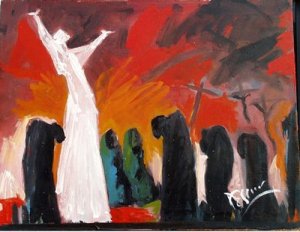 As a liturgical season, Lent is rather straightforward. It is kinda’ easy to write about. There is Ash Wednesday to dramatically mark its beginning, and we all know we are moving relentlessly towards Easter. We count the days even as we mark Lent’s beginning. The Ashes make a visible mark upon us, reminding us that we are dust and to dust we shall return – but that is not the end of the story. We are reminded to repent and believe in the Gospel – but that is not the end goal. We are encouraged to pray, fast, and give alms – but those practices are meant to make room in our lives for God that we too may rise to the newness of life at Eastertide.
Perhaps some will wonder why I did not write, “the newness of life at Easter.” Isn’t Easter that day when we celebrate Jesus’ being raised from dead? Isn’t Easter the finish line, the ultimate, the highest of the high holy days, the pinnacle of the Church’s liturgical celebrations? No, yes, yes, and yes. Easter is not the finish line. Allow me some poetic license here, but Easter is to Eastertide, what Ash Wednesday is to Lent. It is the day we begin to count.
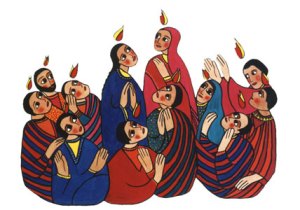
Eastertide is the 50-day season beginning on Easter Sunday with a dramatic mark in the celebration of the Resurrection of Christ, relentlessly moving to Pentecost Sunday. Easter and Pentecost correspond to two Jewish holy days, the first day of Pesach and the holiday of Shavu’ot. In the Jewish tradition, the days between these holidays are known as Counting of the Omer. The idea of counting each day represents spiritual preparation and anticipation for the giving of the Law to Moses on Mount Sinai.
Easter is not the finish line, but the “Ash Wednesday” of Eastertide when we again begin to count, to spiritually prepare and anticipate the giving of the Spirit on Pentecost. If in Lent we have traditional practices to help prepare us to celebrate the Risen Christ, what are we practicing in Eastertide? I think the answer is profoundly simple: we practice what we witnessed on Easter – resurrection.
The Catholic writer, Megan McKenna, has a wonderful vignette about practicing resurrection in her book, Not Counting Women and Children: Neglected Stories from the Bible. She had shared in a Bible study, “that life happens when we are interrupted, and that some of the most powerful acts of resurrection happen to the least likely people; that we are the people of resurrection and hope, called to live passionately and compassionately with others, to defy death, to forgive, and to bring others back into the community, to do something that is life-giving, that fights death and needless suffering.” It is at this point that someone asks, somewhat harshly, “Have you ever brought someone back from the dead.” I love her answer: “My response was, ‘Yes … Every time I bring hope into a situation, every time I bring joy that shatters despair, every time I forgive others and give them back dignity and the possibility of a future with me and others in the community, every time I listen to others and affirm them and their life, every time I speak the truth in public, every time I confront injustice — yes — I bring people back from the dead.”’
If in Lent we made room for God, here in Eastertide we work with Christ, practicing what he has already shown us: newness of life. And so we practice resurrection in our own lives by introducing joy, forgiveness, listening, justice, compassion… and so much more. And we count the days to Pentecost when the Spirit is given that we may take the honed skills of resurrection into a waiting world.
 One moment of time out of a whole lifetime and Thomas is branded for life: Doubting Thomas. Ouch. And the funny thing is that the word “doubt” never appears anywhere in this Gospel passage. There are six perfectly good words in Greek to express doubt. None of them are used. The word that is used is “not trusting.” Continue reading
 friarmusings