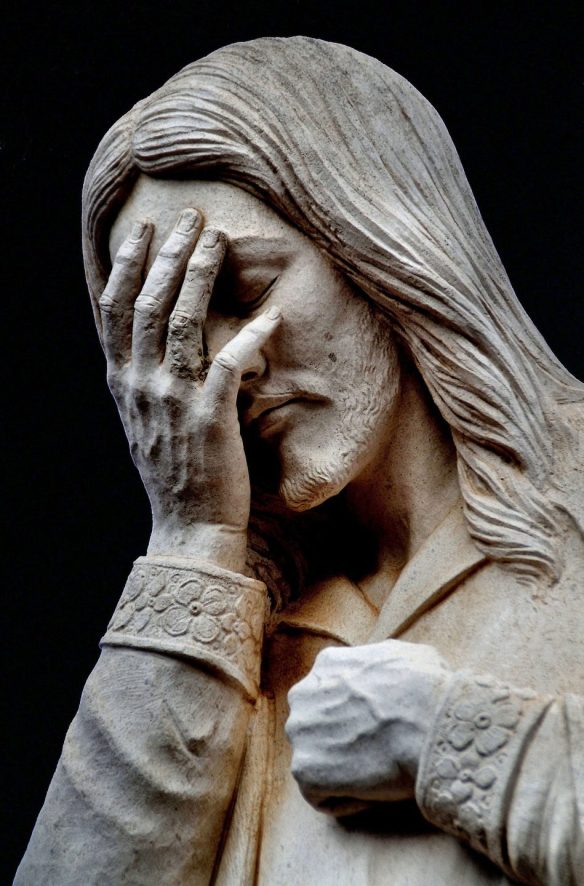
Without Superpower but with Purpose

In today’s Gospel, Jesus sends out the Twelve with power and authority to cast out demons, to cure diseases, and to proclaim the Kingdom of God. It’s a dramatic moment. They are given extraordinary gifts and a clear mission. But what about us? Most of us are not sent with power over demons. We are not miracle workers. We are not itinerant preachers going from village to village. So how does this Gospel speak to us?

While the form of our mission in the world may differ, the heart of the mission remains the same. Jesus sends the Twelve to do two basic things: proclaim the Kingdom and heal the broken. And that remains our mission in our time and place.

Continue reading

Let us go rejoicing

The year is 587 BC. The armies of Babylon have captured and destroyed the city of Jerusalem – including the Temple built by Solomon. The people are taken into the diaspora that will be known as the Babylonian Captivity. “By the rivers of Babylon, there we sat weeping when we remembered Zion…But how could we sing a song [of joy for] the LORD in a foreign land?” (Psalm 137)  There is no Temple, there is no rejoicing.

In yesterday’s first reading we read that King Cyrus of Persia has freed the Israelites from captivity in Babylon, allowing them to return to Jerusalem along with all the sacred items the Babylonians took from the Temple in Jerusalem some 40 years prior. The king’s instructions were to rebuild the Temple and worship God in their tradition.

Continue reading

Faith That Shines

No one who lights a lamp conceals it with a vessel or sets it under a bed; rather, he places it on a lampstand so that those who enter may see the light.” (Luke 8:16)

Jesus uses a simple image—a lamp—to teach a profound truth about discipleship. 

Think about the purpose of a lamp. Lamps are meant to shine, to give light. We can put them on timers or systems like Alexa.  You can set your family room lights to turn on 20 minutes before sunset. Why? Because we know that’s when the light is needed. That’s when the light can fulfill its purpose: brighten the darkness, illuminate, make clear the way to go, to be the beacon of hope like a lighthouse to a seafarer.

And so it is with our faith.

Continue reading

Love and Money

In today’s first reading, St. Paul gives us one of the most quoted lines in all of Scripture today: “The love of money is the root of all evils.” It’s important to notice that he does not say money itself is evil. Money is a tool, something necessary for daily life; life is too complex for a barter system. 

At the beginning of this passage, the author warns against those who treat religion as a way of personal gain—using faith to acquire status, comfort, or wealth. For the most part, in our parishes and communities, this is not where most of us fall. Few people come to Mass in hopes of making money. Most are here out of love for God, a desire for prayer, and the need for grace.

But then we go out into the world and go to work … if we are not able to earn it the old fashioned way: inherit it … or win the Powerball lottery.

Continue reading

What about this generation?

In today’s Gospel, Jesus compares His generation to children in the marketplace. No matter what song is played, they refuse to respond. So Jesus offers them a new song: a lament.

John the Baptist came in austerity fasting, wearing rough clothing, calling for repentance – a bit of the wilderness wild man. Yet in verses just prior to our reading, Jesus has praised John the Baptist and pointed to him as the greatest of those born of women. But the people have hesitated. They can not decide or commit to John’s call for repentance so they go to another extreme. They claim he is possessed and thus can be ignored.

The austere wild man too much? Jesus comes to the people where they are. He came eating and drinking, sharing table fellowship with tax collectors and sinners. Surely, the wandering preacher from Nazareth can’t be of God if He is eating with “them.” They claim Jesus is just a glutton and a drunkard. 

In other words, no matter what God offered, be it stern warning or gracious welcome, many refused to listen. Jesus’ words are indeed a lament. 

Continue reading

Cutty Sark

cutty_sark_1
cutty_sark

Today is International Talk Like a Pirate Day. In case you missed it, Sunday afternoon I posted a short vocabulary of pirate expressions to aid your celebration. Today we celebrate more things nautical. Not one of my usual post, but then again I am always fascinated by words – for example, the expressions “cutty sark.”  Many folks are familiar with that word because of the brand of whiskey. Others might know that the expression has an earlier origin – the whiskey’s name inspired by the legendary clipper ship “Cutty Sark”

But did you know, the name of the ship was inspired from an even older source?

Continue reading

The Assumption of Mary in Art

Much of our religious consciousness is affected by art; we have inherited specific images that are more artistic than biblical.  For example, we always imagine St. Paul being knocked from a horse on the Damascus Road.  There is no mention of the horse in scripture.  Is that a bid deal? Perhaps not.  But when Caravaggio placed Paul on the horse, a sign of privilege or royalty, he removed Paul from the midst of Corinth, the hard-scrabbled sea port town, from among the drunks, slackards, ner-do-wells, and people who sorely needed salvation. Continue reading

A Barrier to Evil

We should certainly hear an echo of the Lord’s Prayer in today’s gospel: ““Lord, if my brother sins against me, how often must I forgive him? As many as seven times?” Jesus answered, “I say to you, not seven times but seventy-seven times.” The mention of “forgiveness” should echo Jesus’ teaching about prayer. In the Lord’s prayer we are told to forgive others as we are forgiven: “If you forgive others their transgressions, your heavenly Father will forgive you. But if you do not forgive others, neither will your Father forgive your transgressions.” (Mt 6:14-15)

OK, the principle is clear, but the practical outworking still needs to be clarified, since its open-ended demand may easily be exploited by a manipulative person; surely there must be a limit? If Mishna B. Yoma represents rabbinic teaching, three times was regarded as sufficient. So, Peter’s proposal of up to seven times is probably intended to express a new limit of generosity. Or maybe it is a reference and contrast to sevenfold vengeance in the case of Cain (as in Cain and Abel). When Cain, doomed to wander homeless, worries that “Anyone may kill me at sight” (Gen 4:14), the Lord promises “Not so! the LORD said to him. If anyone kills Cain, Cain shall be avenged seven times.” (Gen 4:15) 

And so Jesus’ reply in our reading is all the more startling: “I say to you, not seven times but seventy-seven times.” (Mt 18:22)

Continue reading

…their angel in heaven

Today’s gospel is from Matthew and has an interesting verse: “See that you do not despise one of these little ones, for I say to you that their angels in heaven always look upon the face of my heavenly Father.” How should we understand these words? A good place to start is the immediate context.

On the whole, Matthew 18 is a discourse about humility, care for the “little ones,” and reconciliation within the community of believers. In verses 1–5, Jesus identifies “the greatest” in the kingdom as one who humbles themselves like a child. Verses 6–9 warn against causing these “little ones” to stumble.   

This raises an intermediate question: how are we to take the meaning of “little ones”? The options are likely either literal children, who exemplify trust and dependence or spiritually humble disciples, who, like children, rely on God. Most scripture scholars offer that Matthew intends both senses—beginning with literal children, then broadening to include all vulnerable believers. Verse 10, then, is a direct call not to despise (Greek: kataphronēsēte, meaning “look down upon, treat with contempt”) the humble or vulnerable believers symbolized by children.

The most discussed part of the verse is “their angels in heaven.

Continue reading