
Hating One’s Family?

This coming Sunday is the 23rd Sunday (Year C) with the gospel from Luke 14:25-33. Jesus’ command of love makes it unthinkable that he commands hating one’s family all the while commanding to love those we do not know and are even our enemy. As Culpepper [292] notes, one should understand the Semitic hyperbole always uses stark differences so that the contrast is more clearly seen. The term misein (hate) denotes attitudes and modes of action rather than emotions. The point is not how one feels towards one’s parents, but rather one’s effective attitude when it comes to the kingdom.” This becomes clearer in 16:13, “No servant can serve two masters, he will either hate one and love the other, or be devoted to one and despise the other. You cannot serve God and mammon.”  This continues Luke 12:49-52 regarding division with the household caused by the proclamation of the reign of God.

Other scholars argue that “hate” is a Semitic expression meaning “love less” or “put in second place.” For instance: Genesis 29:30–31 says Jacob loved Rachel more than Leah, and in the next verse, Leah is said to be “hated.” This sense of “hate” aligns with Matthew 10:37: “Whoever loves father or mother more than me is not worthy of me…” — a softer but similar idea.

Continue reading
The Cost

This coming Sunday is the 23rd Sunday (Year C) with the gospel from Luke 14:25-33. Many scholars tag these verses as “The cost of discipleship.”  They are unique and peculiar to Luke, focusing on the total dedication necessary for the disciples of Jesus. It must be remembered that Jesus is on the way to Jerusalem and has already predicted his death; so too should the disciples be prepared to leave all behind and make their commitment to the journey that will unfold before them.

Joel Green [564] notes that there are “important topical connections between the current narrative unit and the preceding one. Particularly in Jesus’ story of the great banquet (vv 15–24), he had introduced the possibility that one’s ties to possessions and family might disqualify one from enjoying the feast. As Jesus turns to address the crowds traveling with him, he lists allegiance to one’s family network and the shackles that constitute one’s possessions as impediments to authentic discipleship. Albeit for a different audience, then, Jesus posits the necessity of a corresponding transformation of life in both instances. This conjunction of emphases reminds us that the new practices counseled by Jesus in vv 7–14 are not isolated behaviors but, from Luke’s perspective, must flow out of a transformed disposition, reflecting new commitments, attitudes, and allegiances. That is, the conversion that characterizes genuine discipleship is itself generative, giving rise to new forms of behavior.”

It is here among the crowds of people that Jesus continues to teach discipleship to would-be disciples. Jesus makes no attempt to lure them, rather he makes clear that the way is not easy. Several phases reoccur in these verses:

If any one comes to me [and does not] … he cannot be my disciple (v.26)|
Whoever does not … cannot be my disciple.” (v.27)
everyone of you who does … cannot be my disciple.” (v.33)

The three conditions laid down concern renouncing family ties that would prevent one from becoming a disciple, bearing one’s cross, and forsaking possessions.  Between the second and third sayings twin parables illustrate the folly of failing to consider the cost of an undertaking: the tower builder (vv.28-30) and the king going to war (vv.31-32). The form of the question points to the expected answer for each, “No one, of course” (cf. 11:5, 11; 14:5; 15:4, 17:7). Verse 33 is the conclusion: we must renounce all that keeps us from the fullness of discipleship. 


Image credit: Pexels | Tima Miroshnichenko | CC-BY

Context and Chosing…or not

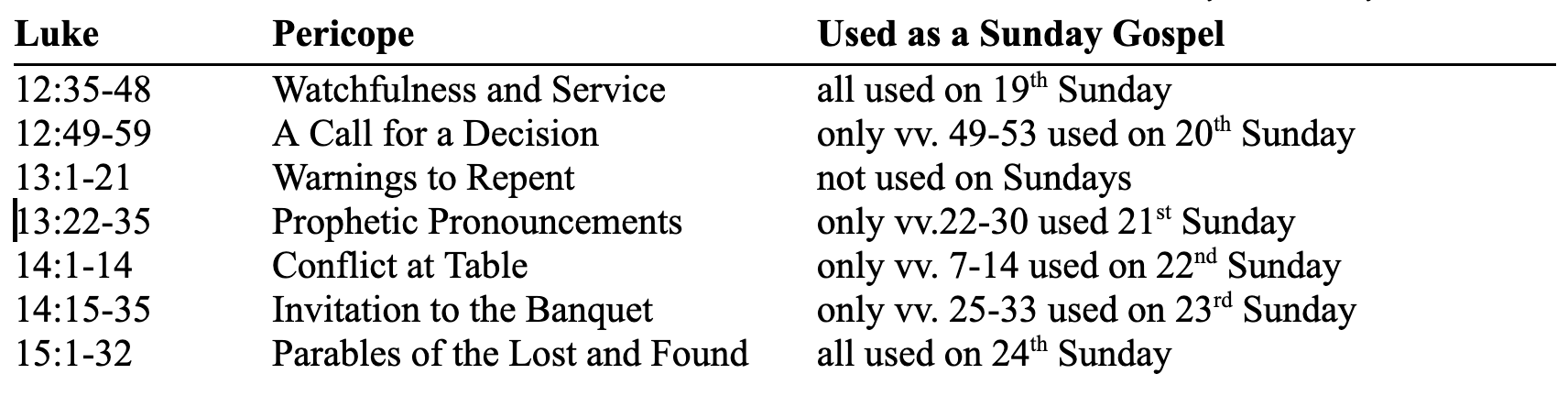
This coming Sunday is the 23rd Sunday in Ordinary Time, Year C. The gospel is from Luke 14:25-33. Here is the sequence of Sunday gospels in these Sundays of Ordinary Time. After having critiqued host and guests alike at the human banquet of the Pharisee, the Sunday choices for gospels passes over the description and invitation to the heavenly banquet

Luke’s Sunday Year C Reading

14:1-14 Honor and Humility at Table 22nd Sunday
14:15-24 Invitation to the Great Banquet passed over
14:25-33 The Cost of Discipleship 23rd Sunday
15:1-32 Parables of the Lost and Found 24th Sunday

In the gospel passage containing the invitation to the heavenly banquet, Jesus tells a parable about those who take a banquet invitation too lightly and because of their casual attitude lose their own right to a place at the table and are replaced by others. This echoes Jesus’ previous lament over Jerusalem (13:31-35). 

Continue reading

Reflections: a different Kingdom

Be you host or guest, Alan Culpepper [287-88] offers these final thoughts on the gospel for the upcoming Sunday. 

These are liberating words [the gospel] that can free us from the necessity of succeeding in our culture’s contests of power and esteem. They free us from over-under relationships and the attitudes and barriers they create, so that we may be free to create human community and enjoy the security of God’s grace.

This commentary on ancient meal practices and social stratification makes two points. First, one should cultivate and practice humility, if only because it is a prudent means of avoiding embarrassment. The eschatological application at the end of each of the two sections drives home a deeper meaning. Although the practice of humility is proper and prudent for disciples, the kingdom of God will bring about an even more revolutionary reversal. The very standards and practices of discrimination will be overthrown. The outcasts will be accepted as equals. Those who live by kingdom standards and values now will not only bear witness to the kingdom but also will be rewarded in “the resurrection of the righteous” (v. 14). Righteousness, not social position or the esteem of others, should be our goal. God does not look on the glitter of our guest list. Instead, God looks to see that we have practiced the generosity and inclusiveness of the kingdom in our daily social relationships. One standard offers the reward of social position, the other the reward of God’s favor.

The distinctiveness of Jesus’ vision of the kingdom was nowhere clearer than in his protest against discriminatory meal practices. Jesus and the Pharisees ate differently. For Jesus, meals were times of celebration and an inclusive fellowship that foreshadowed the inclusiveness of God’s kingdom. The last supper, therefore, not only pointed ahead to the eschatological banquet, but also it reflected on Jesus’ meals with the disciples, Pharisees, crowds, and outcasts in Galilee. The greatest crisis the early church faced, moreover, was not the delay of the parousia but the burning issue of whom one ate with (see Acts 10:9–16, 28; 15:19–20; Gal 2:11–14). Perhaps it is time we learned new table manners.


Image credit: Jesus at Supper | Caravaggio (1606) | National Gallery London | PD-US

Advice for the Hosts

The gospel for the upcoming Sunday is taken from the Gospel of Luke describing an encounter with the Pharisees at a banquet.  Just as Jesus’ fellow guests had occupied themselves in normal, honor-seeking pursuits upon arrival at the meal, so Jesus’ host had followed ordinary conventions in putting together his invitation list. Invitations served as “currency in the marketplace of prestige and power” [Green, 552] for those whose framework was the world as we know it. Seen through the framework of the Kingdom of God, a different currency is the “gold standard.”

Jesus expands the picture of humility by exhorting his audience to invite to their dinner table the needy and those who cannot repay such kindness. Hospitality should be open to all. This kind of reversal of expectations and status is thematic in Luke (e.g., 1:52; 6:20-26; 18:14). In fact, in the very next passage, our meal story continues with Jesus reemphasizing the notion of inviting the poor, the crippled, the lame, and the blind (14:21), this time in a parable representing the eschatological banquet of God, which will include just such marginalized ones, with the “invited guest list” being left out (14:24). 

Continue reading

Advice for the Guests

The gospel for the upcoming Sunday is taken from the Gospel of Luke describing an encounter with the Pharisees at a banquet.  In a wedding banquet setting it was expected that power and prestige would be placed closest to the head of the table (see Note on 14:7 below). This was probably more formal than most meals, but the words apply to any banquet.  Jesus points out the danger in pursuing seats of honor. He tells the story of a wedding where someone quickly grabs a high seat of honor. But then a person more distinguished walks in, and the host insists that the interloper vacate his position. At that point he may find all the other places occupied, so that the only course open to him is to take the lowest place, with all the shame and loss of face implied (cf. Prov. 25:7). So humiliated, the presumptuous one must head to the last seat. The description of the move down the social ladder is drawn out in Greek to underline the person’s shame (you begin with shame… to head for the last seat) It is as if every step hurts.

However, if one chooses the lowest place, the only way one can go is up. Rabbi Simeon b. Azzai is reported to have advised guests to take a place two or three seats lower than that to which they were entitled: ‘Better that people say to you “come up, come up,” and not say to you, “go down, go down”’ (Leviticus Rabbah I.5). 

Continue reading

Honor at Meals

The gospel for the upcoming Sunday is taken from the Gospel of Luke describing an encounter with the Pharisees at a banquet. In yesterday’s post we discussed “humility”. Today we consider “honor.” The meal setting is common in many of the gospels as a metaphor for the celebration of the Kingdom’s come. But it is also often a setting of controversy. Consider that 14:1-6 centered on the debate at table regarding the lawfulness of curing on the Sabbath – reminiscent of earlier discussions about appropriate behavior on the Sabbath (e.g., 6:2, 9; 13:14–16). When Jesus asks if it would be lawful to cure the man with dropsy, those at the table are silent. When Jesus next asks if their son or oxen fell into a cistern would they pull them out, again, they are silent. The easiest take on their reaction is that Jesus has them timid and stumped. But there was a long standing tradition for debate about the understanding of the Law. I would suggest that given Jesus’ challenging questions, one would need time to think about the reasoning – and in the face of such challenging wisdom, perhaps there is a struggle for the host to figure out exactly where this wandering preacher from Nazareth should be sitting.

That dynamic then opens the way for Jesus’ larger questions about honor at meals. Notice that vv.7-11, addressed to guests, is parallel to vv. 12-14, addressed to hosts, both showing a common pattern in which humility plays out.

Continue reading

Humility

The gospel for the upcoming Sunday is taken from the Gospel of Luke describing an encounter with the Pharisees at a banquet. A key theme from this text is “humility.” This word comes into our language from the Middle English, via Anglo-French, from Latin humilis low, humble, from “humus” the word for earth. Webster’s offers this as a definition

  1. not proud or haughty: not arrogant or assertive
  2. reflecting, expressing, or offered in a spirit of deference or submission
  3. ranking low in a hierarchy or scale: insignificant, unpretentious –or  : not costly or luxurious 

Does this capture the biblical sense of “humility?” Humility comes from the Greek tapeinoō (make low, humble; EDNT 3:334). In its verbal and noun forms, the word occurs 18 times in the NT and describes appropriate human conduct before God. And yet the use of the word often has a passive aspect to it.  For example, John the Baptist challenges his listeners to ready themselves for God’s salvation by preparing the way of the Lord and making his paths straight. The decisive feature, however, must be performed by God himself, for every valley will be filled (by him) and every mountain made low (by him), i.e., leveled.  The salvific action begins with God’s own actions. In this we are to humbly await actions from the Lord.

Continue reading

Keeping Track

The gospel for the upcoming 22nd Sunday (Year C) is taken from the Gospel of Luke. On the journey to Jerusalem one of the principal themes has been that of discipleship. Much of Luke 12 attends to that theme especially in terms of preparedness and service.  As Luke’s gospel narrative moves ahead, Jesus continues to teach about the nature of discipleship (see, judge, and act), the urgency of the decision to become a faithful and prudent disciple, and that our decisions and actions have consequences in terms of the kingdom of heaven. To that end, here is the recent progression of Sunday gospels. You’ll notice there are gaps and skips. 

Among the portions missing from the Sunday gospels are

  • Jesus’ call to read the signs of the times as well as one reads the weather in order that one may judge rightly (12:54-59)
  • The parable of the fig tree that is permitted to remain in the vineyard for another season even though it has not yet produced fruit (13:1-9)
  • A healing of a woman, afflicted for 18 years, who was healed on the Sabbath that Jesus might again teach the meaning of the kingdom of God (13:10-17)
  • The parable of the mustard seed (13:18-21)
  • The lament of Jerusalem’s unfaithfulness (13:31-35)
  • A healing on the Sabbath at table (14:2-6)
  • The parable of the great feast (14:15-24)
  • The cost of discipleship and the necessity of preparations (14:25-35)

Some of the verses missing from Sunday gospels are well covered in the gospels of daily Mass, but there are some great images (reading the signs of time, the fig tree, and others) that would be great to have for Sunday homilies. 

That being said, one does well to remember and understand that these verses come after Jesus exhortation to strive to enter that place where are gathered “Abraham, Isaac, and Jacob and all the prophets in the kingdom of God” (13:28) (from last Sunday’s gospel) and before the parable of the great feast (14:15-24) which speaks to the OT image of the kingdom of God as likened to a great banquet. The placement points out that the attitudes of discipleship in this life are reflected in the banquet of the kingdom of God.

This week’s gospel is at table. As Johnson [Luke, 223] notes: “If Jesus eats a meal with a Pharisee on the Sabbath, there surely will be conflict! During the meal Jesus addresses a fundamental attitude that is a constituent portion of discipleship: humility.  This is not a new topic addressed to his disciples.  Consider Luke 9: 

46 An argument arose among the disciples about which of them was the greatest. 47 Jesus realized the intention of their hearts and took a child and placed it by his side 48 and said to them, “Whoever receives this child in my name receives me, and whoever receives me receives the one who sent me. For the one who is least among all of you is the one who is the greatest.” 


Image credit: Jesus at Supper | Caravaggio (1606) | National Gallery London | PD-US

Reflection: the doorkeeper

Alan Culpepper, at the end of his commentary [277-78] on Luke 13:22-30, provides an interesting story from Franz Kafka:

His parable “Before the Law” is the story of a man from the country who seeks admission to the Law. When the doorkeeper tells him he may not enter, he looks through the open door, but the doorkeeper warns him that he is just the first of a series of doorkeepers, each one more terrible than the one before. So the man waits for the doorkeeper’s permission to enter. For days and then years, the man talks with the doorkeeper, answers his questions, and attempts to bribe him, but with no success. The doorkeeper takes the man’s bribes, saying he is only doing so in order that the man will not think he has neglected anything. As the man lies dying, he sees a radiance streaming from the gateway to the Law. Thinking of one question he has not asked, he beckons the doorkeeper and asks him why in all those years no one else has come to that gate. The doorkeeper responds: “No one else could ever be admitted here, since this gate was made only for you. Now I am going to shut it.”

There is an incompleteness one experiences after reading “Before the Law.” It seems as though the man from the country is caught in a terrible institutional “catch-52,” unable to enter the very gate prepared only for him. Some might quickly focus on the gatekeeper as representative of the worst parts of organized religion, or the trap of fear implied in a series of other terrible gatekeepers, or other parts of the parable. 

There is also an incompleteness – or better said – mystery in Jesus’ parable in which the who and how many are never answered to the reader’s satisfaction. But Jesus is clear on several points: one must strive. As noted before, striving with an athlete’s power and intention is seeking an Olympic medal. The man from the country in Kafka’s parable waits for “the Law” to come to him.

All of this points to questions that have bedeviled Christianity since its foundation: what is the balance of grace, election, free will, the action to which people are called, and so much more. Perhaps even if Christian denominations will never agree on the theological balance or answers, we can agree that one should never presume upon God’s grace or God’s gifts.

Perhaps this parable asks us to take this attitude in life: strive as though admission to the kingdom depended entirely on your own doing, but know that ultimately it depends on God’s grace.


Image credit: Pexels | Farouk Tokluoglu | CC-BY