Belief and Rejection

jesus-apostles-endtimesThis coming Sunday is the 15th Sunday of Ordinary Time in Year B. The gospel for the day comes from Mark 6 and narrates the beginning of mission for the disciples.

Some context for the gospel. The miracles of the preceding chapter in the Gospel according to Mark demonstrate his divine powers. Jesus overcomes the life-destroying powers of demonic possession, chronic illness, and death. The gospel two weeks prior contained the stories of Jairus/his daughter and the women with the hemorrhage. Each account tells of an imperfect faith, yet enough faith that God enters into their lives in a way that is healing and ultimately life-giving. For Jairus’ daughter, it is the restoration of life; for the woman with the hemorrhage it is being restored to the fullness of life as her illness will no longer keep her from living life to its fullness in this lifetime. The miracles, viewed together even as they as told together, are the vestige of Jesus’ fuller mission: that all might have life eternal, free from death, and have life completely. Jesus is forming new family bonds, no longer centered on blood relationships, but on faith and those willing to act on that faith. Continue reading →

Jairus’ Daughter

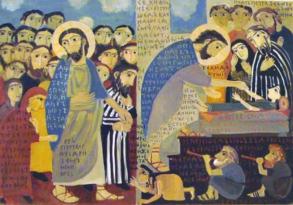
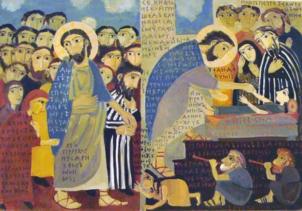
Mark-5-two-miraclesIn today’s post we continue to reflect upon this coming Sunday’s gospel with a return event which opened the readings: Jairus and his daughter. “While he was still speaking, people from the synagogue official’s house arrived and said, “Your daughter has died; why trouble the teacher any longer?” Disregarding the message that was reported, Jesus said to the synagogue official, “Do not be afraid; just have faith.” (Mark 5:35-36) The interruption of attending to the hemorrhaging women creates a time delay in the narrative, during which the young girl dies. The community responds with, messengers to report to the father, and mourners to gather at the house (vv. 35, 38). The messengers present an obstacle to the healing by advising the father to leave Jesus alone, since the girl has died. Jesus takes the initiative by telling Jairus to have faith (v. 36). The reference to faith picks up the conclusion to the healing of the woman. Continue reading →

Daughter

Mark-5-two-miraclesThere is one simple verse in this coming Sunday’s gospel that deserves some reflection. “Daughter, your faith has saved you.” (Mark 5:34). At their core, the concerns and dynamics surrounding ritual uncleanliness, especially leprosy, bodily discharge, or touching corpses, were about relationships. They put one outside of the community. When Jesus calls the woman who touched him “daughter,” he establishes a relationship with one with whom he should not have a relationship. Her illness made her unclean. Her attempts to be healed by doctors made her impoverished. Her brazen invasion of Jesus’ space, touching Jesus’ clothes, “technically” made Jesus’ unclean and could have resulted in him condemning her. Yet by calling her “daughter,” he established the same kind of relationship with her as Jairus has with his “daughter.” He would do anything possible to save his daughter. Continue reading →
The One who heals

Mark-5-two-miraclesThe full gospel reading for Sunday (there is a shorter option) contains two miracle accounts: the raising of Jairus’ daughter from death and the healing of the woman with hemorrhages. This is the account of a woman on rendered ritually “unclean” because of the flow of blood. Although suffering, she was very much alive, but at the same time face a kind of death because of her isolation from family and society. In yesterday’s post, the woman had reached out to touch Jesus’ garment as the passed by. “She said, ‘If I but touch his clothes, I shall be cured.’ Immediately her flow of blood dried up. She felt in her body that she was healed of her affliction.” (Mark 5:28-29) Continue reading →

Absent from life

Mark-5-two-miraclesThe full gospel reading for Sunday (there is a shorter option) begins: “When Jesus had crossed again in the boat to the other side, a large crowd gathered around him, and he stayed close to the sea. One of the synagogue officials, named Jairus, came forward. Seeing him he fell at his feet and pleaded earnestly with him, saying, “My daughter is at the point of death. Please, come lay your hands on her that she may get well and live.” He went off with him, and a large crowd followed him and pressed upon him.” (Mark 5:21-24) – and then drops this story line, picking up the account of a woman on the way – a woman hemorrhaging for many years – and thus rendered ritually “unclean” because of the flow of blood. Although suffering, she was very much alive, but at the same time face a kind of death because of her isolation from family and society. Continue reading →

The fullness of life

Mark-5-two-miraclesLast week (the 12th Sunday in Year B) we heard Mark’s account of Jesus on the stormy waters of the Sea of Galilee (Mark 4:35-41) during which Jesus calmed the seas with his word. This coming Sunday’s gospel moves into Chapter 5. The chapter begins with Jesus and the disciples returning to Jewish land as they again cross the Sea of Galilee. In Mark, the lake represents literally and figuratively the boundary between Gentiles and Jews.

The lectionary moves into additional miracle accounts while skipping the story of the Gerasene demoniac. Our gospel selection includes a miracle within a miracle. They are the final two miracles of the “miracle section” of Mark (4:35-5:43), which includes four miracles and reactions to the miracles:

  • Calming the storm at sea — the disciples still have no faith (Mk 4:34-41)
  • Casting a demon from a man and the subsequent desire of the locals that  Jesus leave town even as the healed man becomes a witness (Mk 5:1-20)
  • Raising Jairus’ daughter – “don’t be afraid, only believe” (Mk 5:21-24, 35-43)
  • Healing the hemorrhaging woman – her faith saved her (Mk 5:25-34)

Continue reading →

Indeed, who then is this

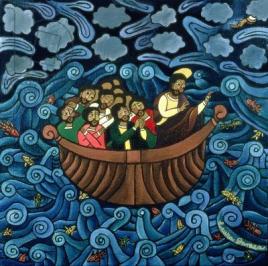
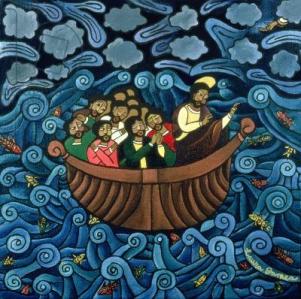
LJA130270Then he asked them, “Why are you terrified? Do you not yet have faith?” They were filled with great awe and said to one another, “Who then is this whom even wind and sea obey?” (Mark 4:40-41)

After quieting the violent storm with a word, Jesus turns to his disciples (and Mark’s readers) and asks: “Why are you terrified? Do you not yet have faith?” (v. 40). The first disciples’ only response is: “Who then is this?” (v. 41). This passage continues to reveal Mark’s theology of discipleship. These very same disciples who have been chosen in 3:7-12, who have been given the mystery of the kingdom of God (4:10-12), and who are privileged to hear Jesus’ teachings and explanation (4:34) are here chided for their timidity and lack of trust, their lack of a deepening faith. The question of their faith is abrupt at this point in Mark’s gospel. Increasingly as Mark’s gospel continues this question of faith continues to arise.  Continue reading →

Reward and Righteousness

The gospel for today is from Matthew 6 and is part of the Sermon on the Mount (5:1-7:29), but too often it is presented in isolation from the Sermon and thus the connection is not obvious to many listeners. Jesus has begun to preach in Galilee, as Scripture foretold (4:12–17), and large crowds are being attracted to his teaching (4:23–25). Matthew presents a lengthy collection of that authoritative teaching.

Continue reading →

Be still

LJA130270This coming Sunday is the gospel of Jesus calming the storm on the Sea of Galilee. “Jesus was in the stern, asleep on a cushion. They woke him and said to him, “Teacher, do you not care that we are perishing?” (Mark 4:38)  While the storm raged, Jesus lay sleeping in the stern upon the cushion that was customarily kept under the coxswain’s seat for those who were not involved in the actual sailing or fishing. The other’s aboard are having a much different experience. Given that at least four of the disciples were professional fishermen and must have experienced such storms before, their anxiety/terror indicates the severity of the incident. The usual pattern for a deliverance from a storm at sea involved a plea to the deity for help, but Mark’s version lacks such a formula. In Matthew the disciples’ words to Jesus to fit the anticipated pattern, “Lord, save us! We are perishing!” (Matt. 8:25). In Mark, however, their cry carries an edge – rebuke? Disbelief? Incredulousness? It is hard to assign a meaning that leaves the disciples other than accusing Jesus of being indifferent to their plight. Continue reading →

Storms in life

LJA130270The gospel for this coming Sunday, the 12th Sunday of Ordinary Time ( Year B), is the Markan account of the calming of the storm waters on the Sea of Galilee.

“On that day, as evening drew on, he said to them, “Let us cross to the other side” (Mark 4:35). As Stoffregen asks: Why do the disciples cross the lake? There are several possible answers: (a) to get to the other side or (b) as recorded in the text, Jesus told them to cross over. Even though (b) is the correct answer, (a) raises the curiosity: what is on the other side? Gentile (unclean) territory indicated by “unclean spirits,” “swine,” and “Decapolis.”  Many scholars hold that this trip across the lake represents the Gentile mission for Mark. The storm at sea represents the storms in the early church as they sought to carry out Jesus’ command “to go to the other side” or “to make disciples of all nations.” It may be noted that the area where the people of God sit while in church is properly called the “nave,” from the Latin “navis” = ship. Continue reading →