
 Next Sunday is the 4th Sunday of Lent, Year B. You can read a full commentary here.
14 And just as Moses lifted up the serpent in the desert, so must the Son of Man be lifted up, 15 so that everyone who believes in him may have eternal life.” 16 For God so loved the world that he gave his only Son, so that everyone who believes in him might not perish but might have eternal life. 17 For God did not send his Son into the world to condemn the world, but that the world might be saved through him. 18 Whoever believes in him will not be condemned, but whoever does not believe has already been condemned, because he has not believed in the name of the only Son of God. 19 And this is the verdict, that the light came into the world, but people preferred darkness to light, because their works were evil. 20 For everyone who does wicked things hates the light and does not come toward the light, so that his works might not be exposed. 21 But whoever lives the truth comes to the light, so that his works may be clearly seen as done in God. (John 3:14-21)
 Sunday next is the
  Tomorrow is the
 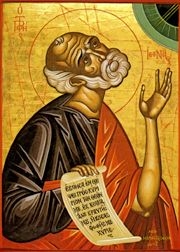 11 “What shall we do with you,” they asked, “that the sea may quiet down for us?” For the sea was growing more and more turbulent.” 12 Jonah said to them, “Pick me up and throw me into the sea, that it may quiet down for you; since I know it is because of me that this violent storm has come upon you.”
 The tempest rages, the crew prays, each to his own god, the cargo is being tossed overboard in an attempt to save the ship that is in danger of breaking up. Jonah is curled up in a corner below decks fast asleep.
 Many folks I know have committed to read the entire Bible – an ambitious plan, but one I highly commend and recommend. For some, their plan was to begin at the beginning with Genesis and read straight through to Revelation. That would never be my recommendation. The Bible is not a novel that moves seamlessly from book to book. Rather it is a collection of books. The Genesis-to-Revelation plan has been written about in
  This is the word of the LORD that came to Jonah, son of Amittai” (Jonah 1:1)
 There are several historical references that one encounters while reading the Book of Jonah. Rather than include this detail in later posts when the references appear, I thought it good to provide some details early on. The setting of the book is a period of Israel’s history when there is a lot going on – inside and outside the traditional boundaries of the Promised Land. The Kingdom of David had split into the Northern Kingdom (confusingly called Israel and consisting of 10 tribes) and the Southern Kingdom (called Judah consisting of two tribes) still loyal to the throne of David and centered in Jerusalem. Beyond the borders was the ever-looming threat of the Assyrian Empire whose capita city was Nineveh. It was located in the area of modern-day Mosul in Northern Iraq. Compared to Israel, it is to the northeast at some distance.
